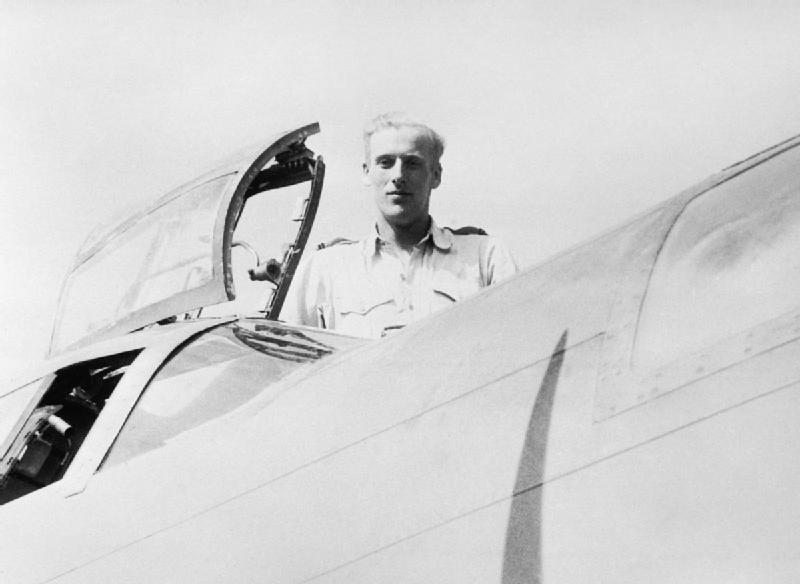
Adrian "Warby" Warburton, (10 March 1918 – 12 April 1944) was a Royal Air Force (RAF) pilot and flying ace of the Second World War. He became legendary in the RAF for his role in the defence of Malta and was described by the then Air Officer Commanding in Chief Middle East, Air Marshal Sir Arthur Tedder, as "the most important pilot in the RAF". Warburton was also awarded a United States DFC. Described as 'Six-medal Warburton', all of Warby's gallantry awards were earned while operating from Malta. He remains the most highly decorated RAF photo-reconnaissance pilot of all time. His life and wo
Adrian "Warby" Warburton, (10 March 1918 – 12 April 1944) was a Royal Air Force (RAF) pilot and flying ace of the Second World War. He became legendary in the RAF for his role in the defence of Malta and was described by the then Air Officer Commanding in Chief Middle East, Air Marshal Sir Arthur Tedder, as "the most important pilot in the RAF". Warburton was also awarded a United States DFC. Described as 'Six-medal Warburton', all of Warby's gallantry awards were earned while operating from Malta. He remains the most highly decorated RAF photo-reconnaissance pilot of all time.
His life and work has been depicted in the books Warburton's War by Tony Spooner, and Malta's Greater Siege & Adrian Warburton DSO* DFC** DFC (USA) by Paul McDonald. Warburton was also the subject of the BBC Timewatch documentary The Mystery of the Missing Ace. The 1953 film Malta Story features a photo-reconnaissance pilot who may be based on Warburton.
0 comentarii0 vizualizări0 reacții
Adrian Warburtona adăugat o fotografie
acum 2 ore
R.I.P Adrian
Early life
Adrian Warburton was born in Middlesbrough on 10 March 1918, the only son of Commander Geoffrey Warburton DSO, a highly respected RN submariner, and Muriel Warburton, née Davidson. Adrian was christened on board a submarine in Grand Harbour, Valletta, Malta.
Warburton attended St Edward's School in Oxford, where two other famous airmen, Guy Gibson and Douglas Bader, were also educated. On leaving school, he became an articled clerk with a firm of accountants in Cheapside, London. He joined a local Territorial Army unit on 1 November 1937, joining the RAF a year later on 31 October 1938.
0 comentarii0 vizualizări0 reacții
Adrian Warburtona adăugat o fotografie
acum 2 ore
R.I.P Adrian
To Malta 1940 Warburton was commissioned in the Royal Air Force (RAF) an acting pilot officer (on probation) on 3 September 1939 and confirmed as a pilot officer on 31 October. During pilot training, Warburton struggled to achieve the minimum standard. Nevertheless, he was awarded his pilot's flying badge in May 1939. Despite writing off his aircraft's undercarriage in a botched landing, he successfully completed advanced flying training and was posted to a torpedo training course at Gosport in Hampshire at the end of August 1939. He was then posted to No 22 Squadron, RAF Thorney Island, on 12 October 1939, which was operating ancient, single-engine Vickers Vildebeest biplanes. The squadron was in the process of being equipped with the advanced Bristol Beaufort torpedo bomber. Warburton's weaknesses on twin-engine aircraft were all too apparent and no attempt was made to convert him onto the Beaufort. In April 1940, 22 Squadron moved to RAF North Coates in Lincolnshire and was involved in mine-laying operations, night bombing of enemy ports and, in May, daylight raids to try and stem the tide of the German Blitzkrieg. The squadron commander failed to return from a mission. Warburton did not fly operationally, and his few…
0 comentarii0 vizualizări0 reacții
Adrian Warburtona adăugat o fotografie
acum 2 ore
R.I.P Adrian
1941 Warburton was promoted to flying officer on 3 January 1941. On 10 January 1941, 431 Flight was designated 69 Squadron, with Tich Whiteley in command. On paper, the squadron had twelve Marylands, but was short of spares and on some days only one aircraft was ready to fly. Later the same month, the citation for Warburton's Distinguished Flying Cross (DFC) was published in The London Gazette: This officer has carried out numerous long distance reconnaissance flights and has taken part in eight air combats. In October, 1940, he destroyed an aircraft, and again, early in December, he shot down an enemy bomber in flames. Flying Officer Warburton has at all times displayed a fine sense of devotion to duty. Most reconnaissance aircraft, built for speed and a high ceiling, were unarmed to reduce weight. But the American Maryland, built primarily as a light bomber, had forward- and rear-facing guns, enabling Warburton and his crew's success in air combat. He achieved his 50th operational mission in February. His reputation of always returning with the goods was now well-established, and he was often selected for special tasks, constantly varying his tactics to achieve the best results. Sometimes he flew at height,…
0 comentarii0 vizualizări0 reacții
Adrian Warburtona lăsat un gând
acum 2 ore
1942 On his "rest tour", Warby promptly had his posting changed from No. 233 Squadron, a training unit, to No. 2 Photo Reconnaissance Unit (PRU). When 2 PRU acquired two Beaufighters, its commander, Squadron Leader Hugh McPhail, had them stripped of guns, cannon, and other equipment, to increase their speed and ceiling. By mid-November, Warburton was on operations over Crete. Both aircraft were then detached to Malta. Within 24 hours, he was revisiting his old haunts including Tripoli, all of Sicily, and southern Italy, once again under the direct control of Air Vice-Marshal Hugh Lloyd. Lloyd later described Warburton as "the absolute king of photographic reconnaissance, the pearl of the Mediterranean." "Warby’s luck" continued when he was attacked by a Hurricane. He said it was rather a poor show, as he only found one bullet hole, in his aircraft's left aileron. To the photographers who flew with him, Warburton showed no outward sign of fear. On 13 February 1942, he conducted a reconnaissance of Taranto accompanied by Corporal Ron Hadden, who said it took them two attempts to penetrate the harbour because of low cloud. Once inside, he flew three runs at 50 feet (15 m), despite intense flak. The…
0 comentarii0 vizualizări0 reacții
Adrian Warburtona lăsat un gând
acum 2 ore
1943 By 1943, a new Warburton had emerged. His longer than regulation hair was gone and his flamboyant dress, at the least on the ground, was a thing of the past. By February, 69 Squadron was enormous, and was split into three squadrons. The PR flight became 683 Squadron, with him in command. Soon afterwards, he met Elliott Roosevelt, son of US President Franklin D. Roosevelt. Elliot commanded all US photo-reconnaissance units in North Africa, and he and Warby developed a close friendship. It was to have fateful consequences. One of the newcomers to Warburton's squadron was 20-year-old Canadian William Keir Carr, known as Bill. When he reported to Warburton, he found him in a revetment shack, stretched out on a table drinking tea surrounded by airmen. Carr soon recognised Warburton's leadership as inspirational. He was no longer the loner of his early days in Malta. He personally flew all the missions targeting the heavily defended island of Pantelleria. Keith Durbridge, one of 683 Squadron's pilots, later remarked that Warburton was the only pilot he ever heard of who was fired at by anti-aircraft batteries from above. His photographs allowed Allied planners to pinpoint every defensive location, which were then…
0 comentarii0 vizualizări0 reacții
Adrian Warburtona lăsat un gând
acum 2 ore
1944 Warby was a consummate planner. He told his father Elliot Roosevelt was moving on and he hoped to accompany him. Roosevelt commanded the 90th Reconnaissance Wing (the size of an RAF group), which included 336 Wing. The group was in the process of moving to San Severo, on the Foggia Plain in southern Italy. Canadian Bill Carr from 683 Squadron described what Warburton then did: Growing tired of being bed-ridden, he climbed out of the window, "borrowed" a vehicle, and made his way to the airport. There, he located some old friends who helped him cut off his cast. He borrowed shorts and a shirt, and a Mark IX Spit from a friendly squadron commander, and flew to see use of his old squadron, now located in Italy. Warburton had no parachute and no maps. The aircraft had no oxygen, yet he coped with clouds which topped out at 25,000 feet (7,600 m). The following day, he visited old friends on 683 Squadron at San Severo. Not long afterwards, General Eisenhower requested Elliot Roosevelt's transfer to England, along with key personnel from 90th Wing, to set up a new reconnaissance wing. Warburton was one of those chosen, although officially…
0 comentarii0 vizualizări0 reacții
Adrian Warburtona lăsat un gând
acum 2 ore
Private life Warburton married Eileen Adelaide Mitchell, known as Betty, on 28 October 1939. He was 21 and had known her for only a few weeks. She was 27, a divorcee with a nine-year-old daughter in her parents' care. Warburton did not tell his parents of the marriage, then or later, and in a clear breach of regulations, did not inform the RAF. He never altered his RAF next-of-kin forms, which named his father. Although he rented a bungalow near Thorney Island where he was based, he virtually ignored his new wife, visited rarely, and lived in the officers' mess, as required by RAF regulations. In later years, Mrs Warburton said they never lived together. In July 1940, on hearing he was in Blackpool, she travelled there to agree to a divorce. They met, but divorce papers were never served. She never saw Warburton again. By the time Warburton returned to North Coates, his complicated personal life was unravelling. He was in serious debt and his future as an officer looked bleak. He was then sent to Malta. However, the RAF was not ignoring his situation. His commanding officer in Malta, Tich Whiteley, arranged to have part of his pay…
0 comentarii0 vizualizări0 reacții
Adrian Warburtona lăsat un gând
acum 2 ore
Death and legacy When he went missing, Warburton had just turned 26 years old. He was a wing commander and his gallantry had been recognised by the award of the Distinguished Service Order and Bar, the Distinguished Flying Cross and two Bars and an American Distinguished Flying Cross. He had flown nearly 400 operations and claimed nine enemy aircraft destroyed. Bill Carr, the young Canadian who joined 683 Squadron in 1943, went on to become a lieutenant general in the Royal Canadian Air Force. He has been described as the father of the modern Canadian Air Force. He said that: Warburton's "charisma was unlike any I ever experienced. While none of us ever hoped to achieve his level of competence as a pilot or his prowess against the enemy, we sincerely hoped for his approval. And this he was wont to give generously when it was justified. How hard we young pilots tried to achieve this may be reflected in the unique achievements of 683 during his tenure as CO. The groundcrew too worked like slaves; indeed I believe they loved the man. Warby was a unique officer in a great many ways. Not only was he a very brave…
0 comentarii0 vizualizări0 reacții
Adrian Warburtona lăsat un gând
acum 2 ore
Tony Spooner Warburton's War
Paul McDonald Malta's Greater Siege & Adrian Warburton DSO* DFC** DFC (USA)
Frederick R Galea Carve Malta on my Heart
Paul McDonald Ladies of Lascaris: Christina Ratcliffe and the Forgotten Heroes of Malta's War
0 comentarii0 vizualizări0 reacții
Adrian Warburtona lăsat un gând
acum 2 ore
Warburton and other members of squadron
Adrian Warburton page at Commonwealth War Graves Commission