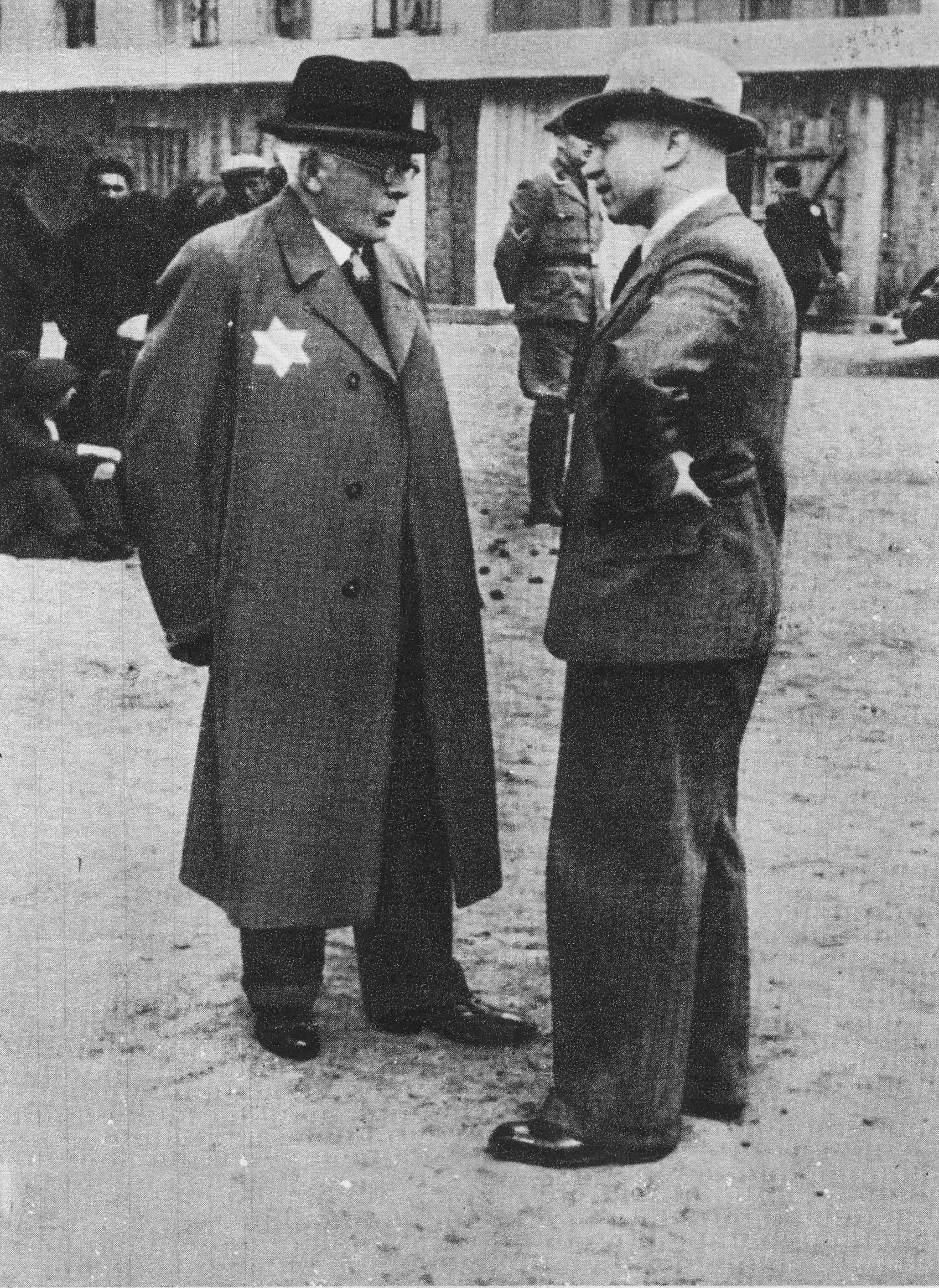
Chaim Mordechaj Rumkowski (February 27, 1877 – August 28, 1944) was the head of the Jewish Council of Elders in the Łódź Ghetto appointed by Nazi Germany during the German occupation of Poland. Rumkowski accrued much power by transforming the ghetto into an industrial base manufacturing war supplies for the Wehrmacht in the mistaken belief that productivity was the key to Jewish survival beyond the Holocaust. The Germans liquidated the ghetto in 1944. All remaining prisoners were sent to death camps in the wake of military defeats on the Eastern Front. As the head of the Judenrat, Rumkowski is
Chaim Mordechaj Rumkowski (February 27, 1877 – August 28, 1944) was the head of the Jewish Council of Elders in the Łódź Ghetto appointed by Nazi Germany during the German occupation of Poland.
Rumkowski accrued much power by transforming the ghetto into an industrial base manufacturing war supplies for the Wehrmacht in the mistaken belief that productivity was the key to Jewish survival beyond the Holocaust. The Germans liquidated the ghetto in 1944. All remaining prisoners were sent to death camps in the wake of military defeats on the Eastern Front.
As the head of the Judenrat, Rumkowski is remembered for his speech Give Me Your Children, delivered at a time when the Germans demanded his compliance with the deportation of 20,000 children to Chełmno extermination camp. In August 1944, Rumkowski and his family joined the last transport to Auschwitz, and he was murdered there on August 28, 1944, by Jewish Sonderkommando inmates who beat him to death as revenge for his role in the Holocaust. This account of his final moments is confirmed by witness testimonies of the Frankfurt Auschwitz trials.
0 comentarii0 vizualizări0 reacții
Chaim Rumkowskia adăugat o fotografie
acum 2 ore
R.I.P Chaim
Background Chaim Rumkowski was born on February 27, 1877, to Jewish parents in Ilyino, a shtetl in Vitebsk Governorate, Russian Empire. In 1892, Rumkowski moved to Congress Poland. He became a Polish citizen after the establishment of the Second Polish Republic in 1918. Rumkowski became an activist of the Zionist movement and was involved in the Łódź Zionist Committee. Before the German invasion of Poland, Rumkowski was an insurance agent in Łódź, a member of Qahal, and the head of a Jewish orphanage at 15 Krajowa Street between 1925 and 1939. According to Dr Edward Reicher, a Holocaust survivor from Łódź, Rumkowski had an unhealthy interest in children. Łódź was annexed by the invading Germans into Nazi Germany and became part of the territory of new Reichsgau Wartheland, separate from the Generalgouvernement established in most of the German-occupied Poland. Smaller Jewish communities were dissolved and forcibly relocated to metropolitan ghettos. The occupation authority ordered the creation of the new Jewish Councils known as the Judenräte which acted as bridges between the Nazis and the prisoner population of the ghettos. In addition to managing basic services such as communal kitchens, infirmaries, post offices and vocational schools, common tasks of the Judenräte…
0 comentarii0 vizualizări0 reacții
Chaim Rumkowskia adăugat o fotografie
acum 2 ore
R.I.P Chaim
Administration Because of the confiscation of cash and other belongings, Rumkowski proposed a currency to be used specifically in the ghetto – the ersatz. This new currency would be used as money, and by this alone, a person could buy food rations and other necessities. This proposal was considered arrogant and illustrated Rumkowski's lust for power. The currency was, therefore, nicknamed by ghetto inhabitants as the "Rumkin". It dissuaded smugglers from endangering their lives to get in and out of the ghetto with goods, as people could not pay for them with regular currency. Rumkowski believed that smuggling of food would "destabilize the ghetto with regard to the prices of basic commodities" and prevented it from taking place. Rumkowski did not allow public protests expressing dissent. With the help of the Jewish Ghetto Police, he violently broke up demonstrations. On occasion, he would request the Nazis to come and break up the commotion, which usually resulted in protesters being killed. The leaders of these groups were punished by not being allowed to earn a living, which in effect meant that they and their families were doomed to starvation. Sometimes the strikers and demonstrators were arrested, imprisoned, or shipped off to…
0 comentarii0 vizualizări0 reacții
Chaim Rumkowskia adăugat o fotografie
acum 2 ore
R.I.P Chaim
Deportations
In January 1942, some 10,000 Jews were sent aboard Holocaust trains to Chełmno based on selections made by the Judenrat. An additional 34,000 victims were sent to Chelmno by 2 April, with 11,000 more in May, and over 15,000 in September 1942, for a total of 71,000 for 1942 as a whole. The children and the elderly as well as anyone deemed "unfit for work" in the eyes of the Judenrat would follow them.
Rumkowski actively cooperated with German demands, hoping to save the majority of the ghetto inmates. Such behaviour set him at odds with the Orthodox observant Jews, because there could be no justification for delivering anyone to certain death. Following the creation of the extermination camp at Chełmno in 1941, the Nazis ordered Rumkowski to organize several waves of deportations. Rumkowski claimed that he tried to convince the Germans to reduce the number of Jews required for deportation and failed.
0 comentarii0 vizualizări0 reacții
Chaim Rumkowskia adăugat o fotografie
acum 2 ore
R.I.P Chaim
Give Me Your Children
On German orders Rumkowski delivered a speech on September 4, 1942, pleading with the Jews in the ghetto to give up children 10 years of age and younger, as well as the elderly over 65, so that others might survive. "Horrible, terrifying wailing among the assembled crowd" could be heard, reads the transcriber's note to his parlance often referred to as: "Give Me Your Children". Some commentators see this speech as exemplifying aspects of the Holocaust.
A grievous blow has struck the ghetto. They [the Germans] are asking us to give up the best we possess – the children and the elderly. I was unworthy of having a child of my own, so I gave the best years of my life to children. I've lived and breathed with children. I never imagined I would be forced to deliver this sacrifice to the altar with my own hands. In my old age, I must stretch out my hands and beg: Brothers and sisters! Hand them over to me! Fathers and mothers: Give me your children!
0 comentarii0 vizualizări0 reacții
Chaim Rumkowskia lăsat un gând
acum 2 ore
Personality Rumkowski was ruthless, using his position as head of the Judenrat to confiscate property and businesses that were still being run by their rightful Jewish owners in the ghetto. He established numerous departments and institutions that dealt with all of the ghetto's internal affairs, from housing tens of thousands of people, to distributing food rations. Welfare and health systems were also set up. For a time, his administration maintained seven hospitals, seven pharmacies, and five clinics employing hundreds of doctors and nurses. Despite their effort, many people could not be helped due to the shortage of medical supplies allowed in by the Germans. Rumkowski helped maintain school facilities. 47 schools remained in operation schooling 63% of school-age children. There was no education in any other ghetto as advanced as in Łódź. He helped set up a "Culture House" where cultural gatherings including plays, orchestra and other performances could take place. He was very involved in the particulars of these events, including hiring and firing performers and editing the content of the shows. He became integrated in religious life. This integration deeply bothered the religious public. For example, since the Germans disbanded the rabbinate in September 1942, Rumkowski began conducting…