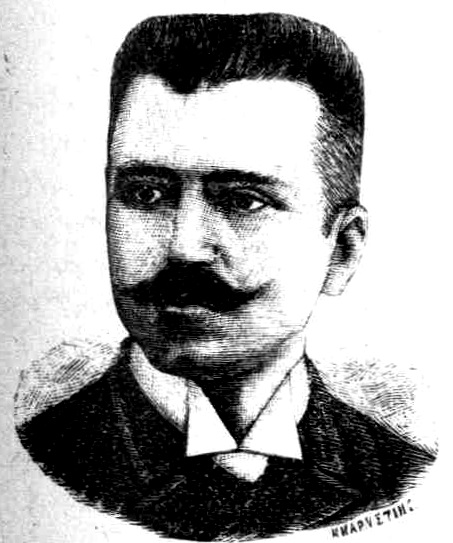
Demetrios Eginitis or Aiginitis (Greek: Δημήτριος Αιγινήτης; July 10, 1862 – March 14, 1934) was a Greek astronomer, physicist, mathematician, author, professor, dean, and politician. He replaced Demetrios Kokkidis becoming the fifth director of the National Observatory of Athens and the longest-serving director in the Observatory's history. He was one of the few Greek astronomers in modern Greek history during the 1800s, others included Georgios Konstantinos Vouris and Johann Friedrich Julius Schmidt. He served as Minister of Education twice. Eginitis was born in Athens, he attended the prest
Demetrios Eginitis or Aiginitis (Greek: Δημήτριος Αιγινήτης; July 10, 1862 – March 14, 1934) was a Greek astronomer, physicist, mathematician, author, professor, dean, and politician. He replaced Demetrios Kokkidis becoming the fifth director of the National Observatory of Athens and the longest-serving director in the Observatory's history. He was one of the few Greek astronomers in modern Greek history during the 1800s, others included Georgios Konstantinos Vouris and Johann Friedrich Julius Schmidt. He served as Minister of Education twice. Eginitis was born in Athens, he attended the prestigious Varvakeio School of Athens and later attended the University of Athens studying Mathematics from 1879 to 1886. He received a scholarship to study astronomy and mathematics at the Sorbonne from 1886 to 1890. While in France he wrote his world-renowned paper Sur la Stabilité du Système Solaire (On the Stability of the Solar System) and also published over one thousand astronomical observations. He returned to Greece and revived the Athens Observatory breaking it into three divisions Astronomy, Meteorology, and Geodynamics. He became a professor at the University of Athens a position he held from 1896 to 1934. He introduced the Eastern European Time Zone in Greece and the Gregorian calendar replacing the…
0 comentarii1 vizualizări0 reacții
Dimitrios Aiginitisa adăugat o fotografie
acum 4 ore
R.I.P Dimitrios
Early life He was born in Athens, Greece. His father's name was George. Demetri's brother was also a astrophysicist named Vasileios Aiginitis. Demetrios married Anthi Efthymiou and the couple had one daughter named Aigli. Demetrios graduated from the famous Varvakeio School of Athens in 1879. By the age of 17, he attended the University of Athens and remained at the institution from 1879 to 1886. He studied mathematics with some of Greece's most brilliant minds of the time namely John Hazzidakis, Cyparissos Stephanos, Vassilios Lakon, and Nikolaos Nikolaidis. Because of his outstanding performance as a student, the Athens University Council for post-doctoral studies awarded him a scholarship to study astronomy and mathematics at the Sorbonne from 1886 to 1890. He left Greece at 24 years of age. Initially, he was accepted as an apprentice astronomer (élève astronome) at the meteorological observatory of Parc Montsouris. He was also affiliated with the Paris Observatory. For two years Demetrios traveled around France and England working at different astronomical facilities namely the meteorological centre of Parc Saint Maur, the Meudon Observatory, the Observatory of Nice and Lockyer’s astronomical laboratory in England. By 1889 he was awarded a staff astronomer at the Paris Observatory. He…
0 comentarii1 vizualizări0 reacții
Dimitrios Aiginitisa lăsat un gând
acum 4 ore
Return to Athens The Athens Observatory was funded by Simon Sinas. Johann Friedrich Julius Schmidt, his research and equipment were all financed by the fund. When Schmidt and Sinas died the Observatory was no longer funded. Greek astronomer Demetrios Kokkidis managed the Observatory with no salary for a short period making minor advancements in the field of astronomy. Kokkidis was extremely busy teaching at three different institutions. The Greek government decided to ask Eginitis to take over the dilapidated structure and in 1890 they passed a special law under the government of Charilaos Trikoupis. Eginitis was responsible for updating the equipment and beginning a new era of research for the facility. He was the longest-serving director of the National Observatory of Athens from 1890 to 1934. It is the oldest research institution in Greece. By the year 1895, Eginitis established three departments within the National Observatory of Athens: Astronomy, Meteorology, and Geodynamics. Eginitis expanded the network of weather stations and created dozens of provincial weather stations. The astronomer also established seismological stations to monitor earthquakes and other geophysical activity. By 1896, he became professor of Meteorology and Astronomy at the University of Athens a position he held until 1934, roughly…
0 comentarii1 vizualizări0 reacții
Dimitrios Aiginitisa lăsat un gând
acum 4 ore
Sur la Stabilité du Système Solaire The planets orbit around the Sun but they also independently rotate. Astronomers debated the stability of the Solar System. The Solar System was understood to be chaotic, although it seemed to be stable. Observational Astronomers noticed by viewing Jupiter and Saturn via astronomical telescopes that Jupiter's orbit appeared to be shrinking while that of Saturn was expanding. This caused alarm, and an explanation was sought Pierre-Simon Laplace, Joseph-Louis Lagrange, and Siméon Denis Poisson proposed an explanation using complex mathematics. Laplace found a common trend within the Jupiter–Saturn system. Five periods of Jupiter's orbit around the Sun are equal to two periods of Saturn's orbit. Laplace concluded that any two planets and the Sun must be in mutual equilibrium and thereby launched his work on the stability of the Solar System. In 1786, he proved that the eccentricities and inclinations of planetary orbits to each other always remain small, constant, and self-correcting. Eignities built on this research and performed similar calculations for Earth, Jupiter, and Saturn using complex mathematics. While Eignities was in France he tried to solve difficult astronomical problems. The first problem was the belief our world will be destroyed. Eignities concluded the…
0 comentarii1 vizualizări0 reacții
Dimitrios Aiginitisa lăsat un gând
acum 4 ore
Conclusions
The major axes of planetary orbits are subject to secular inequalities of the third order with respect to the masses of the planets.
These inequalities are periodic and of periods excessively long, so that, on account of their smallness, they may be supposed proportional to time for several centuries.
The Earth and Saturn, as a result of these inequalities, approach the Sun by exceedingly small quantities.
0 comentarii1 vizualizări0 reacții
Dimitrios Aiginitisa lăsat un gând
acum 4 ore
Bibliography
Theodossiou, E.Th.; Manimanis, V.N.; Mantarakis, P. (2007). "Demetrios Eginitis Restorer of the Athens Observatory" (PDF). Journal of Astronomical History and Heritage. 10 (2): 123–132. Bibcode:2007JAHH...10..123T. doi:10.3724/SP.J.1440-2807.2007.02.05. ISSN 1440-2807. S2CID 129260817. Retrieved August 26, 2022.
Stefanidis, Michail K. (1952). Εθνικόν και Καποδιστριακόν Πανεπιστήμιον Αθηνών Εκατονταετηρίς 1837-1937. Τόμος Ε′, Ιστορία της Φυσικομαθηματικής Σχολής [National and Kapodistrian University of Athens Centenary 1837-1937. Volume V, History of the Faculty of Physics and Mathematics] (PDF). Athens: National and Kapodistrian University of Athens.
Eginitis, D. (1890). Mémoire Sur La Stabilité Du Systéme Solaire [The Stability of the Solar System]. Paris, FR: Observatory of Paris.
Savaidou, Irini Mergoupi (2010). 'Δημόσιος Λόγος περί Επιστήμης στην Ελλάδα, 1870–1900: Εκλαϊκευτικά Εγχειρήματα στο Πανεπιστήμιο Αθηνών, στους Πολιτιστικούς Συλλόγους και στα Περιοδικά [Public Discourse about Science in Greece, 1870-1900: Population Projects at the University of Athens, in Cultural Associations and Magazines] (PDF). Athens, GR: Department of History and Philosophy of Science of the University of Athens.
Moulton, Forest Ray (1914). An Introduction to Celestial Mechanics. London, UK: Macmillan & Co. ISBN 9780598943972. {{cite book}}: ISBN / Date incompatibility (help)