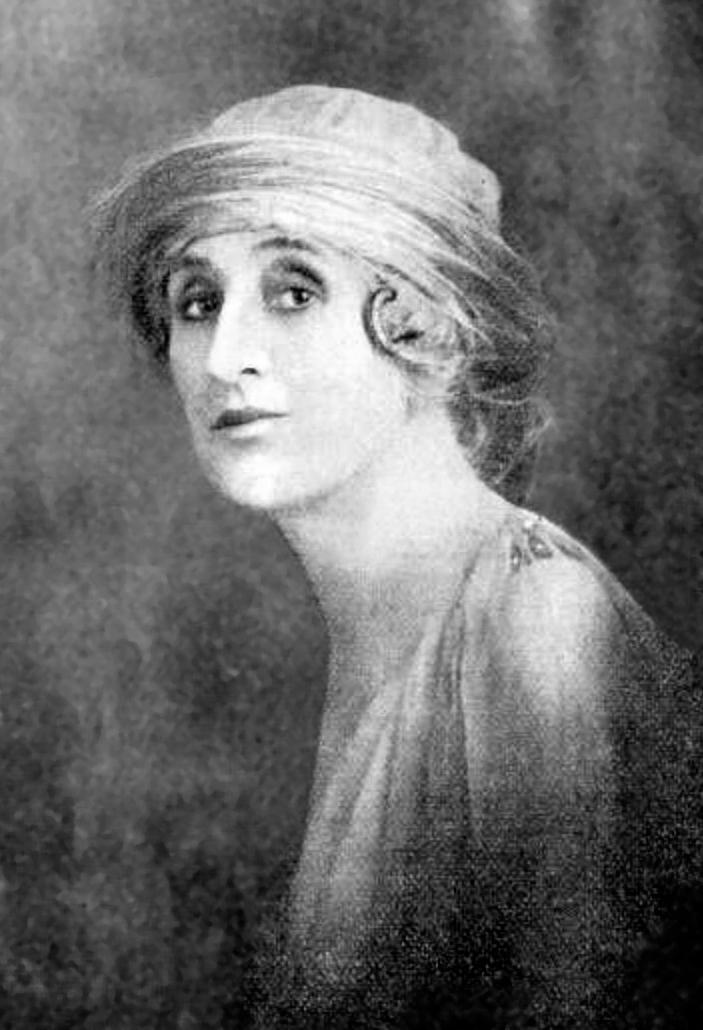
Adela Dora Ohlfsen-Bagge (22 August 1869 – 7 February 1948), known professionally as Dora Ohlfsen, was an Australian sculptor and art medallist. Working mostly in Italy, her first prominent work was a bronze medallion, The Awakening of Australian Art (1907), which won an award at the 1908 Franco-British Exhibition in London and was purchased for the Petit Palais in Paris. Other notable works include the Anzac Medal (1916), created to raise funds for Australians and New Zealanders who fought in the Gallipoli campaign, and Sacrifice (1926), the war memorial in Formia, Italy. Ohlfsen's portrait m
Adela Dora Ohlfsen-Bagge (22 August 1869 – 7 February 1948), known professionally as Dora Ohlfsen, was an Australian sculptor and art medallist. Working mostly in Italy, her first prominent work was a bronze medallion, The Awakening of Australian Art (1907), which won an award at the 1908 Franco-British Exhibition in London and was purchased for the Petit Palais in Paris. Other notable works include the Anzac Medal (1916), created to raise funds for Australians and New Zealanders who fought in the Gallipoli campaign, and Sacrifice (1926), the war memorial in Formia, Italy. Ohlfsen's portrait medallions were commissioned by or on behalf of a wide range of public figures, such as the actor Mary Anderson, the poet Gabriele D'Annunzio, and several senior politicians, including H. H. Asquith, David Lloyd George, Billy Hughes, and Mussolini, who allowed her to sketch him in 1922 at the Palazzo Chigi while he worked. In 1948 Ohlfsen and her lifelong partner, Hélène de Kuegelgen, were found dead in their apartment in Rome as a result of a gas leak, deemed by the police to have been an accident. The women were buried together in the city's non-Catholic cemetery, and friends packed up the contents of Ohlfsen's…
0 comentarii0 vizualizări0 reacții
Dora Ohlfsen-Baggea adăugat o fotografie
acum 2 ore
R.I.P Dora
Early life and education The fourth of seven daughters, Ohlfsen was born in Ballarat, Victoria, to Kate Ohlfsen-Bagge, née Harrison, an Australian whose family were from England, and Christian Hermann Ohlfsen-Bagge, an engineer born in Grabionna (now Poland) of Norwegian stock. The family was well known locally. Kate Ohlfsen-Bagge was the daughter of Captain John Harrison—born in Cumberland, England, and known in Australia for land squatting and political activism—and granddaughter of the first government printer in Victoria, George Howe. Christian Ohlfsen-Bagge moved to Australia in 1849 and made money during the Victorian gold rush. In 1855 he was the architect of the Olympic Theatre in Melbourne (demolished in 1894), which had been constructed in England and shipped to Australia, and he was involved in the construction of the Ballarat public library and the Bondi Ocean Outfall Sewer. When Ohlfsen was 14, the family moved to 4 Mona Terrace, Darling Point, a suburb of Sydney, and from 1884 to 1886 she attended Sydney Girls High School. A 1908 Sydney Mail profile described her when she left school as a "tall, willowy girl of 16, with a very distinguished manner, beautiful dark eyes, and hair, and a brilliant complexion". From around 1888…
0 comentarii0 vizualizări0 reacții
Dora Ohlfsen-Baggea adăugat o fotografie
acum 2 ore
R.I.P Dora
Berlin and St. Petersburg Information about Ohlfsen's life in Europe derives in large measure from Ohlfsen herself, mostly in letters to journalists and friends, including Gother Mann, director of the Art Gallery of New South Wales. There are inconsistencies between the accounts. The historian Ros Pesman writes that "either [Ohlfsen], the journalist, or both constructed a romantic narrative of the life of the 'lady artist', a little outré and eccentric, including early exotic adventuring and later participation in a cosmopolitan and sophisticated art world." In Berlin she attended Theodor Kullak's Neue Akademie der Tonkunst, where she studied under Moritz Moszkowski and said she had played for the Kaiser. Her time in Berlin was cut short by health problems, which she attributed to neuritis in her left arm. "All arrangements were made for my debut," she told an interviewer, "and a concert tour through Germany arranged, for which I was to be paid. Now, it was almost unheard of for a debutante to receive payment, and a foreigner appearing there had never previously been paid. My master had arranged that I should. Just as everything was ready, neuritis of the arm developed in a bad way, and I had to give…
0 comentarii0 vizualizări0 reacții
Dora Ohlfsen-Baggea adăugat o fotografie
acum 2 ore
R.I.P Dora
Via di S. Nicola da Tolentino Fearing the onset of the 1905 Russian Revolution, Ohlfsen and Kuegelgen moved to Rome in 1902. "From an artist's viewpoint," she wrote, "there is no country like Italy. Its very air breathes the cameraderie and Bohemianism which every artist craves." In letters and interviews, Ohlfsen said she had taken painting classes from Manuel Benedito-Vives at the Spanish Academy; Kuegelgen apparently worked there in or around 1906, perhaps as a model. Ohlfsen also said she had been taught sculpture by Camille Alaphilippe at the French Academy in Rome; Paul Landowski, creator of Christ the Redeemer in Rio de Janeiro; and the metal engraver Pierre Dautel. Art historians Eileen Chanin and Steven Miller note that the French Academy was open only to male French citizens at the time, so Ohlfsen probably attended evening classes there. They write that Dautel, who specialized in medallion portraits and had been compared to Pisanello, had the greatest influence on Ohlfsen. The women settled into a studio and apartment at Via di S. Nicola da Tolentino 72, opposite the church of San Nicola da Tolentino agli Orti Sallustiani and near Piazza Barberini. It seems they lived there until their deaths in…
0 comentarii0 vizualizări0 reacții
Dora Ohlfsen-Baggea adăugat o fotografie
acum 2 ore
R.I.P Dora
The Awakening of Australian Art (1907) The first of Ohlfsen's art to be added to a public collection was The Awakening of Australian Art (1907), a bronze medallion 29.5 cm in diameter, which the French government purchased in 1907 for the Petit Palais. "Australia is personified as the New Dawn or Venus arising from the sea," Chanin and Miller write. The pastoral scene on the back, with its "strangely living flock of sheep and the lonely shepherd", conveys "the whole soul and spirit of wide spaces of marvellous solitude and of newness and freedom", in the view of one reporter. "Miss Ohlfsen has caught the spirit of Australia." In June 1908 the medal won an award at the Franco-British Exhibition in London. A few months earlier, Ohlfsen's work had been praised in Rivista di Roma, in a three-page cover story by Rusconi: The spirit of a Pisanello, a Boldù or a Matteo de' Pasti is revived in the tenuous and robust medals of the very young sculptor. In their subtle, low relief, of necessity restrained as to light and shade, they vibrate with an intense spirit of life, as do some of the most famous medals of our Renaissance. And…
0 comentarii0 vizualizări0 reacții
Dora Ohlfsen-Baggea lăsat un gând
acum 2 ore
Visit to Sydney (1912–1913) By 1912 Ohlfsen's work was highly regarded. In 1909 she became the first Australian to be added to the Biographical Dictionary of Medallists, and the following year she was said to be working on a medallion of Archduke Eugen of Austria after Princess Marie of Windisch-Graetz introduced them. She sculpted three nudes around this time: The Pitcher Goes to the Fountain (c. 1909), Le septième voile (1911), and Dawn (by 1912), all lost. Hoping to receive a commission in Australia, she returned for 15 months in July 1912. She had made clear in 1908 that she missed Australia: "The scent and sight of a piece of wattle, the scent of gum leaves, even the trying hot winds of Rome affect me indescribably, and bring with them a nostalgia which shows me that my heart is always entirely Australian." The Art Gallery of New South Wales bought five of her works after she submitted 20 pieces, including three statuettes, to a Royal Art Society of New South Wales exhibition in September 1912. Among the works shown was a medallion portrait in lead of Hélène de Kuegelgen, showing "that fair-haired beauty as a woman of noble elegance of…
0 comentarii0 vizualizări0 reacții
Dora Ohlfsen-Baggea lăsat un gând
acum 2 ore
Anzac medal (1916) During World War I (1914–1918), Ohlfsen and Kuegelgen trained as Red Cross nurses. She wrote to Gother Mann of the Art Gallery of New South Wales: There is a great need of nurses and now a branch of the English Red Cross Society has come to Rome and English women are asked & go through a Voluntary Aid course. Great preparations are being made for bringing English wounded to this country and one sees crowds of English, French and Serbian officers and soldiers about ... I also told you that when I first [contacted] Paris I found my founder was dead and my reducers for medals—all killed. The number of artists killed too is appalling. In January 1915 she helped to nurse the injured during the Avezzano earthquake, and later worked in the Italian Auxiliary Hospital near her studio in Rome; photographs of her in her nurse's uniform were published in Australia. Art historian Juliette Peers noted that Ohlfsen's "anecdotes of life on the Italian front found a ready market amongst Australian journalists". Other artwork at this time included a medallion of her friend Colonel Duke Fulco Tosti di Valminuta. In October 1916 Ohlfsen created the work…
0 comentarii0 vizualizări0 reacții
Dora Ohlfsen-Baggea lăsat un gând
acum 2 ore
Visit to Sydney (1920–1922) To promote sales of the Anzac Medal, Ohlfsen visited Australia in 1920 for the first time since 1913. She set up a studio in Sydney at 110 Bathurst Street, and Dame Margaret Davidson organized an exhibition of her work there. Exhibits included Mrs. Grey (1917), a painting of Alexandra Simpson, model for the Anzac medal; The Awakening of Australian Art; a pastel of the Austrian bombing of Venice; a small sculpture called the Blind Ardito (the Arditi were an Italian World War I elite unit); and medallion portraits of General Birdwood, David Lloyd George, H. H. Asquith, General Giuseppe Garibaldi II, Sir Charles Wade, William Holman, and Cardinal William Henry O'Connell. A writer who met her in 1922 described her as "[t]all and of one figure": [A] commanding presence, and beautifully gowned, her finely moulded features suggested more the influence of her Polish father than of her English mother. The dark eyes held the inscrutable depths of the visionary, and, somehow, she reminded me irresistibly of Paderewski, a fellow countryman. Her exquisitely modulated voice unmistakably revealed an Italian accent. Her other work at this time included medallions of Australian Prime Minister Billy Hughes (1921) and one…
0 comentarii0 vizualizări0 reacții
Dora Ohlfsen-Baggea lăsat un gând
acum 2 ore
Mussolini medallion (1922) In 1922 Ohlfsen was commissioned, by a man with mining interests in Italy, to create a medallion of Benito Mussolini, Prime Minister of Italy from October 1922 to July 1943. After apparently giving her two-hour sittings at the Palazzo Chigi while he worked, Mussolini signed the plaster cast and added the inscription "per ardua ad astra" (through adversity to the stars). An early supporter of Mussolini and the National Fascist Party, Ohlfsen was in the crowd during the March on Rome on 30 October 1922 when the fascists took power. "We have been passing through many thrilling times here," she wrote to the Sydney Morning Herald in January 1923, "no less than a revolution with a king the head of it. ... At 1 pm I went down to the Café Aragno, on the Corso, with a party of friends. ... We stood on chairs there till 5:30, watching the Corteo march past. ... The Corteo was headed by Mussolini, and the entire procession composed of 100,000 Fascisti, marched past the tomb [of the unknown soldier], giving the Fascisti salute—raising the arm—as in the days of ancient Rome." She described Mussolini in 1925: He is, indeed, a…
0 comentarii0 vizualizări0 reacții
Dora Ohlfsen-Baggea lăsat un gând
acum 2 ore
Sacrifice (1926) In or around 1923, as a result of Ohlfsen's friendship with Duke Fulco Tosti di Valminuta, who had become an undersecretary in the Ministry of Foreign Affairs, the Italian government commissioned her to create a war memorial in Formia on the coast of Lazio. At the time she was reportedly the only woman in Italy and the only non-Italian to have been awarded such a commission. In February 1925 she told a correspondent that the work was completed, apart from finishing touches, and was being sent to Formia. Entitled Sacrifice, the 30-foot-tall sculpture consists of a young man, in bronze, standing on a white-marble pedestal with his arms outstretched; on the pedestal itself, holding a palm and a laurel branch, a woman inclines toward the names of those who died in World War I. The inscription, translated, reads "Oh, my country! The life thou gave me I return to thee." The unveiling in July 1926 in the Piazza della Vittoria was attended by General Armando Diaz; Ohlfsen was awarded the Freedom of the City and a silver shield. She described the ceremony in a letter: Thousands were present; the entire province, Commandants of the fifth Army Corps and…
0 comentarii0 vizualizări0 reacții
Dora Ohlfsen-Baggea lăsat un gând
acum 2 ore
Later work In 1930 Ohlfsen was invited, along with other artists, to submit sketches for sculptures for the inner shrine of Melbourne's Shrine of Remembrance. Asked to sketch Charity and Love, she was disappointed, calling the invitation "this crumb". In the end, the memorial committee chose other work and her idea didn't progress beyond a plaster cast. Robert Randolph Garran, the former Solicitor-General who became her friend and mentor, had suggested her to a group that was organizing the memorial. "I have the most glorious idea you can conceive of for the Canberra War Memorial but do not dare to tell you," she wrote to him in January 1932. "These are very hard times for me and I simply have not got the money to go to Australia unless it is for something definite. ... Supposing I had the money available (it is not a question of a mere steamer ticket) and went to Australia and after a heart-breaking fight did not get the work I would be so smashingly disappointed that I would be quite capable of killing myself!" Visitors to Rome still called in at Ohlfsen's studio on the Via di S. Nicola da Tolentino. Writing in the…
0 comentarii0 vizualizări0 reacții
Dora Ohlfsen-Baggea lăsat un gând
acum 2 ore
Death Little was heard from Ohlfsen during World War II (1939–1945). In October 1940 her name was included in a list of Australians who had been denied permission to leave Italy, a list released by Australia's Minister for External Affairs. Reportedly distressed by the dismantling of the Formia war memorial in 1941, she had been left without work by the fall of the fascists, the source of many of her commissions. The protecting powers gave her some kind of assistance during the war, after which she and Kuegelgen apparently had to finance themselves by selling their belongings. On 7 February 1948 the women were found dead as a result of a gas leak in their apartment on Via di S. Nicola da Tolentino. The police declared the deaths an accident, but there was inevitably speculation that it was suicide. "To the end," Peers wrote, "[Ohlfsen] maintained the sense of the dramatic that she had always cultivated." According to Miller, her studio was packed up by friends, and the contents have not been traced. The women were buried together at Cimitero Acattolico, the non-Catholic cemetery in Rome, in zone 1, row 15, plot 28, tomb number 1091. Ohlfsen's relief of Dionysus…
0 comentarii0 vizualizări0 reacții
Dora Ohlfsen-Baggea lăsat un gând
acum 2 ore
Ohlfsen's work is held in:
Australia: Australian War Memorial, National Library of Australia, and National Gallery of Australia in Canberra; the Art Gallery of New South Wales, Powerhouse Museum, and University of Sydney in Sydney; the National Museum of Victoria in Melbourne; and the Art Gallery of Ballarat.
France: the Petit Palais in Paris.
United Kingdom: the British Museum in London, the University of Glasgow, and the National Library of Wales in Aberystwyth.
0 comentarii0 vizualizări0 reacții
Dora Ohlfsen-Baggea lăsat un gând
acum 2 ore
Posthumous exhibitions
Through Women's Eyes, Australian War Memorial, Canberra, 30 July 1994 – 30 June 1995.
Beyond the Picket Fence: Australian women's art in the National Library collections, National Library of Australia, Canberra, 8 March 1995 – 8 June 1995.
Review: Speaking of Women, Art Gallery of New South Wales, Sydney, 8 March 1995 – 8 June 1995.
Dora Ohlfsen and the façade commission, Art Gallery of New South Wales, Sydney, 12 October 2019 – March 2020.
0 comentarii0 vizualizări0 reacții
Dora Ohlfsen-Baggea lăsat un gând
acum 2 ore
Medallions
Herbert M Moran of Sydney. Roma MCMXXXIX. xvii
0 comentarii0 vizualizări0 reacții
Dora Ohlfsen-Baggea lăsat un gând
acum 2 ore
Works cited
Newspapers and websites are cited in the References section only.