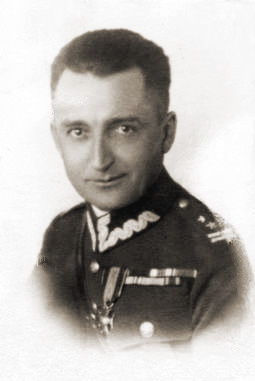
August Emil Fieldorf (nom de guerre: “Nil”; 20 March 1895 – 24 February 1953) was a Polish brigadier general who served as deputy commander-in-chief of the Home Army after the suppression of the Warsaw Uprising (August 1944 – October 1944). In 1953, he was executed by the communist regime.
August Emil Fieldorf (nom de guerre: “Nil”; 20 March 1895 – 24 February 1953) was a Polish brigadier general who served as deputy commander-in-chief of the Home Army after the suppression of the Warsaw Uprising (August 1944 – October 1944).
In 1953, he was executed by the communist regime.
0 comentarii0 vizualizări0 reacții
Emil August Fieldorfa adăugat o fotografie
acum 4 ore
R.I.P Emil
Biography
General Fieldorf's ancestors were partly of German origin. He was born on 20 March 1895 in Kraków. In the city, he finished his studies at the boy's college of St Nicholas and later a seminary. In 1910, he joined the Polish pro-independence paramilitary organization Riflemen's Association, becoming a full member in 1912. He also finished the school for non-commissioned officers.
0 comentarii0 vizualizări0 reacții
Emil August Fieldorfa adăugat o fotografie
acum 4 ore
R.I.P Emil
World War I
On 6 August 1914, Fieldorf volunteered for the newly formed 1st Brigade of the Legions under Józef Piłsudski. With them, he set out for the Russian Front, where he served in the position of second-in-command of an infantry platoon. In 1916, he was promoted to sergeant, and in 1917 directed to officer school.
After the oath crisis, he was pressed into the Austro-Hungarian Army and moved to the Italian front, which he abandoned to return to Poland. In August 1918, he volunteered at the Polish Military Organisation in his home city of Kraków.
0 comentarii0 vizualizări0 reacții
Emil August Fieldorfa adăugat o fotografie
acum 4 ore
R.I.P Emil
Formation of a new Polish state
From November 1918, Fieldorf served in the ranks of the Polish Army in the newly forming Second Republic, initially as a platoon commander and, from March 1919, commanded a heavy machine gun company. In 1919 and 1920, he took part in the campaign to join the Wilno region to Poland proper. After the commencement of the Polish-Bolshevik War, as a company commander he participated in liberating Dyneburg, Żytomierz and in the 1920 Polish Expedition to Kiev.
Fieldorf married Janina Kobylinska in 1919, with whom he had two daughters, Krystyna and Maria. Remaining on active duty after World War I, he was promoted to major and posted to the 1st Polish Infantry Regiment, as a battalion commander. In 1935, he was given command of the "Troki" independent battalion of the Border Protection Corps. A year later, he became a lieutenant colonel. Shortly before the outbreak of World War II, he was made commander of the 51st Giuseppe Garibaldi Rifle Regiment within the 12th Infantry Division on the eastern fringes of Poland (Kresy Wschodnie).
0 comentarii0 vizualizări0 reacții
Emil August Fieldorfa adăugat o fotografie
acum 4 ore
R.I.P Emil
World War II Fieldorf commanded his regiment during the Polish September Campaign. After the Division's defeat, on the night of September 8–9, he fled in civilian clothes to his native Kraków. From there he attempted to get to France, but was stopped on the Slovak border. He was interned in October 1939, but fled several weeks later from a camp and reached France via Hungary, where he joined the newly-forming Polish Armed Forces in the West. In France, he completed staff courses and was promoted to full colonel in May 1940. In September of that year, he was smuggled back to occupied Poland as the first emissary of the Polish government-in-exile, under the nom de guerre "Nil" which he had chosen for himself. His circuitous route back to Poland took him through South Africa, and by air, over Rhodesia, Sudan, and Egypt, then on to Romania, and by train to Poland. His aeroplane's flight-path over Sudan and Egypt followed the Nile, hence his nom de guerre, "Nil" (Nile in Polish). He initially joined the Union of Armed Struggle in Warsaw and from 1941 in Wilno and in Białystok. A year later he was given command of the Kedyw (special operations…
0 comentarii0 vizualizări0 reacții
Emil August Fieldorfa lăsat un gând
acum 4 ore
Arrests and execution On 7 March 1945, Fieldorf was arrested by the Soviet NKVD in the town of Milanówek. Initially, he was misidentified under the name Walenty Gdanicki and sent to a Gulag camp in the Ural Mountains. Released in 1947, he returned to new Poland ruled by the communist Polish Workers' Party government and the increasingly repressive Ministry of Public Security. He settled in Biała Podlaska under his assumed name and did not return to underground activities. Moving between Warsaw and Kraków, he eventually settled in Łódź. The government, which was persecuting former resistance members loyal to the London-based government-in-exile, offered an amnesty to them, in 1948. Not knowing that the amnesty was a sham, Fieldorf outed himself to the authorities. He was then placed under investigatory arrest in Warsaw. In prison, he refused to collaborate with the Communist security services, even under torture. General Fieldorf's brutal interrogations were personally supervised by MBP colonel Józef Różański. Kazimierz Gorski, Polish secret police, the UB interrogator, testified in 1997: "[Józef] Różański would stop by frequently during many of my interrogations of general [August] Fieldorf, and he would have conversations with him on many subjects. The prosecuting attorney Benjamin Wajsblech would show…
0 comentarii0 vizualizări0 reacții
Emil August Fieldorfa lăsat un gând
acum 4 ore
Commemorating and recognition
In 1972, a statue was erected on his symbolic grave. In 1989, following the collapse of Communist Poland, Fieldorf was officially rehabilitated.
In 2006, President Lech Kaczyński posthumously awarded him the Order of the White Eagle. In 2012, the supposed mass grave site was to be searched for Fieldorf's remains.
0 comentarii0 vizualizări0 reacții
Emil August Fieldorfa lăsat un gând
acum 4 ore
Search for justice Fieldorf's daughter, Maria Fieldorf Czarska, called for the prosecutor responsible for the execution of her father, Helena Wolińska-Brus (who lived in Oxford, England until her death in 2008), to be brought to face justice in Poland. Wolińska-Brus, a military prosecutor in the 1950s, was accused of aiding in the investigation and trial that resulted in Fieldorf's execution. Wolińska-Brus signed Fieldorf's arrest warrant and extended his detention several times, although she was aware of his innocence. A 1956 report issued by the communist authorities concluded that Wolińska-Brus had violated the rule of law and was involved in mock investigations and show trials that frequently resulted in executions. The charges against her were initiated by the Institute of National Remembrance, which claimed Wolińska-Brus was an "accessory to a court murder", which is classified as a Stalinist crime, and is punishable by up to 10 years in prison. The case attracted international attention. The United Kingdom refused to extradite her, and Wolińska-Brus died on 26 November 2008 without being brought to justice. Speaking about other individuals who have had complicity in the court-sanctioned murder (that is of fabricated evidence) of her father, Maria Fieldorf-Czarska said: I can neither allow the…
0 comentarii0 vizualizări0 reacții
Emil August Fieldorfa lăsat un gând
acum 4 ore
Feature film
In 2009 a historical drama movie entitled Generał Nil based on Fieldorf's life premiered in Poland to generally positive reviews. It was directed by Ryszard Bugajski with Olgierd Łukaszewicz in the title role.
0 comentarii0 vizualizări0 reacții
Emil August Fieldorfa lăsat un gând
acum 4 ore
Order of the White Eagle (2006)
Gold Cross of Order of Virtuti Militari
0 comentarii0 vizualizări0 reacții
Emil August Fieldorfa lăsat un gând
acum 4 ore
Cross of Independence (9 January 1932)
Knight's Cross of the Order of Polonia Restituta (11 November 1937)
0 comentarii0 vizualizări0 reacții
Emil August Fieldorfa lăsat un gând
acum 4 ore
Biography of Brigadier-General Emil August Fieldorf
Is this justice or revenge?, The Independent, 30 December 1998
Oxford don's wife 'sent war hero to his death', The Daily Telegraph, 22 November 2007
Britain must not stand in the way of Polish justice, The Scotsman, 25 November 2007
Polish enemies fight over Gen Emil Fieldorf, The Daily Telegraph, 25 November 2007
0 comentarii0 vizualizări0 reacții
Emil August Fieldorfa lăsat un gând
acum 4 ore
Bibliography
Stanisław Marat, Jacek Snopkiewicz, Zbrodnia. Sprawa generała Fieldorfa-Nila, Wydawnictwo Alfa, Warszawa 1989, ISBN 83-7001-308-2,
Tadeusz Kryska-Karski i Stanisław Żurakowski, Generałowie Polski Niepodległej, Editions Spotkania, Warszawa 1991, wyd. II uzup. i poprawione, s. 91,