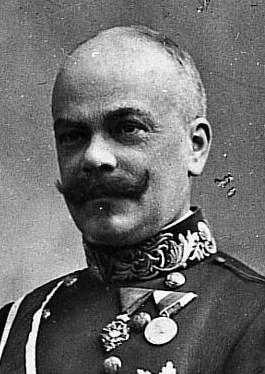
Ernest Karl Franz Joseph Thomas Friedrich von Koerber (6 November 1850 – 5 March 1919) was an Austrian liberal statesman who served as prime minister of the Austrian portion of Austria-Hungary from 1900 to 1904 and again in 1916.
Ernest Karl Franz Joseph Thomas Friedrich von Koerber (6 November 1850 – 5 March 1919) was an Austrian liberal statesman who served as prime minister of the Austrian portion of Austria-Hungary from 1900 to 1904 and again in 1916.
0 comentarii0 vizualizări0 reacții
Ernest von Koerbera adăugat o fotografie
ieri
R.I.P Ernest
Biography
Ernest von Koerber was born in Trento, Tyrol, Austrian Empire, in a German speaking family, the son of a Gendarmerie officer. Koerber attended the elite Theresianum boarding school in Vienna and, having obtained his Matura degree, went on to study law at the University of Vienna. He became extremely involved in Austrian culture and politics. The study of the Rechtsstaat ("legal state") doctrine, or constitutionality and civil rights was popular during Koerber's teen years and Koerber and his constitutionally-minded peers such as Sieghart, Steinbach, Baernreither, and Redlich learned and immersed themselves in this principle.
0 comentarii0 vizualizări0 reacții
Ernest von Koerbera adăugat o fotografie
ieri
R.I.P Ernest
Political career
Koerber’s knowledge of government was apparent when in 1874 he launched his career in the civil service, entering the Austrian Ministry of Commerce. In 1895 he was appointed general manager of the Imperial Royal Austrian State Railways and obtained the honorific title of a Geheimrat the following year. By 1897 Koerber was a member of the Imperial Council parliament of Cisleithania (i.e. the 'Austrian' portion of Austria-Hungary) and Commerce Minister. At this time, after the Austro-Hungarian Compromise of 1867, there were separate internal governments for the Austrian lands and the Kingdom of Hungary. Two years later in 1899, Koerber rose to the position of Austrian Minister of the Interior. In 1900, Emperor Franz Joseph asked Koerber to create a cabinet and serve as prime minister. This was by far the most influential position of Koerber’s career. Koerber served in this capacity until the end of 1904.
0 comentarii0 vizualizări0 reacții
Ernest von Koerbera lăsat un gând
ieri
First Koerber cabinet From the beginning of his term in office, Minister-President Koerber encountered many difficulties. Within the multinational Dual Monarchy, he had full authority only over the Cisleithania crown lands. Furthermore, the Imperial Council parliament was politically weak. In order to make major liberal reforms Koerber depended largely on Article 14, a provision in the December Constitution which allowed the Emperor to issue an “emergency regulation” for any necessary purposes. The meetings of the Imperial Council quickly transformed into forums for Koerber to bargain with party leaders. Koerber’s tenure in office was also marked by rising national tensions within Austria-Hungary. The Dual Monarchy dissipated any sense of allegiance to a single crown. The various ethnic groups resented one another and it became apparent that most government actions would leave at least one offended group. In military matters, Koerber opposed providing the Hungarian portion of the Austro-Hungarian Army (the Royal Hungarian Honvéd) with its own artillery units. While the emperor advocated such a policy, Koerber sided with crown prince Archduke Franz Ferdinand against it, stating that the principle of parity would require the Imperial-Royal Landwehr to also have artillery, which Austria could not afford. Even education was a controversial aspect…
0 comentarii0 vizualizări0 reacții
Ernest von Koerbera lăsat un gând
ieri
Second Koerber cabinet Koerber returned to the spotlight during World War I. From 7 February 1915 to 28 October 1916, he served as Austro-Hungarian Finance Minister (one of three k.u.k common ministries which served both countries). In the ongoing discussions on the goals of the war, Koerber strictly opposed Foreign Minister Stephan Burián's ideas to annex Russian Congress Poland (Vistula Land), stating that it could further weaken the cohesion and political balance of the Dual Monarchy. After the Austrian minister-president Count Karl von Stürgkh was assassinated by Friedrich Adler on 21 October 1916, aged Emperor Franz Joseph quickly recalled Koerber to return as his successor. Many had hoped that Koerber would modify the tyrannical system that had developed during wartime. However, after Franz Joseph's death on November 21, Koerber came into conflict with the new emperor, Charles I, and did not make such changes. In fact, the constant disputes made it difficult for Koerber to get anything accomplished. Koerber still held out hope that Austria and Hungary were able to unite, both politically and socially. Charles I, however, continued to take measures that would hinder this progress. Koerber, an aged man by this point, decided he could no longer take…
0 comentarii0 vizualizări0 reacții
Ernest von Koerbera lăsat un gând
ieri
Support for Zionism
Koerber was a friend and supporter of Theodor Herzl. He was impressed by his Zionist project and assured Herzl that he would stand behind him in his endeavors to win a charter for Jewish settlement in Palestine.