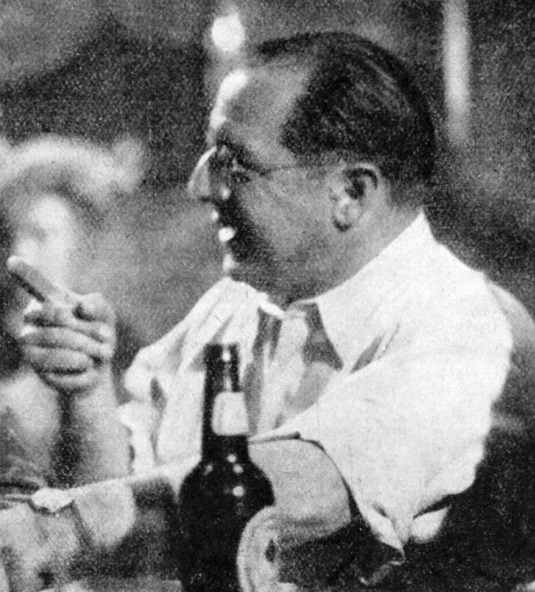
Georg Wilhelm Pabst (25 August 1885 – 29 May 1967) was an Austrian film director and screenwriter. He started as an actor and theater director, before becoming one of the most influential German-language filmmakers during the Weimar Republic.
Georg Wilhelm Pabst (25 August 1885 – 29 May 1967) was an Austrian film director and screenwriter. He started as an actor and theater director, before becoming one of the most influential German-language filmmakers during the Weimar Republic.
0 comentarii0 vizualizări0 reacții
Georg Wilhelm Pabsta adăugat o fotografie
ieri
R.I.P Georg
Early years
Pabst was born in Raudnitz, Bohemia, Austria-Hungary (today's Roudnice nad Labem, Czech Republic), the son of a railroad official. While growing up in Vienna, he studied drama at the Academy of Decorative Arts and began his career as a stage actor in Switzerland, Austria and Germany. In 1910, Pabst traveled to the United States, where he worked as an actor and director at the German Theater in New York City.
In 1914, he decided to become a director, and he returned to recruit actors in Europe. Pabst was in France when World War I began, he was arrested and held as an enemy alien and interned in a prisoner-of-war camp near Brest. While imprisoned, Pabst organised a theatre group at the camp and directed French-language plays. Upon his release in 1919, he returned to Vienna, where he became director of the Neue Wiener Bühne, an avant-garde theatre.
0 comentarii0 vizualizări0 reacții
Georg Wilhelm Pabsta adăugat o fotografie
ieri
R.I.P Georg
Career Pabst began his career as a film director at the behest of Carl Froelich who hired Pabst as an assistant director. He directed his first film, The Treasure, in 1923. He developed a talent for "discovering" and developing the talents of actresses, such as Louise Brooks and Leni Riefenstahl. Film theorist Karel Reisz noted that Pabst was among the first filmmakers to time his cuts to specific movements, using cutting on action to create seamless transitions and enhance the fluidity of his films. Pabst's best known films concern the plight of women, including The Joyless Street (1925) with Greta Garbo and Asta Nielsen, Secrets of a Soul (1926) with Lili Damita, The Loves of Jeanne Ney (1927) with Brigitte Helm, and Pandora's Box (1929) and Diary of a Lost Girl (1929) with American actress Louise Brooks. He also co-directed with Arnold Fanck a mountain film entitled The White Hell of Pitz Palu (1929) starring Leni Riefenstahl. After the coming of sound, he made a trilogy of films that secured his reputation: Westfront 1918 (1930), The Threepenny Opera (1931) with Lotte Lenya (based on the Bertolt Brecht and Kurt Weill musical), and Kameradschaft (1931). Pabst also filmed three versions of…
0 comentarii0 vizualizări0 reacții
Georg Wilhelm Pabsta lăsat un gând
ieri
Death
On 29 May 1967, Pabst died in Vienna at the age of 81. He was interred at the Zentralfriedhof in Vienna.
0 comentarii0 vizualizări0 reacții
Georg Wilhelm Pabsta lăsat un gând
ieri
Awards
1941, Venice Film Festival: Gold Medal of the Biennale for Best Director for his film The Comedians
0 comentarii0 vizualizări0 reacții
Georg Wilhelm Pabsta lăsat un gând
ieri
In fiction
Daniel Kehlmann's 2023 novel, The Director, shows Pabst's moral struggles under the Nazi regime.
0 comentarii0 vizualizări0 reacții
Georg Wilhelm Pabsta lăsat un gând
ieri
G. W. Pabst at IMDb
"The Other Eye", Filmessay on G.W.Pabst, by Johanna Heer & Werner Schmiedel (A/USA 1991/92)