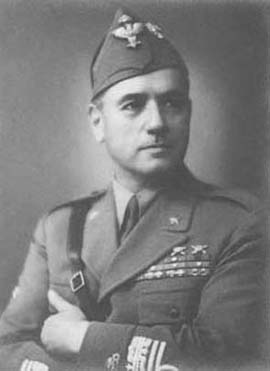
Giovanni Messe (10 December 1883 – 18 December 1968) was an Italian field marshal and politician. In the Second World War, he was captured in Tunisia but made chief of staff of the Italian Co-belligerent Army after the armistice of September 1943. Later, he was an elected representative in the Italian Senate. He is considered by many to have been the best Italian general of the war.
Giovanni Messe (10 December 1883 – 18 December 1968) was an Italian field marshal and politician. In the Second World War, he was captured in Tunisia but made chief of staff of the Italian Co-belligerent Army after the armistice of September 1943. Later, he was an elected representative in the Italian Senate. He is considered by many to have been the best Italian general of the war.
0 comentarii0 vizualizări0 reacții
Giovanni Messea adăugat o fotografie
acum 2 ore
R.I.P Giovanni
Early life and career
Messe was born in Mesagne, in the Province of Brindisi in the Apulia region of Italy on 10 December 1883. Giovanni Messe pursued a military career in 1901. He saw action in the Italian conquest of Libya and in the First World War. During this conflict, he gave an important contribution to the creation and training of the "Arditi", elite infantry units, and with the rank of maggiore was the commander of the IX Nono Reparto Arditi that fought in the zone of Monte Grappa. Emerging considerably decorated from these conflicts, he became aide-de-camp to King Victor Emmanuel III, holding this post from 1923 to 1927. From this date until 1935, Messe commanded a unit of Bersaglieri and held the rank of colonel.
If he had written his autobiography, Messe could have told the story of Italian military history in the first half of the twentieth century
0 comentarii0 vizualizări0 reacții
Giovanni Messea adăugat o fotografie
acum 2 ore
R.I.P Giovanni
Ottomans and First World War
He was sent to Libya as part of the Italo-Turkish War, he took part in several battles in the Tripoli area, where he earned his first decorations on the field, but was repatriated in September 1912 for health reasons. After recovering and being promoted to Lieutenant, in 1913 he was assigned to the III Battalion of the 84th Infantry Regiment stationed in Libya. Promoted to Captain on 17 November 1915, Messe was repatriated at the end of 1916 to participate in the First World War on the Italian front. During the First World War, Messe fought in the 57th Infantry Regiment and with several Arditi units, including the IX Assault Unit, which he commanded on Monte Grappa, distinguishing himself in the conquest of Col Moschin and being wounded twice. He was nominated for the Gold Medal for Military Valor, later commuted to the third Silver Medal for Military Valor for the feats of arms on Monte Asolone, and obtained two promotions (to Major and Lieutenant Colonel) for "war merit".
0 comentarii0 vizualizări0 reacții
Giovanni Messea adăugat o fotografie
acum 2 ore
R.I.P Giovanni
Interwar period After the war, on 3 June 1919 he was initiated into Freemasonry in the Michelangiolo Lodge in Florence in 1919, and was assigned to the Padua depot which he left to participate in the operations in Albania in 1920, when this nation tried to gain independence from the Italian Protectorate of Albania. Returning to Italy in 1923, he was appointed effective Aide-de-Camp to the sovereign Victor Emmanuel III after four years he was promoted to Colonel and appointed honorary Aide-de-Camp. Messe was given command of the 9th Bersaglieri Regiment, which he held until September 16, 1935, when he was given designated command of the 3rd Celere Brigade in Verona. After being promoted to Brigadier General, he obtained effective command of the Celere Brigade and was subsequently appointed Deputy Commander of the Cosseria Division, with which he participated in the final stages of the campaign in East Africa during the conquest of Ethiopia. He returned to Italy on September 28, 1936, and after briefly serving as inspector of the Celere troops, he was promoted to Division General and commander of the 3rd Celere Division "Principe Amedeo Duca d'Aosta" (the previous Celere Brigade, which had since been reorganized as a…
0 comentarii0 vizualizări0 reacții
Giovanni Messea adăugat o fotografie
acum 2 ore
R.I.P Giovanni
Greece
From 15 November 1940, Messe commanded the Special Army Corps during the Greco-Italian War of late 1940 and early 1941 and achieved some success against Greek forces commanded by Alexandros Papagos. Before winter had even set in however, the Italian forces were forced onto the defensive, as Greek forces launched a counterattack and moved into parts of Italian controlled Albania. On April 4, Hitler told Mussolini that defending Albania was crucial for Operation Marita. In early April, Papagos launched new attacks toward Elbasan, Berat, and Valona, but despite some initial gains, the Greek advance slowed as Italian defences strengthened. Giovanni Messe launched an counterattack from South Albania occupying the Western coast of Greece, with the help of the German Armed Forces (Wehrmacht), the Battle of Greece, ended in an Axis victory.
0 comentarii0 vizualizări0 reacții
Giovanni Messea lăsat un gând
acum 2 ore
Russia Having returned to Italy in June, on 14 July 1941 Messe obtained command of the Italian Expeditionary Corps in Russia, replacing the designated Commander in Vienna who had fallen ill, General Francesco Zingales , with whom he undertook the advance into Russia between the Dnieper and Don rivers. This Army Corps had approximately 62,000 men in three Divisions ("Celere", "Pasubio" and "Torino", the last ones on foot despite their qualification as "motor transportable") and the 63rd CC.NN. Assault Legion "Tagliamento", approximately 2,000 men under the command of the consul Niccolò Nicchiarelli. Overall, Messe could count on 17 Rifle Battalions (12 Infantry, 3 Motorcyclist Bersaglieti, 2 Blackshirts), 7 Battalions of accompanying weapons, a Battalion of Sappers, 14 Independent Companies, 10 Cavalry Squadrons (Regiments "Savoia Cavalleria" and "Lancieri di Novara"), 4 Regiments of almost useless CV33 pompously defined by the regime as tanks, in reality the equivalent of the British Bren carriers, 24 Artillery Groups, 10 Engineer Battalions, a Chemical Battalion and 12 Carabinieri Sections ; a contingent of the Royal Air Force was also deployed (51 fighters, 22 reconnaissance aircraft and 10 Savoia-Marchetti SM81 transport trimotors, the latter often representing a means of quickly supplying the troops at the front…
0 comentarii0 vizualizări0 reacții
Giovanni Messea lăsat un gând
acum 2 ore
Tunisia
In February 1943, Messe was appointed as the new commander of the Italo-German Tank Army (Deutsch-Italienische Panzerarmee) formerly commanded by Erwin Rommel. The name was changed to 1st Italian Army in recognition of the fact that the army consisted of one German and three Italian corps. Rommel was promoted to the command of the new Army Group Africa (Heeresgruppe Afrika).
Messe fought a defensive campaign against the advancing British and allied forces, and was defeated at the Mareth Line. The lack of resources available to the general Messe could not prevent the inevitable defeat of the Axis in North Africa.
On 12 May 1943 Messe was promoted to the rank of marshal of Italy (Maresciallo d'Italia). The following day, the 5th German Tank Army collapsed with the fall of Tunis and the 1st Italian Army was surrounded, still holding the line at Enfidaville. Messe along with Kurt Freiherr von Liebenstein formally surrendered to British and New Zealand forces under General Bernard Freyberg.
0 comentarii0 vizualizări0 reacții
Giovanni Messea lăsat un gând
acum 2 ore
Post-armistice
As a loyal supporter of the Royalist cause, like many Italian officers Messe soon found himself re-employed, when after the Italian armistice in September 1943, he was made chief of staff of the Italian Co-Belligerent Army (Esercito Cobelligerante Italiano), consisting of those units loyal to King Victor Emmanuel, many of which were reconstituted from Italian POWs and armed by the Allies. He served in this post with distinction until the war's end and then retired from the military in 1947 after 46 years of distinguished service.
0 comentarii0 vizualizări0 reacții
Giovanni Messea lăsat un gând
acum 2 ore
Life after the army
After the war, Messe was one of the founders of "Armata Italiana della Libertà" (Italian Army of Liberty), an anti-Communist paramilitary that was joined by some fifty generals and admirals.
Messe wrote a book about his experiences, titled Come finì la guerra in Africa. La mia armata in Tunisia (How the war in Africa ended. My army in Tunisia). His military popularity remained with him in civilian life and from 1953 to 1955, Messe was a democratically elected representative in the Italian Senate. He was also president of the Italian Veterans Association, a post which he held until his death. His life was profiled in a biography written by Luigi Argentieri titled Messe—soggetto di un'altra storia (Messe—subject of another history) published in 1997.
Giovanni Messe died on 18 December 1968, at the age of eighty-five.
0 comentarii0 vizualizări0 reacții
Giovanni Messea lăsat un gând
acum 2 ore
Awards and decorations
Silver Medal of Military Valor – Gorizia, 21–23 May 1917
War Merit Cross – Albania, 19 June 1920
Promotion for War Merits – to Lieutenant General, Valona – Kalamas, 1940–1941
Promotion for War Merits – to Lieutenant Colonel, 1918