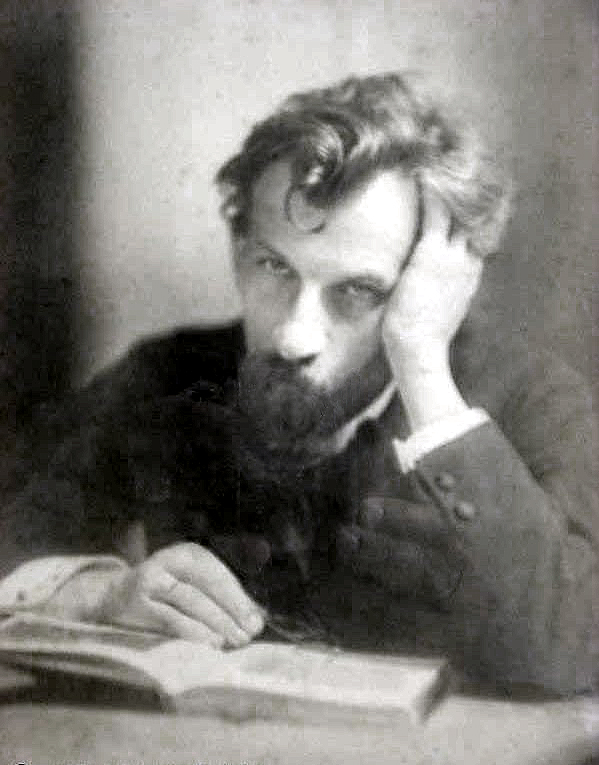
Hans Erich Pfitzner (5 May 1869 – 22 May 1949) was a German composer, conductor and polemicist who was a self-described anti-modernist. His best known work is the post-Romantic opera Palestrina (1917), very loosely based on the life of the sixteenth-century composer Giovanni Pierluigi da Palestrina and his Missa Papae Marcelli.
Hans Erich Pfitzner (5 May 1869 – 22 May 1949) was a German composer, conductor and polemicist who was a self-described anti-modernist. His best known work is the post-Romantic opera Palestrina (1917), very loosely based on the life of the sixteenth-century composer Giovanni Pierluigi da Palestrina and his Missa Papae Marcelli.
0 comentarii3 vizualizări0 reacții
Hans Pfitznera adăugat o fotografie
ieri
R.I.P Hans
Life Pfitzner was born in Moscow where his father played cello in a theater orchestra. The family returned to his father's native town Frankfurt in 1872, when Pfitzner was two years old, he always considered Frankfurt his home town. He received early instruction in violin from his father, and his earliest compositions were composed at age 11. In 1884 he wrote his first songs. From 1886 to 1890 he studied composition with Iwan Knorr and piano with James Kwast at the Hoch Conservatory in Frankfurt. (He later married Kwast's daughter Mimi Kwast, a granddaughter of Ferdinand Hiller, after she had rejected the advances of Percy Grainger.) He taught piano and theory at the Koblenz Conservatory from 1892 to 1893. In 1894 he was appointed conductor at the Staatstheater Mainz where he worked for a few months. These were all low-paying jobs, and Pfitzner was working as Erster (First) Kapellmeister with the Berlin Theater des Westens when he was appointed to a modestly prestigious post of opera director and head of the conservatory in Straßburg (Strasbourg) in 1908, when Pfitzner was almost 40. In Strasbourg, Pfitzner finally had some professional stability, and it was there he gained significant power to direct…
0 comentarii3 vizualizări0 reacții
Hans Pfitznera adăugat o fotografie
ieri
R.I.P Hans
The Nazi era Increasingly nationalistic in his middle and old age, Pfitzner was at first regarded sympathetically by important figures in Nazi Germany, in particular by Hans Frank, with whom he remained on good terms. But he soon fell out with chief Nazis, who were alienated by his long musical association with the Jewish conductor Bruno Walter. He incurred extra wrath from the Nazis by refusing to obey the regime's request to provide incidental music to Shakespeare's A Midsummer Night's Dream that could be used in place of the famous setting by Felix Mendelssohn, unacceptable to the Nazis because of his Jewish origin. Pfitzner maintained that Mendelssohn's original was far better than anything he himself could offer as a substitute. As early as 1923, Pfitzner and Hitler met. It was while the former was a hospital patient: Pfitzner had undergone a gall bladder operation when Anton Drexler, who knew both men well, arranged a visit. Hitler did most of the talking, but Pfitzner dared to contradict him regarding the antisemitic thinker Otto Weininger, causing Hitler to leave in a huff. Later on, Hitler told Nazi cultural architect Alfred Rosenberg that he wanted "nothing further to do with this Jewish rabbi."…
0 comentarii3 vizualizări0 reacții
Hans Pfitznera adăugat o fotografie
ieri
R.I.P Hans
Musical style and reception Pfitzner's music—including pieces all the major genres except the symphonic poem—was respected by contemporaries such as Gustav Mahler and Richard Strauss, although neither man cared much for Pfitzner's innately acerbic manner (and Alma Mahler repaid his adoration with contempt, despite her agreement with his intuitive musical idealism, a fact evident in her letters to the wife of Alban Berg). Although Pfitzner's music betrays Wagnerian influences, the composer was not attracted to Bayreuth, and was personally despised by Cosima Wagner, in part because Pfitzner sought notice and recognition from such "anti-Wagnerian" composers as Max Bruch and Johannes Brahms. Pfitzner's works combine Romantic and Late Romantic elements with extended thematic development, atmospheric music drama, and the intimacy of chamber music. Columbia University musicologist Walter Frisch has described Pfitzner as a "regressive modernist." His is a highly personal offshoot of the Classical/Romantic tradition as well as the conservative musical aesthetic and Pfitzner defended his style in his own writings. Particularly notable are Pfitzner's numerous and delicate lieder, influenced by Hugo Wolf, yet with their own rather melancholy charm. Several of them were recorded during the 1930s by the distinguished baritone Gerhard Hüsch, with the composer at the piano. His…
0 comentarii3 vizualizări0 reacții
Hans Pfitznera adăugat o fotografie
ieri
R.I.P Hans
Recordings
His complete orchestral works have been recorded by the German conductor Werner Andreas Albert. His complete songs have been recorded on the CPO label. Also, his chamber music, including 4 string quartets, 2 piano trios, a violin sonata, a couple of odd piano works, a piano quintet and a string sextet, and a cello sonata have been recorded several times.
0 comentarii3 vizualizări0 reacții
Hans Pfitznera lăsat un gând
ieri
Hans Pfitzner at AllMusic
UbuWeb:A New Musical Reality": Futurism, Modernism, and "The Art of Noises" by Robert P. Morgan
Free scores by Hans Pfitzner at the International Music Score Library Project (IMSLP)
Newspaper clippings about Hans Pfitzner in the 20th Century Press Archives of the ZBW
Die neue Aesthetik der musikalischen Impotenz: Ein Verwesungssymptom? by Hans Pfitzner