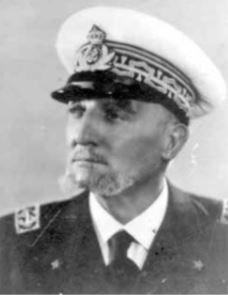
Ildebrando Goiran (14 June 1882 in Turin – 16 November 1945 in Rome) was an Italian admiral and recipient of the Gold Medal of Military Valor.
0 comentarii0 vizualizări0 reacții
Ildebrando Goirana lăsat un gând
acum 4 ore
Early years
He was born in Turin on June 14, 1882, the son of Army officer and Senator Giovanni Goiran and Irma Lazzarini. After attending the Nunziatella Military School, in August 1898 he entered the Royal Naval Academy of Livorno, graduating as ensign in April 1902. His first assignment was on the battleship Emanuele Filiberto. In November 1905 he was promoted to sub-lieutenant and in 1910 to lieutenant. He participated in the Italo-Turkish War, initially on board the protected cruiser Etruria, then on the torpedo cruiser Caprera and finally, as military commander, on the chartered steamer Re Umberto. During the war he distinguished himself in the summer of 1912, when he was designated as beach commander in Misrata in Tripolitania, and then in the spring of 1913 (after the end of the hostilities with the Ottoman Empire and during the campaign against the Senussi), on the occasion of the landing in Tolmeta in Cyrenaica.
0 comentarii0 vizualizări0 reacții
Ildebrando Goirana lăsat un gând
acum 4 ore
World War I After a short period in Rome as section head of the Regia Marina's general staff office, in the summer of 1914 he was assigned on the destroyer Impetuoso, where he was at the time of the entry of the Kingdom of Italy into World War I, which took place on May 24, 1915. At the beginning of 1916 he was in command of the torpedo boat 33 PN for a month, before being reassigned to Impetuoso as executive officer. In June 1916 he became commander of the torpedo boat 42 PN and, while in Venice, he was made aware of a project that Captain Carlo Pignatti Morano was working on with the authorization of Admiral Paolo Thaon di Revel, aimed at forcing of the port of Pola, the main base of the Austro-Hungarian fleet, in order to attack the ships moored there. More specifically, Pignatti Morano had planned to enter the Fasana channel, just north of Pola, between the Istrian coast and the Brioni islands, where one or two of the enemy capital ships stationed in Pola were stationed, usually in turn; despite the presence of coastal batteries and destroyers, it would have been easier to attack…
0 comentarii0 vizualizări0 reacții
Ildebrando Goirana lăsat un gând
acum 4 ore
Interwar years In November 1919 he was promoted to Commander and appointed executive officer of the armored cruiser San Marco; in March 1920 he was transferred to the battleship Conte di Cavour, again as executive officer, and in December he was assigned to the maritime defense of Venice, also carrying out a mission in Fiume in the following months. In May 1923 he was appointed commander of the MAS squadron of the naval forces of the Mediterranean, in December 1924 he was commander of a destroyer squadron (with Nicola Fabrizi as flagship), in November 1925 he took over the direction of the naval mechanic's school in Venice and in April 1926 he was promoted to captain. In April 1928 he became commander of the scout cruiser Quarto and from 1929 he was in command of a squadron of Indomito-class destroyers. In 1931 he became chief of staff of the 2nd Fleet, embarked on the battleship Andrea Doria and later on the light cruiser Giovanni delle Bande Nere. In January 1933 he was promoted to rear admiral and appointed naval commander of Sardinia and of the La Maddalena Naval Fortress Area. In 1935 he was promoted to vice admiral and for…
0 comentarii0 vizualizări0 reacții
Ildebrando Goirana lăsat un gând
acum 4 ore
World War II and later years
After the Armistice of Villa Incisa following Italy's brief campaign against France in June 1940, right after its entry into World War II, Goiran was appointed naval delegate in the Commissione Italiana d'Armistizio con la Francia.
In June 1941 he was again appointed commander-in-chief of the Northern Tyrrhenian Naval Department until November, when he was placed at the disposal of the Ministry of the Navy. He then returned to the position of President of the High Council of the Navy from October 1942 until the Armistice of Cassibile in September 1943. Afterwards, he did not collaborate with the authorities of the Italian Social Republic and in August 1944, after the liberation of Rome, he was part of the commission tasked with investigating into officers who had been guilty of collaborationism.
He died in Rome on November 16, 1945.