Jan Teska (1876-1945) was a Polish journalist, publisher of the Dziennik Bydgoski, a national activist and a Polish politician from the 1900s till the end of World War II.
Jan Teska (1876-1945) was a Polish journalist, publisher of the Dziennik Bydgoski, a national activist and a Polish politician from the 1900s till the end of World War II.
0 comentarii1 vizualizări0 reacții
Jan Teskaa adăugat o fotografie
acum 3 ore
R.I.P Jan
Prussian partition Jan Teska was born on 16 July 1876 in Chojnica near Poznań. He was the son of Antonina née Gołaska and Antoni, a farmer. After a preparatory year, he passed the 3rd grade exam to enter the Saint Mary Magdalene High School in Poznań. There, he was active in the Scientific Aid Society of the city. Jan left junior high school after completing the 8th grade. He took his Matura in Wschowa, but did not take the oral exam. Afterwards, he moved to Kraków for over a year, studying Polish language and literature. On 1 April 1900 he started working in the editorial office of the paper Orędownik (English: Spokesman) in Poznań. He performed one year of military service as a volunteer in the 47th Infantry Regiment of the 10th Division of the German Empire in Poznań. Once released from the army, he transferred to East Prussia to study in Mazury. At that time, he wrote articles for Praca in Poznań and took over the editorial office of Gazeta Polska in Kościan. After a few months, he moved to Gniezno where he edited until 1907 the local daily paper Lech Gazeta Gnieźnieńska. On 1 November 1907 he went…
0 comentarii1 vizualizări0 reacții
Jan Teskaa adăugat o fotografie
acum 3 ore
R.I.P Jan
Interwar period In Bydgoszcz, Jan Teska actively participated in national and social activities together with other Polish residents. He became the secretary of the Polish People's Council in Bydgoszcz (Polish: Polska Rada Ludowa w Bydgoszczy), chaired by Jan Biziel, which prepared the handover of the city from German hands. He was also a delegate to the Polish District Sejm (Polish: Polski Sejm Dzielnicowy) gathering in Poznań in December 1918. On 19 January 1920 he was a member of the Polish delegation which officially took over Bydgoszcz from the German authorities. In 1920, he became a councilor of the temporary City Council, and on 25 June 1925 he was elected city councilor by the City Council. From 1925 to 1931, Teska served as the president of the Union of Pomeranian Journalists (Polish: Syndykat Dziennikarzy Pomorskich). The post-war crisis and progressive inflation led the "Dziennik Bydgoski" to financial difficulties: in 1920, the newspaper was transformed into a joint-stock company, Drukarnia Bydgoska SA, with Jan Teska as its editor-in-chief. The daily paper was a voice of the Polish Christian democracy, but regularly leaned towards the National Democratic movement and Józef Piłsudski's Sanacja. During interwar, "Dziennik Bydgoski" grew to become the most important daily…
0 comentarii1 vizualizări0 reacții
Jan Teskaa adăugat o fotografie
acum 3 ore
R.I.P Jan
WWII
After the Invasion of Poland in September 1939, Teska left Bydgoszcz: Nazis forces destroyed the building of the editorial office and the printing house of the Dziennik Bydgoski.
Wanted by the Gestapo, he hid in Warsaw under the alias of "Józef Topolski" and entered the underground army. Having an excellent practice of German language, he took an active part in the "Operation N", mixing sabotage, subversion and black propaganda activities against the Wehrmacht.
Furthermore, Jan Teska actively participated in the activities of the underground Christian democratic political party Labour Faction (1937). He was a close associate of Zygmunt Felczak, who advocated cooperation with the socialist left and supported radical social changes in Poland. In July 1943, Felczak set up a separate group called Stronnictwo Zrywu Narodowy (English: National Rising Party) or "Zryw": Teska became its president.
In 1944, he participated in the Warsaw Uprising, in charge of the insurgent radio "Błyskawica". After the end of the uprising, he was sent to the transit camp (Durchgangslager or Dulag) 121 in Pruszków.
0 comentarii1 vizualizări0 reacții
Jan Teskaa lăsat un gând
acum 3 ore
Post-war years
At the end of WWII, Teska was nominated by the Political Parties Consultation Commission (Polish: Centralna Komisja Porozumiewawcza Stronnictw Demokratycznych) created in November 1944, as a delegate to the Pomeranian Voivodeship National Council: there, he was representing the press and trade unions.
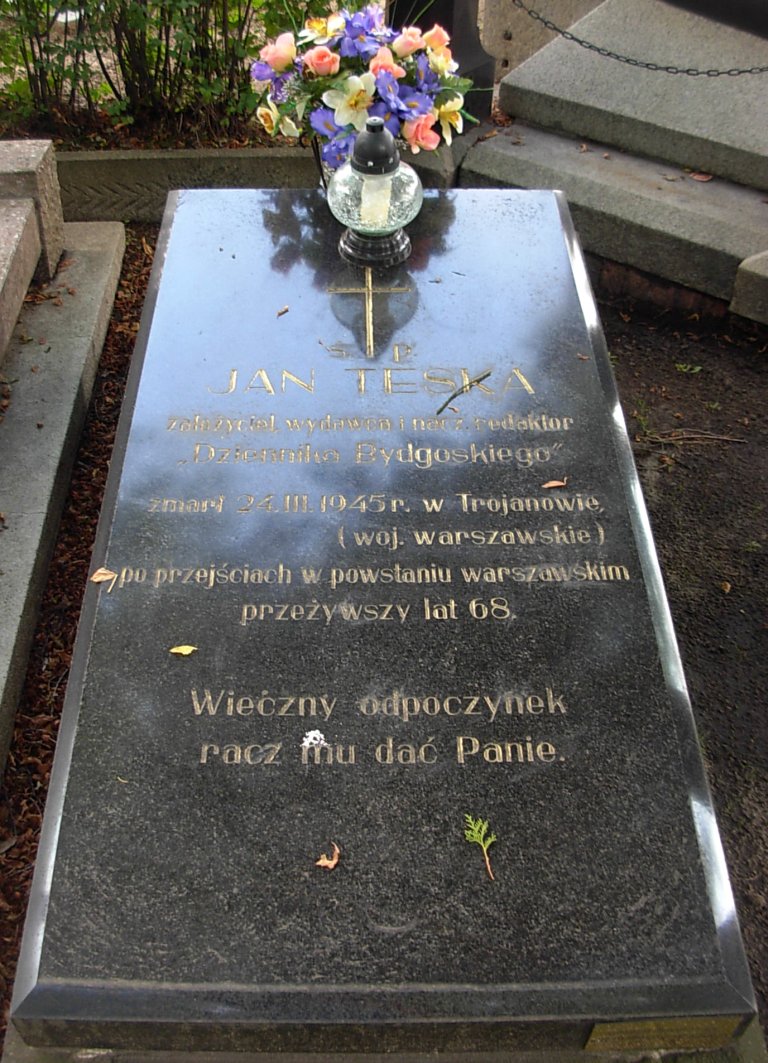
Unfortunately, Jan Teska died on 24 March 1945 in Trojanów near Sochaczew, before the inaugural meeting of this council. His body, interred in Sochaczew, was exhumed and reburied on 19 May 1945 at the Nowofarny Cemetery of Bydgoszcz.
0 comentarii1 vizualizări0 reacții
Jan Teskaa lăsat un gând
acum 3 ore
Political activity His initial political views were significantly influenced by a group of activists of the bourgeois movement, gathered around the "Orędownik" magazine, where he worked from 1900. Once editor of the "Dziennik Bydgoski", Jan Teska proclaimed, in line with his thoughts, that the newspaper would be "an outpost of national defense, a new fortification against the flood of Germans". He addressed his articles to the people, small merchants, craftsmen, workers, peasants and considered Prosperity to be the main driving force of social progress, achieved by the improvement of trade and industry. From 1905 onward, he actively cooperated with the "Guard" (Polish: Straża), a self-defense association in the Province of Posen. Teska also championed the creation of: a "National People's Party" branch in Bydgoszcz in 1911; a local "Związek Samopomocy Ludu Polskiego" (English: Self-defence Union of the Polish People) in 1913. After World War I, Teska became permanently associated with the Christian-democratic movement and its rapid development in the region. In 1922, he was a co-organizer of the Christian Trade Unions in Bydgoszcz. Until the Second World War, Bydgoszcz Christian-democratic movement was the strongest political group in the city and in the 1930s it became the second most important Christian…
0 comentarii1 vizualizări0 reacții
Jan Teskaa lăsat un gând
acum 3 ore
Wincentyna Teskowa Jan Teska was married to Wincentyna, born on 29 September 1888 in Poznań from Wiktoria née Marszały and Wincenty Winiewicz, a worker. She and Teska married in 1905: she funded the publication of the first issues of "Dziennik Bydgoski" with the 4000 Marks of her wedding dowry. Until 1920, she used to manage the publishing house on her own when her husband was serving justice sentences for "insults to the Prussian authorities". During the First World War, Wincentyna performed the duties of the publishing house's administrator while cooperating with local female writers, Stefania Tuchołkowa and Alina Prus-Krzemińska. Her management proved to be successful, as "Dziennik Bydgoski" gained new readers during the war years. Like Jan, Wincentyna was also active in social and charitable activities: from 1907 onward, she took part in the "Reading Rooms for Women" Society (Polish: Towarzystwo Czytelni dla Kobiet); in 1908, she co-founded the "Sokolic" club in Bydgoszcz; between 1918 and 1920, she was a member of the Polish People's Council of Bydgoszcz urban area; during the Greater Poland Uprising, together with Stefania Tuchołkowa and Apolonia Ziółkowska, she organized the passage of volunteers towards the insurgency. On 27 November 1929 she was awarded the Officer's…
0 comentarii1 vizualizări0 reacții
Jan Teskaa lăsat un gând
acum 3 ore
Commemorations
A street in Bydgoszcz, in the Fordon district, was named after Jan Teska.
In 1996, a commemorative plaque to honor Jan Teska was placed on the wall of the former printing house of the "Dziennik Bydgoski", at 52 Długa Street in Bydgoszcz.
On September 21, 2022, a commemorative plaque to Wincentyna Teskowa was unveiled on the building of the Delegation of the Institute of National Remembrance in Bydgoszcz.
0 comentarii1 vizualizări0 reacții
Jan Teskaa lăsat un gând
acum 3 ore
Bibliography
(in Polish) Błażejewski Stanisław, Kutta Janusz, Romaniuk Marek (1994). Bydgoski Słownik Biograficzny. Tom I. Bydgoszcz: Wojewódzki Ośrodek Kultury. p. 113. ISBN 8385327320.
(in Polish) Jeleniewski, Marek K. (2012). Życie społeczno-polityczne XX-lecia międzywojennego w świetle polskiej prasy w Bydgoszczy. Bydgoszcz: Wydawnictwo Uniwersytetu Kazimierza Wielkiego. p. 113. ISBN 978-83-7096-869-4.
(in Polish) Jeleniewski, Marek K. (2009). Wielojęzyczna bydgoska prasa lokalna do 1939 roku. Bydgoszcz : miasto wielu kultur i narodowości. Bydgoszcz: Przedsiębiorstwo Marketingowe Logo. pp. 199–215. ISBN 978-83-87586-98-0.
(in Polish) Exhibition Wincentyna Teskowa (1888-1957), Anna Nadolska, Instytut Pamięci Narodowej, Bydgoszcz 2022.