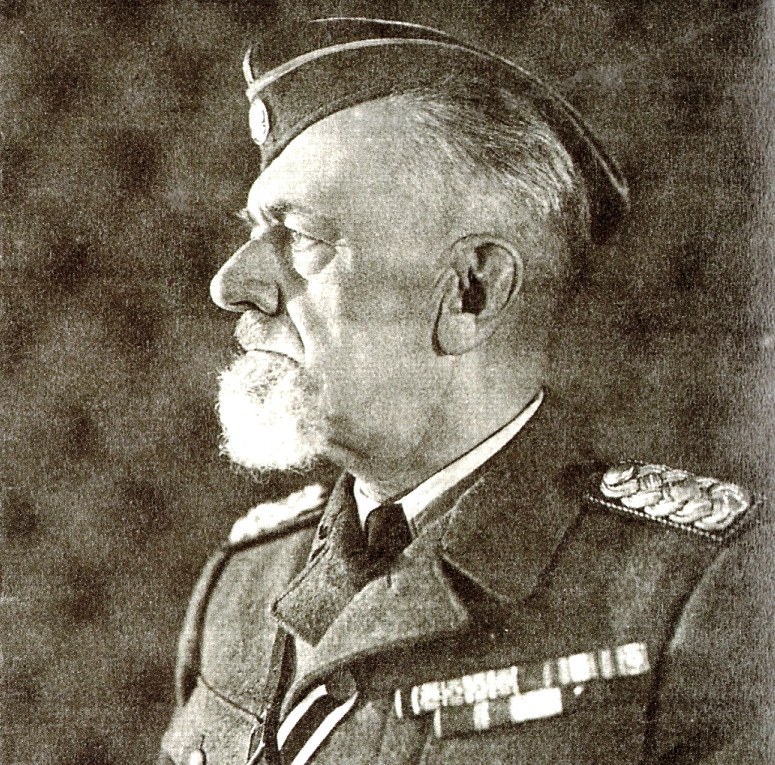
Leon Rupnik, also known as Lav Rupnik or Lev Rupnik (August 10, 1880 – September 4, 1946) was a Slovene general in the Kingdom of Yugoslavia who collaborated with the Fascist Italian and Nazi German occupation forces during World War II. Rupnik served as the President of the Provincial Government of the Nazi-occupied Province of Ljubljana from November 1943 to early May 1945. Between September 1944 and early May 1945, he also served as chief inspector of the Slovene Home Guard (Slovene: Domobranci), a collaborationist militia, although he did not have any military command until the last month
Leon Rupnik, also known as Lav Rupnik or Lev Rupnik (August 10, 1880 – September 4, 1946) was a Slovene general in the Kingdom of Yugoslavia who collaborated with the Fascist Italian and Nazi German occupation forces during World War II. Rupnik served as the President of the Provincial Government of the Nazi-occupied Province of Ljubljana from November 1943 to early May 1945. Between September 1944 and early May 1945, he also served as chief inspector of the Slovene Home Guard (Slovene: Domobranci), a collaborationist militia, although he did not have any military command until the last month of the war.
0 comentarii0 vizualizări0 reacții
Leon Rupnika adăugat o fotografie
acum 4 ore
R.I.P Leon
Early career
Rupnik was born in Lokve near Gorizia, a village in what was then the Austrian county of Gorizia and Gradisca (now part of Nova Gorica, southwestern Slovenia). A career soldier, from 1895 to 1899 he studied at the infantry military academy in Trieste and graduated as a junior second lieutenant. His schooling continued in Vienna from 1905 to 1907. After World War I, he joined the Royal Yugoslav Army in May 1919 with the rank of active staff major. He thereafter climbed the ranks, becoming a lieutenant-colonel (1923), colonel (1927), brigadier general (1933) and major general (1937). When the Wehrmacht invaded the Kingdom of Yugoslavia on April 6, 1941, Rupnik was Chief of Staff of 1st Army Group.
0 comentarii0 vizualizări0 reacții
Leon Rupnika adăugat o fotografie
acum 4 ore
R.I.P Leon
The Rupnik Line
After the Third Reich and the Kingdom of Italy had formed the Axis alliance, the Kingdom of Yugoslavia decided to construct a line of fortresses along the borders to defend itself against possible attacks from the north and the west. The constructions was mostly carried out on the border with Italy in the Drava Banovina. The line was initially staffed by 15,000, but the number increased to 40,000 by 1941. As Rupnik was in charge of their completion, the 'Rupnik Line' became the common name for these fortifications.
The defences were built on the French Maginot Line and Czechoslovak models, adapted to local conditions. After the invasion of Yugoslavia on April 6, 1941, few of them were ready and the German Wehrmacht campaign quickly rendered the line obsolete.
0 comentarii0 vizualizări0 reacții
Leon Rupnika adăugat o fotografie
acum 4 ore
R.I.P Leon
Collaboration After the quick defeat of the Royal Yugoslav Army, Rupnik was released from German military prison and moved to Italian-annexed southern Slovenia (known as the Province of Ljubljana) on April 17, 1941. On June 7, 1942, he accepted the position of president of the Provincial Council of Ljubljana, thus replacing Juro Adlešič as mayor under Italian annexation. After the Italian armistice in September 1943, Ljubljana was occupied by the Germans. Friedrich Rainer, Nazi Gauleiter of Carinthia, nominated Rupnik as president of the new provincial government, after a consultation with Roman Catholic Bishop Gregorij Rožman, who agreed with Rainer's intention to put Rupnik in charge of the provisional government. Bishop Rožman praised Rupnik highly, stating he was "the most capable man for this administrative position". Friedrich Rainer also proposed the creation of the Home Guard, which functioned under the command of SS Lieutenant-General, Erwin Rösener, who in turn reported directly to SS Chief, Heinrich Himmler. Together with Anton Kokalj, Ernest Peterlin and Janko Kregar, Rupnik was also one of the founders of the Slovene Home Guard, an auxiliary military unit of the SS, formed as a voluntary militia to fight the partisan resistance movement. The militia was organized mostly by…
0 comentarii0 vizualizări0 reacții
Leon Rupnika lăsat un gând
acum 4 ore
Anti-Semitism Known for his antisemitic and openly pro-Nazi views prior to the war, Rupnik was a notorious anti-Semite, who wrote anti-Semitic tracts and made anti-Semitic speeches. Some notable examples include: In a lecture he gave in Ljubljana in 1944, entitled "Bolshevism: a tool of international Judaism" and subtitled "Jewish endeavours towards global supremacy", Rupnik stated:The Jews' straight dogmatic hatred of all who are not Jewish is finally challenged everywhere by a revolt by the home nation that sooner or later removes all parasites from their country or limits by law their economic, religious and political activity. (A transcript of the entire lecture is available.) In a lecture at Polhov Gradec, on June 5, 1944, Rupnik stated: With solid trust in the righteousness of the leader of Europe, of the German nation, we must calmly and with all fanaticism lead the battle against Jewish global supremacy serving Stalin’s and Tito’s bandits and their assistants, Anglo-American gangsters. At the ceremony where the Home Guard swore oaths of allegiance, on January 30, 1945, Rupnik announced:If the German soldier and you, my bold Home Guard soldiers, allowed these Jewish mercenaries to flourish, they would yet kill all decent thinkers, believers in the nation and…
0 comentarii0 vizualizări0 reacții
Leon Rupnika lăsat un gând
acum 4 ore
Arrest, trial, and execution On May 5, 1945, Leon Rupnik fled to Austria with a small group of 20 collaborators. He was arrested by the British on July 23 and returned to Yugoslavia in January 1946. He was put on trial alongside Rösener and others, and was sentenced to death for treason on August 30, 1946. He was executed by firing squad on September 4, 1946 at Ljubljana's Žale cemetery, and was buried the same day in an unmarked grave. In January 2020 the Supreme Court of Slovenia annulled the court judgement of 1946 for not meeting the necessary legal standards in force at the time of trial. In response the Simon Wiesenthal Center issued a condemnation of the annulment, stating that Rupnik "played a major role in the arrest and deportation of Jews from Ljubljana in 1943 and 1944". They further noted "This shameful decision constitutes a shocking distortion of the history of the Holocaust and a horrific insult to Rupnik's many victims and their families. We kindly request that you promptly convey our protest to the pertinent Slovenian authorities so that the proper measures can be taken to undo the enormous damage wrought by this unjust decision of…
0 comentarii0 vizualizări0 reacții
Leon Rupnika lăsat un gând
acum 4 ore
Other
Rupnik's son, Vuk, was an active officer of the Slovene Home Guard and commander of one of the most belligerent units in the militia.