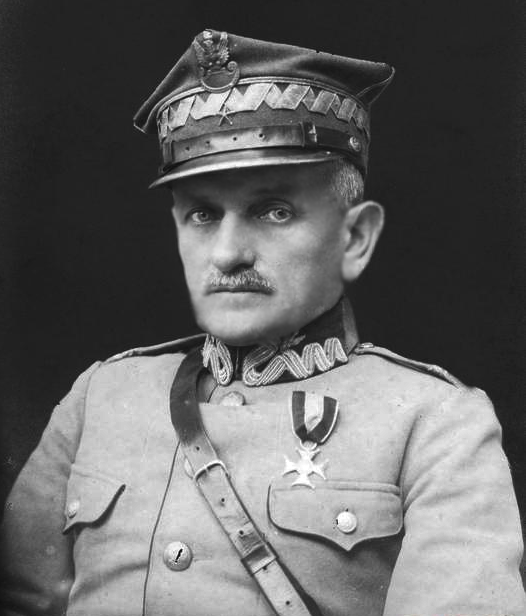
Leonard Wilhelm Skierski (26 April 1866 – spring 1940) was a Polish military officer. He was a general of the Imperial Russian Army and then served in the Polish Army. He fought in World War I and in the Polish–Soviet War. He is a victim of the Katyn massacre of 1940 and was murdered by the NKVD in Kharkov in the Ukrainian Soviet Socialist Republic. He is one of fourteen Polish generals and one of the oldest military commanders to be a victim of the Katyn massacre.
Leonard Wilhelm Skierski (26 April 1866 – spring 1940) was a Polish military officer. He was a general of the Imperial Russian Army and then served in the Polish Army. He fought in World War I and in the Polish–Soviet War. He is a victim of the Katyn massacre of 1940 and was murdered by the NKVD in Kharkov in the Ukrainian Soviet Socialist Republic. He is one of fourteen Polish generals and one of the oldest military commanders to be a victim of the Katyn massacre. Imperial Russian Army and World War I Leonard Wilhelm Skierski was born in Stopnica near Kielce in Russian-ruled Congress Poland, into an old Polish aristocratic Calvinist family of Puchała coat of arms. His parents were Henryk Skierski and Helena née Hassman. His younger brother Stefan Skierski became the superintendent (bishop) of the Polish Reformed Church. Early in his youth Skierski graduated from a philological school in Kielce and joined the Cadet Corps in Voronezh. As a Protestant, Skierski was not a subject to severe laws concerning Polish Catholics serving in the Russian Army and was able to advance there. On 1 September 1884, he joined the Mikhailov's College of Artillery in Saint Petersburg.…
0 comentarii1 vizualizări0 reacții
Leonard Skierskia adăugat o fotografie
ieri
R.I.P Leonard
Independent Poland On 15 May 1919, Skierski joined the Polish Army. As the Polish armed forces lacked high-ranking officers, he was instantly promoted to the rank of lieutenant general (Polish: generał porucznik). On 30 May, Skierski was assigned to the 7th Infantry Division stationed in Silesia during the Silesian Uprisings; the unit saw no combat. After the cessation of hostilities on that front, on 10 August Skierski became commander of the 1st Rifle Division of General Józef Haller's Blue Army. His formation took part in heavy fighting in Volhynia during the final stages of the Polish–Ukrainian War. On 15 September 1919, the division was fully integrated with the Polish command system and renamed to 13th Infantry Division. Early in his Polish Army service, Skierski became known as a skilled and flexible commander of infantry units; he was also highly popular among his troops. Because of that, Polish Commander-in-chief Józef Piłsudski used Skierski in important front sectors of the Polish–Soviet War. In December 1919, Skierski was withdrawn from the front and assigned to the 4th Infantry Division. In the spring of 1920, his unit took part in the Kiev offensive, in which the Polish forces reached the city of Kiev. From…