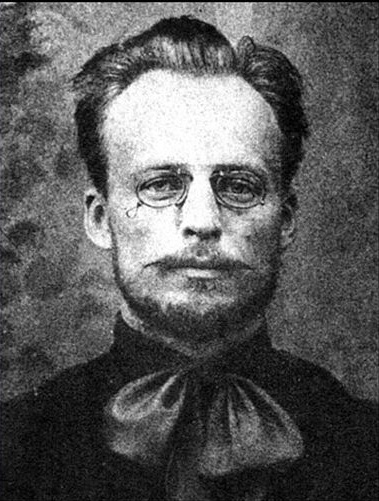
Alexander Konstantinovich Bogomazov (Russian: Алекса́ндр Константи́нович Богома́зов) or Oleksandr Kostiantynovych Bohomazov (Ukrainian: Олекса́ндр Костянти́нович Богома́зов; March 26, 1880 – June 3, 1930) was a Ukrainian painter, cubo-futurist, modern art theoretician and is recognised as one of the key figures of the Ukrainian avant-garde scene. In 1914, Oleksandr wrote his treatise The Art of Painting and the Elements. In it he analyzed the interaction between Object, Artist, Picture, and Spectator and sets the theoretical foundation of modern art. During his artistic life Oleksandr Bohomazo
Alexander Konstantinovich Bogomazov (Russian: Алекса́ндр Константи́нович Богома́зов) or Oleksandr Kostiantynovych Bohomazov (Ukrainian: Олекса́ндр Костянти́нович Богома́зов; March 26, 1880 – June 3, 1930) was a Ukrainian painter, cubo-futurist, modern art theoretician and is recognised as one of the key figures of the Ukrainian avant-garde scene. In 1914, Oleksandr wrote his treatise The Art of Painting and the Elements. In it he analyzed the interaction between Object, Artist, Picture, and Spectator and sets the theoretical foundation of modern art. During his artistic life Oleksandr Bohomazov mastered several art styles. The most known are Cubo-Futurism (1913–1917) and Spectralism (1920–1930).
0 comentarii0 vizualizări0 reacții
Oleksandr Bohomazova adăugat o fotografie
acum 3 ore
R.I.P Oleksandr
Early life Oleksandr Bohomazov was born in Yampil, Kharkiv Region (now Sumy Oblast, Ukraine) as a second child to Kostiantyn & Anisia Bohomazov's. The artist's father was an accountant, who worked at the local sugar factory and later rose to the status of a merchant. The boy hardly knew his mother – she left the family and remarried a visiting military officer. Oleksandr started to show early interest in painting while studying at the gymnasium. However, his father did not approve of his style, considering it too raw, and insisted that the boy graduate from the Kherson Agricultural School, where he majored in agronomy from 1896 to 1902. But the passion for art prevailed, and with the support of his uncle, Oleksandr, convinces his father to allow him to move to Kyiv and enter the Kyiv Academy of Arts in 1902. In Kyiv Art School, Bohomazov was taught by Oleksandr Murashko and Ivan Seleznev, while Oleksandra Ekster and Oleksandr Arkhypenko, future stars of the avant-garde, studied with him. In 1905, he was expelled from the school due to his participation in political demonstrations and strikes. As of 1906, he studied in the Kyiv studio of Serhiy Sviatoslavskyi and spent the…
0 comentarii0 vizualizări0 reacții
Oleksandr Bohomazova adăugat o fotografie
acum 3 ore
R.I.P Oleksandr
The Finnish Cycle, 1911 In June 1911, while working part-time in the newspaper Kyivska Dumka (Kyivan Thought), Bohomazov was sent on a business trip to Karelia (back then, Russian Empire, now Finland & Russia), to create paintings and prints of Finnish landscapes for an illustrated supplement to the newspaper. For one and a half months Bohomazov was travelling along the touristic route along Imatra, Lappeenranta, Vyborg, Punkaharju, Savonlinna. This trip resulted in dozens of paintings, watercolours, and inks. The exact number is unknown, and nowadays, the Finnish Cycle is spread out among private collectors and museums. While visiting Imatra, he painted 'The Tower’ (NAMU) and ‘A Castle in Finland’ (collection of K.Grygoryshyn), both depicting the famous architectural marvel of Grand Hotel de Cascade (now Valtionhotelli). The hotel was built in the form of a castle in Art Nouveau style and is reminiscent of Olavinlinna fortress situated on the other side of Lake Saimaa. Another object of painter's attention were the famous rapids Imatrankoski and Vallinkoski. Bohomazov became very fond of them and was enjoying the peaceful Finnish landscapes, which were in tune with artist's inner world. ‘I was painting Little Imatra in oil, a few days ago (Another name for…
0 comentarii0 vizualizări0 reacții
Oleksandr Bohomazova adăugat o fotografie
acum 3 ore
R.I.P Oleksandr
Cubo-Futurism Period, 1913–1915 Years of 1913–14 became a time of the artist's intense search for ways to develop "new art". In September 1914, Bohomazov finished the theoretical work "Painting and Its Elements", which summarised his reflections on the nature of creativity and its components. The works belonging to the year 1913 were created by Bohomazov, when the main provisions included in his theoretical work had not yet been thought out and formulated, but the style and form-creating elements of these works testify that the master was already familiar with various artistic directions of avant-garde art, in particular and with the futuristic concept of displaying the state of the environment through the demonstration of the movement of the objects that made it. In the works of this time, he intuitively, rather than consciously, uses a number of techniques that enhance the feeling of movement and convey the dynamism of the depicted object. So, for example, he actively uses a bundle of straight lines that converge and, in turn, form certain ray- and fan-like forms that create a powerful effect of movement. At the same time, the artist often uses such a technique as extending straight lines along their entire length and…
0 comentarii0 vizualizări0 reacții
Oleksandr Bohomazova adăugat o fotografie
acum 3 ore
R.I.P Oleksandr
Life in Caucasus, 1915-1917
From 1915 until the end of 1917, Bohomazov lived in the Caucasus. He worked as a teacher of painting and drawing in the village of Geryusy (now the city of Goris, Armenia). ‘The air is clear, you can see for miles, and everything seems in blossom,’ he wrote to his wife. Works from his productive stay include a bright 1915 painting The Caucasus and a 1916 charcoal View of the Caucasus as seen from his balcony. The picturesque nature of the Caucasus region had inspired Bohomazov to create numerous other cubo-futuristic canvases, which were later on collated under the cycle 'Memories of Caucasus'. For some time, his wife Wanda stayed with him in Geryusy.
After returning to Kyiv in the end of 1917, Bohomazov starts teaching across numerous high schools and art academies, to be able to support his family financially.
0 comentarii0 vizualizări0 reacții
Oleksandr Bohomazova lăsat un gând
acum 3 ore
Introducing Spectralism, 'The Sawmill', late 1910s–1920s In 1917, the anti-Establishment artist welcomed the ideas of October Revolution, joining Olexandra Exter in Agitprop decoration of trains and boats. Yet, contrary to the later development and interpretation of Bolshevik Revolution, he saw the fall of Russian Empire and the ideas of revolution as contributing to the release of Ukrainian national artistic potential, and in tune with the proclamation of Ukrainian Independence of 1917-18. His speech to the first All-Ukrainian Artists’ Congress in June 1918 was that of a fiercely patriotic artist, slamming art schools for sticking to ‘guidelines from the North’ (i.e. Russia) where ‘the spirit of Academism destroys the mind’ and young Ukrainian artists had been ‘deprived of their individuality, while their souls poisoned’. While teaching, Bohomazov continues with his analysis of art theory throughout the 1920s, creating his own colour charts, exploring the effect of contrast in variation of colour tonalities. Whilst Bohomazov's theories remain to be further thoroughly studied, his innovative ideas were formalised in 1927 as part of the set course at the Kyiv Art Institute. Same year, he became the founding member of the Association of the Revolutionary Masters of Ukraine (ARMU), together with David Burliuk, Vadym…
0 comentarii0 vizualizări0 reacții
Oleksandr Bohomazova lăsat un gând
acum 3 ore
Personal life Bohomazov met his wife Wanda Monastyrska, also an artist, in 1908 in Kyiv Academy of Arts, where both were studying. Being in an emotionally low period in his life due to break up with his father, who disapproved of his choice of career and refused to help him materially, meeting Wanda was a true rescue for the artist. Oleksandr was smitten with Wanda on first sight but, initially, she rejected him. Yet, after years of Bohomazov's efforts, their relationship grew, and gradually Wanda became not only Bohomazov's main inspiration, but also his biggest support. The couple married in 1913 in Boyarka. In 1917, Wanda gave birth to their daughter, Yaroslava. Their marriage sparked Bohomazov's creative genius, making 1913–15 his most creatively productive period. Oleksandr painted his wife on more than 30 occasions and the evolution of their relationship can be tracked through Bohomazov's portrayals of his wife. While the initial portraits of Wanda from 1908 to 1911 were very gentle and touching, the 1914 view of Wanda reading is more daring (they were now married). By 1915, his images of Wanda had evolved into something far stronger, more confident and sexually charged. Around 1920, Oleksandr caught tuberculosis, which…
0 comentarii0 vizualizări0 reacții
Oleksandr Bohomazova lăsat un gând
acum 4 ore
Theoretical Work & Teaching Bohomazov's theoretical work deserves a separate outmost recognition. In 1914, while living in the small suburban town of Boyarka, near Kyiv, the artist wrote a treatise called "Painting and Its Elements". In it, Bohomazov traced the genesis of the artistic form, which arises from the moment of movement of its primary element – the dot. Referring to the elements of painting — line, form, painting mass, environment, etc., Bohomazov operates with these concepts, understanding them in dynamics, analysing painting as a complex system that is constantly changing, living according to its internal laws. In "Painting and Its Elements", for the first time, rhythm is considered not only as a quantitative, but also a qualitative category, and this was a groundbreaking discovery of the artist. The treatise explains how the artistic personality translates the pace and rhythm of everyday life into the language of painting. It shows how a tranquil picture plane is filled with agitated lines and pictorial forms, with a charge of mobile energy, in much the same manner as our relaxed psyche is agitated and filled with the rhythm of lines and forms of the object which we contemplate. Rhythm has a psychological aspect:…
0 comentarii0 vizualizări0 reacții
Oleksandr Bohomazova lăsat un gând
acum 4 ore
International Recognition After artist's death, his name in Soviet Union was forgotten, his works being exposed just once in 1966 in Writers' Union House in Kyiv in the exhibition "Graphics and Art of Oleksandr Bohomazov". Until the early 1970s, the work of Oleksandr Bohomazov remained ignored not only by the Western art historians but also by those of Ukraine. At the end of 1973, thanks to the intermediary of Ukrainian colleagues from Kyiv, French-Bulgarian art researcher Andréi Nakov was able to gain access to Bohomazov's studio, which, at the time, was in the hands of his widow. Impressed by the futurist work of the artist, he spoke about it on several occasions and published the first brief studies devoted to Bohomazov in 1973, 1977 and later in 1992 in Western European editorials. For the first time his works appeared outside Kyiv only in 1973, when several of them were included in the exhibition Tatlin’s Dream at Fischer Fine Art in London. Following the fall of the Berlin Wall, and Ukraine's independence, broader exhibition of his work became possible. In 1991 his paintings were exhibited at the Musée d’Art Moderne in Toulouse, whose director Alain Mousseigne not only shared Andréi Nakov's…
0 comentarii0 vizualizări0 reacții
Oleksandr Bohomazova lăsat un gând
acum 4 ore
Literature A.Bohomazov. Painting and Elements. Comp.T.Popova. (Parallel text in Ukrainian and English.) Kyiv. 1996. – 152 p. ISBN 996-532-001-7 {{isbn}}: ignored ISBN errors (link), LCCN 2003-481219 Oleksandr Bohomazov, 1880–1930 : kataloh tvoriv (Catalogue of works, Ukraine/English). Kyiv: Harant, 1991. LCCN 2003-500490 Mudrak, Myroslava M. “The Painted Surface in the Ukrainian Avant-garde: from Facture to Construction.” Pantheon 45 (1987): 138–43. Nakov, Andrei. “De l’expression futuriste au formalisme construit,” 13–24, in Alexandre Bogomazov, Jampol, 1880 – Kyiv, 1930 . Musee d’Art Moderne, Refectoire des Jacobins, Toulouse . N.p.: Editions Arpap, 1991. Exhibition Avangarde & Ukraine. 6 May – 11 July 1993. Villa Stuck Munich, Germany. Catalogue, 200p: ISBN 3-7814-0346-7 Exhibition L'art en Ukraine. 28 October 1993 – 17 January 1994. Musée des Augustins de Toulouse, France. Catalogue (160 p): ISBN 2-901820-07-7 John E.Bowlt. N.D.Lobanov-Rostovsky. Katalog-rezone Khudozhniki Russkogo Teatra / Catalogue-raisonne Painters of Russian theatre. 1880–1930. Collection of Nikita and Nina Lobanov-Rostovsky. In Russian, 156 colour and 1026 b/w illustrations. 1994. – 528 p. ISBN 5-210-00233-0 The phenomenon of the Ukrainian avant-garde, 1910-1935 / Phénomène de l’avant-garde ukrainienne, 1910–1935. Edited by Myroslav Shkandrij. (Parallel text in English, Ukrainian and French.) 196 p. Winnipeg, Man. : Winnipeg Art Gallery, 2001. ISBN 978-0-88915-208-3 Kyiv to…
0 comentarii0 vizualizări0 reacții
Oleksandr Bohomazova lăsat un gând
acum 4 ore
Alexander Bogomazov
Andrei Nakov, Art Historian, about Alexander Bogomazov
James Butterwick: Alexander Bogomazov uartlib.org, englisch (pdf)
0 comentarii0 vizualizări0 reacții
Oleksandr Bohomazova lăsat un gând
acum 4 ore
Alexander Bogomazov: Ukrainian Picasso
A.Bogomazov. Painting and Elements. 1914. (scanned from О.Богомазов / A.Bogomazov. Живопис та Елементи / Painting and Elements. Kyiv, 1996). For non-commercial use only