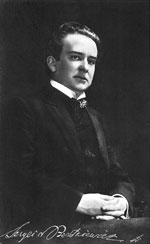
Sergei Eduardovich Bortkiewicz (28 February 1877 [O.S. 16 February] – 25 October 1952) was a Romantic composer and pianist. He moved to Vienna in 1922 and became a naturalized Austrian citizen in 1926.
Sergei Eduardovich Bortkiewicz (28 February 1877 [O.S. 16 February] – 25 October 1952) was a Romantic composer and pianist. He moved to Vienna in 1922 and became a naturalized Austrian citizen in 1926.
0 comentarii0 vizualizări0 reacții
Sergei Bortkiewicza adăugat o fotografie
acum o oră
R.I.P Sergei
Early life and origins Sergei Eduardovich Bortkiewicz was born in Kharkov in the Russian Empire (present-day Kharkiv, Ukraine), on 28 February 1877 to parents Edward and Zofia (née Uszyńska) Bortkiewicz, who were Polish nobility. He spent most of his childhood on the family estate of Artiomovka, near Kharkov. Bortkiewicz received his musical training from Anatoly Lyadov and Karel van Ark at the Imperial Conservatory of Music in Saint Petersburg. In 1900, he left Saint Petersburg and travelled to Leipzig, where he became a student of Alfred Reisenauer and Salomon Jadassohn, both pupils of Franz Liszt. In July 1902, Bortkiewicz completed his studies at the Leipzig Conservatory and was awarded the Schumann Prize on graduation. On his return to the Russian Empire in 1904, he married Elisabeth Geraklitowa, a friend of his sister, and then returned to Germany, where he settled in Berlin. It was there that he started to compose seriously. From 1904 until 1914, Bortkiewicz continued to live in Berlin but spent his summers visiting his family or travelling around Europe on concert tours. For a year he also taught at the Klindworth-Scharwenka Conservatory. There he met the Dutch pianist Hugo van Dalen, who became a lifelong friend. Van…
0 comentarii0 vizualizări0 reacții
Sergei Bortkiewicza adăugat o fotografie
acum o oră
R.I.P Sergei
First World War
The outbreak of World War I in 1914 changed Bortkiewicz's life. As Russian citizens, he and his wife were both placed under house arrest, then deported from Germany to Russia, via Scandinavia. He returned to Kharkov, where he established himself as a music teacher, and also gave concerts.
The latter years of the war saw the beginning of the Russian Revolution, which forced the composer and his family to flee their estate at Artiomovka due to occupation by the Bolsheviks. In June 1919, the Bolsheviks fled before the White Army and Bortkiewicz was able to return and help rebuild the family estate, which had been completely plundered. While Bortkiewicz traveled to Yalta with his wife, Kharkov fell to the Red Army, which meant that he and his family could not return to Artiomovka. With the area now surrounded by the Red Army, the composer watched his mother and the husband of his sister Vera fall ill with typhus, both dying in the chaos at Novorossiysk. Bortkiewicz sought to escape from Yalta and succeeded in obtaining passage on the steamer Konstantin, which brought them safe, but impoverished, to Constantinople in November 1919.
0 comentarii0 vizualizări0 reacții
Sergei Bortkiewicza lăsat un gând
acum o oră
Between the wars In Constantinople, with the help of the court pianist to the Sultan, Ilen Ilegey, Bortkiewicz began to give concerts and started teaching again. He became well known throughout a number of embassies and made the acquaintance of the wife of the Yugoslavian ambassador Natalie Chaponitsch, to whom he dedicated his Trois Morceaux, Op. 24 (1922). She organised musical gatherings for Bortkiewicz within the embassy, and it was with the help of her husband that the composer and his wife were able to obtain a visa for Yugoslavia. Bortkiewicz and his wife came to Sofia via Belgrade, where they had to wait for some time before obtaining an Austrian visa. On 22 July 1922, the composer and his wife reached Austria. Initially Bortkiewicz chose Baden as his residence, where he remained until 1923. He then moved and settled in Vienna, where he was to remain for the next five years. In 1926 he obtained Austrian citizenship. In 1928, Bortkiewicz went to Paris for six months and then returned to live in Berlin. In 1933, he was forced to leave Germany again—being a Russian he was now facing persecution from the Nazis and saw his name being deleted from…
0 comentarii0 vizualizări0 reacții
Sergei Bortkiewicza lăsat un gând
acum o oră
Second World War World War II profoundly affected Bortkiewicz and his wife. At the end of the war he described in a letter dated 8 December 1945 to his friend Hans Ankwicz-Kleehoven how he still lived: I'm writing to you from my bathroom where we have crawled in because it is small and can be warmed on and off with a gas light. (!) The other rooms cannot be used and I cannot touch my piano. This is now! What awaits us further? Life is becoming more and more unpleasant, merciless. I teach at the Conservatory with the heat at 4 degrees, soon even less! During this period he composed a number of works including his Piano Sonata No. 2, Op. 60. The sonata was first performed by the composer on 29 November 1942 in the Brahmssaal of the Musikverein in Vienna. Hugo van Dalen gave the Dutch premiere on 9 February 1944 in Amsterdam. The war negatively impacted Bortkiewicz's finances. Most of his printed compositions were held by his German publishers Rahter & Litolff; they were destroyed in Allied bombing, resulting in the loss of all his income from the sale of his music. The health of Bortkiewicz and…
0 comentarii0 vizualizări0 reacții
Sergei Bortkiewicza lăsat un gând
acum o oră
After the War In the autumn of 1945, Bortkiewicz was appointed director of a master class at the Vienna City Conservatory, which helped to give the composer some of the financial security he so sought. During this period he composed his Six Preludes, Op. 66 (1946–47), of which only two—Numbers 1 and 3—have so far been located. These preludes are dedicated to the Dutch pianist Hélène Mulholland (1912–2000), who helped him after the war by sending much needed food and clothes. After his retirement in 1948, the community of Vienna awarded him an honorary pension. At the instigation of Hans Ankwicz-Kleehoven, a Bortkiewicz Society was founded in 1947 in Vienna in order to keep the memory of Bortkiewicz's music alive. The inaugural meeting took place in the library hall of the Akademie at Schillerplatz on 10 April 1947. As a result of that meeting, on the first Monday of each month from November to May, friends of the composer and members of the Society gathered in the Künstlerhaus and listened to concerts of the composer's music, much of which was played by Bortkiewicz himself. The Bortkiewicz Society was dissolved on 6 March 1973. On 26 February 1952, the Bortkiewicz Society…
0 comentarii0 vizualizări0 reacții
Sergei Bortkiewicza lăsat un gând
acum o oră
Nationality
According to Jeremiah A. Johnson, Bortkiewicz referred to himself as Russian, his country of origin as "Little Russia" or "South Russia", and Kharkov as its intellectual capital. Johnson also said that Bortkiewicz opposed Ukrainian independence.
However, some other modern authors regard Bortkiewicz as either a Ukrainian composer (particularly Yi Jing Chen; Y. O. Levkulych), or as Ukrainian-born (Emma Scanlon).
0 comentarii0 vizualizări0 reacții
Sergei Bortkiewicza lăsat un gând
acum o oră
Works
Bortkiewicz's piano style was influenced by Franz Liszt, Frédéric Chopin, Tchaikovsky, Sergei Rachmaninoff, early Scriabin, Wagner, and Ukrainian folklore. The composer never saw himself as a modernist, as can be seen from his Künstlerisches Glaubensbekenntnis (artistic credo), written in 1923.
0 comentarii0 vizualizări0 reacții
Sergei Bortkiewicza lăsat un gând
acum o oră
According to Boris Schwarz:
[Bortkiewicz's] craftsmanship was meticulous, his imagination colorful and sensitive, his piano writing idiomatic; a lush instrumentation underlines the essential sentimentality of his melodic invention ... Bortkiewicz mastered the skills of the past without adding anything distinctly personal or original ...Johnson discussed certain elements of Ukrainian folk culture influenced Bortkiewicz's work.
When van Dalen died in 1967, he bequeathed to his family manuscripts of several Bortkiewicz compositions and an autobiography Erinnerungen (published in German in Musik des Ostens, 1971, pp. 136–69, in Dutch by Hugo van Dalen in De Zevende Dag, July–August 1939, and in English by B. N. Thadani, Recollections, 2nd ed., Cantext, 2001). A number of letters and printed scores were donated to the Gemeentemuseum in The Hague, which later became part of the collection of the Netherlands Music Institute. The latter has the only existing copy of the manuscript of the Piano Sonata No. 2, Op. 60, and of two of the Preludes, Op. 66.
0 comentarii0 vizualizări0 reacții
Sergei Bortkiewicza lăsat un gând
acum o oră
Recordings
Symphonies Nos. 1 and 2. BBC Scottish Symphony Orchestra, Martyn Brabbins (Hyperion)
Piano Concerto No. 1 in B-flat major, Op. 16. Marjorie Mitchell (piano), Vienna State Opera Orchestra, William Strickland (American Decca – Brunswick UK)
Piano Concerto No. 1 in B-flat major, Op. 16. Stephen Coombs (piano), BBC Scottish Symphony Orchestra, Jerzy Maksymiuk (Hyperion)
Pieces for Violin and Piano. Christian Persinaru (violin) and Nils Franke (piano) (Apex).
Complete Piano works. Jouni Somero (FC-Records, in nine volumes)
Complete Piano Music. Klaas Trapman (Piano Classics, six CDs)
Piano works. Stephen Coombs (Hyperion, in two volumes)
0 comentarii0 vizualizări0 reacții
Sergei Bortkiewicza lăsat un gând
acum o oră
Piano pieces. Anna Reznik (Classical Recordings)
Piano Concertos Nos. 2 and 3. Stefan Doniga (piano), Janáček Philharmonic Orchestra, David Porcelijn (Netherlands Muziek Instituut)
Violin Concerto in D minor, Op. 22. Dutton Recording CDLX7323 Royal Scottish National Orchestra, Marin Yates (conductor), Sergey Levitin (violin)
Symphonic Poem after Shakespeare's Othello, Op. 19. Dutton Recording CDLX7323 Royal Scottish National Orchestra, Marin Yates (conductor)
0 comentarii0 vizualizări0 reacții
Sergei Bortkiewicza lăsat un gând
acum o oră
Cited sources Chen, Yi Jing (August 2021). The First Movements of Sergei Bortkiewicz's Two Piano Sonatas, Op. 9 and Op. 60: A Comparison including Schenkerian Analysis and an Examination of Classical and Romantic Influences (Doctor of Musical Arts dissertation). Denton, Texas: University of North Texas. p. 4. Retrieved 21 October 2023. Johnson, Jeremiah A. (October 2016). Echoes of the Past: Stylistic and Compositional Influences in the Music of Sergei Bortkiewicz (Doctor of Musical Arts). University of Nebraska–Lincoln. Kościelak-Nadolska, Agnieszka (2016). "Życie i twórczość Sergiusza Bortkiewicza (1877–1952), cz. I: Sylwetka artysty" [The life and work of Sergiusz Bortkiewicz (1877–1952), part. I: Profile of the artist]. Notes Muzyczny. 1. Levkulych, Y. O. (2021). ДФОРТЕПІАННА СПАДЩИНА СЕРГІЯ БОРТКЕВИЧАУ АКТУАЛЬНОМУ ПРОСТОРІ ВИКОНАВСЬКОГОМИСТЕЦТВА ХХ – ПОЧАТКУ ХХІ СТОЛІТТЯ [The piano heritage by Sergei Bortkiewicz in the current space of the performing arts of the 20th – early 21st century] (PDF) (Thesis) (in Ukrainian). Kiyv: National Music Academy of Ukraine. Scanlon, Emma (October 2017). Pianism Reimagined: an analytical inquiry of left-hand piano through the career and commissions of Paul Wittgenstein (PDF) (PhD thesis). Maynooth University. Schwarz, Boris (20 January 2001). "Bortkiewicz [Bortkievich], Sergei [Sergey] Eduardovich". Grove Music Online. revised by Sigrid Wiesmann (8th ed.). Oxford University…
0 comentarii0 vizualizări0 reacții
Sergei Bortkiewicza lăsat un gând
acum o oră
Nederlands Muziek Instituut (in Dutch)
Free scores by Sergei Bortkiewicz at the International Music Score Library Project (IMSLP)