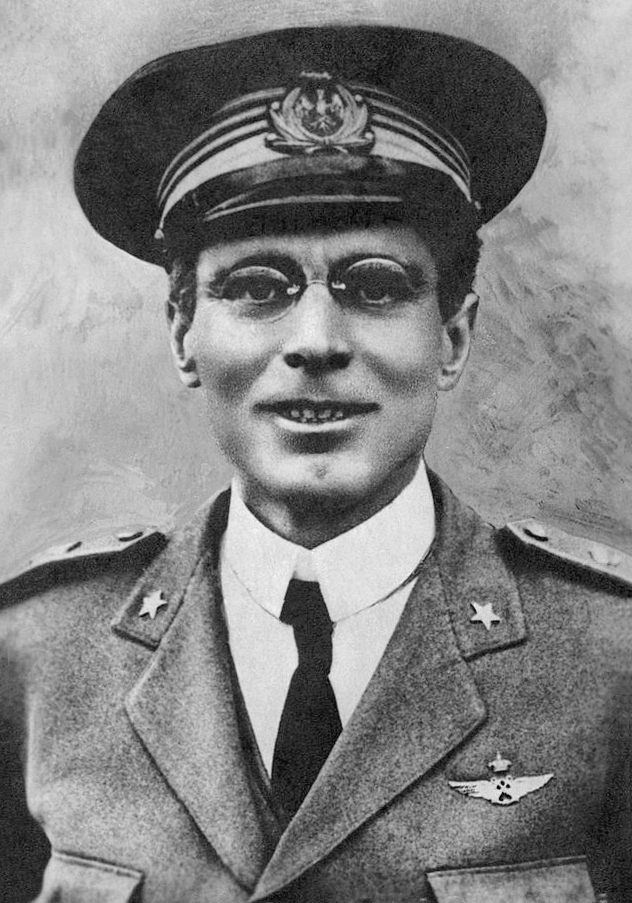
Umberto Nobile (Italian pronunciation: [umˈbɛrto ˈnɔːbile]; 21 January 1885 – 30 July 1978) was an Italian aviator, aeronautical engineer and Arctic explorer. Nobile was a developer and promoter of semi-rigid airships in the years between the two World Wars. He is primarily remembered for designing and piloting the airship Norge, which may have been the first aircraft to reach the North Pole, and which was indisputably the first to fly across the polar ice cap from Europe to America. Nobile also designed and flew the Italia, a second polar airship; this second expedition ended in a deadly cras
Umberto Nobile (Italian pronunciation: [umˈbɛrto ˈnɔːbile]; 21 January 1885 – 30 July 1978) was an Italian aviator, aeronautical engineer and Arctic explorer.
Nobile was a developer and promoter of semi-rigid airships in the years between the two World Wars. He is primarily remembered for designing and piloting the airship Norge, which may have been the first aircraft to reach the North Pole, and which was indisputably the first to fly across the polar ice cap from Europe to America. Nobile also designed and flew the Italia, a second polar airship; this second expedition ended in a deadly crash and provoked an international rescue effort, some participants of which also lost their lives or went missing and presumed dead.
0 comentarii0 vizualizări0 reacții
Umberto Nobilea adăugat o fotografie
acum 2 ore
R.I.P Umberto
Early career Umberto Nobile was born in Lauro, in the southern Italian province of Avellino, into a family of small landowners. His father Vincenzo, a civil servant, belonged to the cadet branch of an aristocratic family that had been stripped of its titles after the Italian unification over their continuing loyalty to the deposed Bourbons, and which had adopted the Nobile surname for that reason. After graduating from the University of Naples in 1908 with a degree in industrial engineering, Nobile was hired by the Italian state railways. In 1911 his interests turned to the field of aeronautical engineering and he enrolled into a course offered by the Italian Army's Engineers Corps. During World War I he served as a military engineer, working at the Military Factory for Aeronautical Construction and Experience (Stabilimento Militare di Costruzioni ed Esperienze Aeronautiche) in Rome. During this time he designed airships designed for anti-submarine reconnaissance, 15 of which would be built after the war, and taught courses for aspiring officers. In 1918 he designed the first Italian-made parachute. He was director of the Factory from 1919 until 1927. He also lectured at the University of Naples, obtained his test pilot's license and wrote the…
0 comentarii0 vizualizări0 reacții
Umberto Nobilea adăugat o fotografie
acum 2 ore
R.I.P Umberto
Norge In late 1925, Norwegian explorer Roald Amundsen sought out Nobile to collaborate on a flight to the North Pole – still at that time an unachieved goal for aviators – using an airship. Amundsen had previously in early 1925 flown to within 150 nautical miles (280 km) of the North Pole, in a pair of Italian-built Dornier Wal flying boats along with the American millionaire-adventurer Lincoln Ellsworth and the pilot Hjalmar Riiser-Larsen, but their planes were forced to land near 88 degrees North, and the six men were trapped on the ice for 30 days. The Italian State Airship Factory, which had built Nobile's N-1, made it available for the expedition 29 March 1926. Amundsen insisted in the contract that Nobile should be the pilot and that five of the crew should be Italian; Amundsen named the airship Norge (Norway). On 14 April the airship left Italy for Leningrad in Russia with stops at Pulham (England) and Oslo. On its way towards its Arctic jumping-off point, Ny-Ålesund (Kings Bay) at Vestspitsbergen, Svalbard (belonging to Norway) it also made a stop at the airship mast at Vadsø (Northern Norway). On 29 April 1926, Amundsen was dismayed at the arrival of…
0 comentarii0 vizualizări0 reacții
Umberto Nobilea adăugat o fotografie
acum 2 ore
R.I.P Umberto
Italia Despite the controversy, Nobile continued to maintain good relations with other polar scientists, and he started planning a new expedition, this time fully under Italian control. Nobile's company managed to sell the N-3 airship to Japan; however, relations between Nobile and his competitors in the fascist government were hostile, and he and his staff were subjected to threats and intimidation. Nobile's popularity with the public meant he was, for the moment, safe from direct attack. When the plans for his next expedition were announced, Italo Balbo is said to have commented, "Let him go, for he cannot possibly come back to bother us anymore." The Italia, nearly identical to the Norge, was slowly completed and equipped for Polar flight during 1927–28. Part of the difficulty was in raising private funding to cover the costs of the expedition, which finally was financed by the city of Milan; the Italian government limited its direct participation to providing the airship and sending the aging steamer Città di Milano as a support vessel to Svalbard, under the command of Giuseppe Romagna. This time the airship used a German hangar at Stolp en route to Svalbard and the mast at Vadsø (Northern Norway). On…
0 comentarii0 vizualizări0 reacții
Umberto Nobilea adăugat o fotografie
acum 2 ore
R.I.P Umberto
Controversial search and rescue In the wake of the crash, a collection of nations, including the Soviet Union, Norway, Sweden, Finland, and Italy, launched the first polar air and sea rescue effort. Privately owned ships which had been chartered by polar scientists and explorers also participated. Even Roald Amundsen put aside his past differences with Nobile and boarded a French seaplane and headed for the rescue headquarters; this plane disappeared between Tromsø and Svalbard, and though a pontoon from the craft was later found, the bodies of Amundsen, the pilot René Guilbaud and the four others on board were not. After a month of privation for the Italia survivors, the first rescue plane, a Swedish Air Force Fokker C.V-E ski plane, piloted by Lieutenant Einar Lundborg, with Lieutenant Schyberg as observer, landed near the crash site. Nobile had prepared a detailed evacuation plan, with the most seriously wounded man (the heavy built mechanic Cecioni) at the top of the list and himself as number 4, with the navigator (Viglieri) and the radio operator (Biagi) as respectively no. 5 and 6. However, Lundborg refused to take anyone but Nobile. He argued that the plane could only take one survivor and the…
0 comentarii0 vizualizări0 reacții
Umberto Nobilea lăsat un gând
acum 2 ore
Later life In July 1931, Nobile took part in the expedition of the Soviet icebreaker Malygin to Franz Josef Land and the northern Kara Sea. He moved to the Soviet Union in 1932, and lived there for nearly five years to work on the Soviet semi-rigid airship program. Few details of the program have been documented, but Nobile supervised the manufacturing of three airships, including SSSR-V6 OSOAVIAKhIM, and designed two others that were intended for military use. Nobile returned to Italy in December 1936, after he had been appointed as a member of the Pontificial Academy of Sciences. For a few months he also worked on aviation projects with Caproni, including methods to recover from a spin and an aircraft that could carry a MAS (motorboat) or a tank. Due to the hostility of the Fascist government, Nobile moved to the United States in 1939 to teach at Lewis University (at the time called Lewis Holy Name School of Aeronautics due to its aviation-focused curriculum) in Romeoville and in Chicago. He was permitted to remain in the US after Italy declared war on the United States, but declined the offer of US citizenship and opted to return to Europe in…
0 comentarii0 vizualizări0 reacții
Umberto Nobilea lăsat un gând
acum 2 ore
Personal life
Nobile was married to Carlotta Ferraiolo, daughter of a wealthy notary from Teano and ten years his senior, from 1916 until her death in 1934. Together they had a daughter. In 1959 he remarried with Gertrude Stolp, a German woman whom he had met in Spain in 1943 and who later became chief librarian at the headquarters of the Food and Agriculture Organization in Rome.
0 comentarii0 vizualizări0 reacții
Umberto Nobilea lăsat un gând
acum 2 ore
Timeline of hydrogen technologies
Enrico Forlanini – another Italian designer of semi-rigid airships