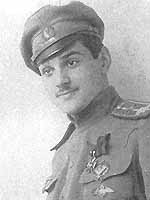
Cavalry Second Lieutenant Yury Vladimirovich Gilsher (Russian: Ю́рий Влади́мирович Ги́лшер) (27 November 1894 – 20 July 1917) was a Russian fighter ace of World War I. Initially a cavalryman, but then an airman, Gilsher overcame two serious injuries to become an ace. After suffering a fracture of both bones in his right forearm, he later lost a foot to amputation because of a crash. He returned to duty with a prosthetic foot. Gilsher rose to his unit's command and scored five victories between April and July 1917 before being killed in action on 20 July 1917.
Cavalry Second Lieutenant Yury Vladimirovich Gilsher (Russian: Ю́рий Влади́мирович Ги́лшер) (27 November 1894 – 20 July 1917) was a Russian fighter ace of World War I. Initially a cavalryman, but then an airman, Gilsher overcame two serious injuries to become an ace. After suffering a fracture of both bones in his right forearm, he later lost a foot to amputation because of a crash. He returned to duty with a prosthetic foot. Gilsher rose to his unit's command and scored five victories between April and July 1917 before being killed in action on 20 July 1917.
0 comentarii1 vizualizări0 reacții
Yury Gilshera adăugat o fotografie
acum 7 ore
R.I.P Yury
Early life and cavalry service
Gilsher was born in Moscow, the Russian Empire, on 27 November 1894, to a noble family. He was educated at Moscow's Alexeyevskoye Commercial School.
Bucking the traditions of his social class, he enrolled in university and studied civil engineering instead of joining the military. He graduated in early 1914. however upon the outbreak of war he volunteered for the Imperial Russian Army, He trained as a cavalryman at the Nicholas Cavalry College, in which he enrolled on 13 December 1914. He graduated from the Saint Petersburg school as a Praporshchik on 14 June 1915. His class's equestrian maneuvers had several times been disrupted by overflying aircraft spooking horses and cadets alike.
0 comentarii1 vizualizări0 reacții
Yury Gilshera lăsat un gând
acum 7 ore
Aviation career While he was still in cavalry training, Gilsher applied for a transfer to aviation. On 16 June 1915, he was forwarded to aviation training at the Gatchina Flying School. He graduated on 21 October 1915, and was posted to the 4th Army Air Detachment. Nine days later, he was designated as a military pilot. On 9 November, the new unit moved forward into combat. However, Gilsher's career suffered a setback on 20 November when a propeller fractured both bones in his right forearm while he was starting an aircraft engine. He was removed from the unit and assigned to Moscow's Dux aircraft factory as a quality control inspector until he healed. After recovery, he underwent advanced flight training on fighters in Odessa during February 1916 and returned to active service on 21 March 1916, posted to the 7th Fighter Aviation Detachment. The unit transferred to combat duty at Tarnopol. On 12 April 1916, Gilsher was promoted to Kornet. On 10 May 1916, Gilsher and his aerial observer flew a sortie in Sikorsky S-16 serial no. 201. They attacked a German Aviatik B.III and downed it. Upon their return to base, the fighter plane went into a spin at…
0 comentarii1 vizualizări0 reacții
Yury Gilshera lăsat un gând
acum 7 ore
Decorations
Order of St. Vladimir, 4th Class with Swords and Bow: ca 10 May 1916
Order of St. George, 4th Class: 28 May 1917
Order of St. Anne, 4th Class: 2 June 1917
Gold Sword for Bravery: 4 December 1917
0 comentarii1 vizualizări0 reacții
Yury Gilshera lăsat un gând
acum 7 ore
List of aerial victories
See also Aerial victory standards of World War I, List of World War I flying aces from the Russian Empire
Confirmed victories are numbered and listed chronologically.