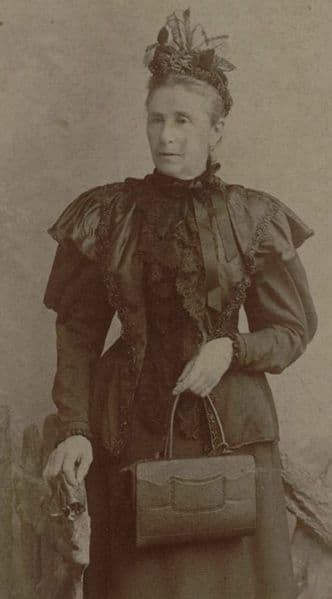
Amalia Malka Nathansohn Freud (née Nathansohn; 18 August 1835 – 12 September 1930) was the mother of Sigmund Freud. She was born in Brody in the Kingdom of Galicia and Lodomeria to Jakob Nathanson and Sara Wilenz and later grew up in Odesa, where her mother came from (both cities are located in modern-day Ukraine). She was married to Jacob Freud in 1855. Amalia Freud died of tuberculosis in Vienna at the age of 95.
Amalia Malka Nathansohn Freud (née Nathansohn; 18 August 1835 – 12 September 1930) was the mother of Sigmund Freud. She was born in Brody in the Kingdom of Galicia and Lodomeria to Jakob Nathanson and Sara Wilenz and later grew up in Odesa, where her mother came from (both cities are located in modern-day Ukraine). She was married to Jacob Freud in 1855.
Amalia Freud died of tuberculosis in Vienna at the age of 95.
0 comentarii0 reacții
Amalia Freuda adăugat o fotografie
acum 3 luni
R.I.P Amalia
Children
On 6 May 1856, when Amalia Freud was still 20 years old, she gave birth to her first child by her husband Jacob Freud, Sigmund Schlomo, who became a famous neurologist and the founder of psychoanalysis.
Amalia was almost always pregnant in the decade following Sigmund's birth, giving birth to seven more children in just nine years, of which six lived to adulthood. However, none of her other children became as renowned as their eldest brother. They are enumerated below in the consecutive order of their births:
Julius (October 1857 – 15 April 1858), died in infancy
Anna (31 December 1858 – 11 March 1955)
Regina Debora "Rosa" (born on 21 March 1860, deported to Treblinka on 23 September 1942)
Marie "Mitzi" (born on 22 March 1861, deported to Treblinka on 23 September 1942)
Esther Adolfine "Dolfi" (23 July 1862 – 5 February 1943 in Theresienstadt)
Pauline Regine "Pauli" (born on 3 May 1864, deported to Treblinka on 23 September 1942)
Alexander Gotthold Efraim (19 April 1866 – 23 April 1943)
0 comentarii0 reacții
Amalia Freuda adăugat o fotografie
acum 3 luni
R.I.P Amalia
Character
Amalia was considered by her grandchildren to be an intelligent, strong-willed, quick-tempered but egotistical personality. Ernest Jones saw her as lively and humorous, with a strong attachment to her eldest son whom she called "mein goldener Sigi".
0 comentarii0 reacții
Amalia Freuda lăsat un gând
acum 3 luni
Relationship with eldest son
Just as Amalia idolised her eldest son, so there is evidence that the latter in turn idealised his mother, whose domineering hold over his life he never fully analysed. He did however recount a railway journey with her at the age of 4 amongst his earliest memories and also recalled her instruction in German reading and writing. Late in life, he would term the mother-son relationship "the most perfect, the most free from ambivalence of all human relationships. A mother can transfer to her son the ambition she has been obliged to suppress in herself". His tendency to split off and repudiate hostile elements in the relationship would be repeated with significant figures in his life such as his fiancée and Wilhelm Fliess.
0 comentarii0 reacții
Amalia Freuda lăsat un gând
acum 3 luni
Freud and his mother
Freud and his mother Amalia, in her apartment in Vienna, 5 May 1926