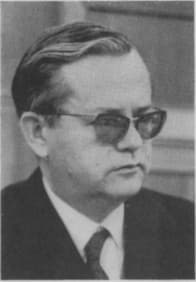
Blaže Koneski (Macedonian and Serbian: Блаже Конески; 19 December 1921 – 7 December 1993) was a Macedonian poet, writer, literary translator, and linguistic scholar, who had a major contribution to the codification of the standard Macedonian language, for which he earned the reputation of father of the Macedonian literary language. He is the key figure who shaped Macedonian literature and intellectual life in the country. During his life and after his death, Koneski has been accused of deliberately serbianizing the Macedonian standard.
Blaže Koneski (Macedonian and Serbian: Блаже Конески; 19 December 1921 – 7 December 1993) was a Macedonian poet, writer, literary translator, and linguistic scholar, who had a major contribution to the codification of the standard Macedonian language, for which he earned the reputation of father of the Macedonian literary language. He is the key figure who shaped Macedonian literature and intellectual life in the country. During his life and after his death, Koneski has been accused of deliberately serbianizing the Macedonian standard.
0 comentarii0 reacții
Blaže Koneskia adăugat o fotografie
acum 3 luni
R.I.P Blaže
Early years Koneski was born on 19 December 1921 in Nebregovo, near Prilep, in the province of South Serbia, part of the Kingdom of Serbs, Croats and Slovenes (current-day North Macedonia), in a pro-Serbian family. He belonged to the Ljamevci family, whose Slava (patron saint) was St. Nicholas Day. His maternal uncle, Serbian Chetnik Gligor Sokolović, was one of the champions of Serbian propaganda in Ottoman Macedonia in the early 20th century. According to Koneski himself, his village became oriented towards the Serbian propaganda in the early 20th century and Sokolović was responsible for this shift. However, per Koneski, this shift was not nationally motivated and his family did not raise him as a Serbian, rather he always felt as a Macedonian. Per the Macedonian Bulgarian authors Dragi Dragnev and Kosta Tsarnushanov, Konevski was born as Blagoje Ordan Ljameski or Ljamević in a family that was strongly pro-Serbian and identified as Serbian. According to historian Chris Kostov, in his youth, he regarded Serbian as his native language. The Internal Macedonian Revolutionary Organization revolutionary Traycho Chundev described him in his diary as a "Serboman" who insists on the Serbian alphabet. He studied in his native village and Prilep. After receiving a…
0 comentarii0 reacții
Blaže Koneskia adăugat o fotografie
acum 3 luni
R.I.P Blaže
Early codification of Macedonian A Commission for the Establishment of the Macedonian Language, Alphabet and Orthography was tasked with establishing an alphabet and a standardized language, with three linguistic commissions of ASNOM functioning from 1944 to 1945. At the age of 22, he was nominated to join the commission. He was the youngest member of the commission and had the most recent education in Slavic linguistics then. A conflict emerged between Koneski and Venko Markovski. The letter yer divided Markovski and Koneski, which the former supported and the latter opposed. Koneski advocated for the full adoption of the Serbian Cyrillic alphabet. Slavist Victor Friedman has said that Koneski advocated for the adoption of Serbian Cyrillic on purely linguistic and pedagogical grounds. Koneski argued that at the time most Macedonians were educated with this orthography and insisted that any other choice would make them illiterate. Most members of the commission wanted to create a distinct Macedonian alphabet. There were long debates over the dorsopalatals kj and gj. Koneski proposed the signs for their Serbian palatal equivalents (ћ and ђ), but other members perceived them as "too Serbian." Vasil Iljoski convinced him that he was being "politically naive" in endorsing the use…
0 comentarii0 reacții
Blaže Koneskia adăugat o fotografie
acum 3 luni
R.I.P Blaže
Later work Koneski came up with a new interpretation of national history, distinguishing the Macedonian revival from the Bulgarian revival. Combining the Marxist socioeconomic analytical perspective with the post-romantic national discourse, Koneski sought to de-Bulgarianize history and language, perceiving the Macedonian national consciousness as antagonistic to the Bulgarian national consciousness. In 1945, he worked as a lector in the Macedonian National Theater. As part of the theater, Koneski translated Othello by William Shakespeare, the works by Ivo Andrić and Vjekoslav Kaleb. He also translated poetry from German (works by Friedrich Gottlieb Klopstock, Johann Wolfgang Goethe, Friedrich Schiller, Friedrich Hölderlin, Heinrich Heine), Russian (works by Alexander Blok and Vladimir Mayakovsky), Serbo-Croatian (works by Petar Petrović Njegoš and Desanka Maksimović), Czech (works by Karel Jaromir Erben and Jan Neruda), Polish (works by Adam Mickiewicz, Juliusz Słowacki, Leopold Staff, Julian Tuwim, Tadeusz Różewicz), Slovenian (works by France Prešeren), and Bulgarian (works by Lazar Poptraykov and Nikola Yonkov Vaptsarov). On behalf of the ministry, he was included in a group that was to arrange the establishment of the Faculty of Philosophy. In 1946, he began working as a lecturer at the Department of Macedonian Language in the newly established Faculty of Philosophy. He was…
0 comentarii0 reacții
Blaže Koneskia adăugat o fotografie
acum 3 luni
R.I.P Blaže
Literary works and awards
Koneski wrote poetry and prose. His collections of poetry include: Mostot, Pesni, Zemjata i ljubovta, Vezilka, Zapisi, Cesmite, Stari i novi pesni, Seizmograf, among others. He also wrote a collection of short stories named Vineyard Macedonian: Lozje. His 1948 poem Teškoto (named after the dance Teškoto) is taught in Macedonian elementary schools.
Koneski won a number of literary prizes such as the AVNOJ prize, the Njegoš prize, the Golden Wreath ("Zlaten Venec") of the Struga Poetry Evenings (in 1981), the Award of the Writer's Union of the USSR, Herder Prize (in 1971) and others.
0 comentarii0 reacții
Blaže Koneskia lăsat un gând
acum 3 luni
Legacy In December 1993, shortly after Koneski's death, the doyen of Macedonian historians Blaže Ristovski criticized Koneski's alphabet and insisted on its reform, demanding changes in the Macedonian letters, with the proposed changes being described as Bulgarophilic. By the late 1990s, writers and journalists, who were close to the VMRO-DPMNE and pro-Bulgarian, made Serbification accusations against him, denouncing the Macedonian national identity in the same way as Bulgaria. They regarded Koneski as a "Serbian agent" and glorified his opponent Markovski. The Faculty of Philology at the University of Skopje was named after him on 26 March 1997. His birthplace has been transformed into a memorial and educational center in North Macedonia. A Macedonian Historical Dictionary was published, edited by historian Stojan Kiselinovski from Greek Macedonia, which caused a public scandal due to the entry for Koneski, where instead of emphasizing his historical contribution, it simply stated that Koneski "advocated the use of the Serbian alphabet (that of Vuk Karadžić) in Macedonia." According to Bulgarian historian Tchavdar Marinov, it is nearly a taboo topic in North Macedonia to point out the Serbophilia of the Yugoslav Macedonian builders of the Macedonian language and national identity as Koneski, and this is considered there…