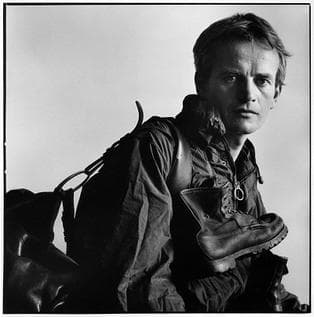
Charles Bruce Chatwin (13 May 1940 – 18 January 1989) was an English travel writer, novelist and journalist. His first book, In Patagonia (1977), established Chatwin as a travel writer, although he considered himself instead a storyteller, interested in bringing to light unusual tales. He won the James Tait Black Memorial Prize for his novel On the Black Hill (1982), while his novel Utz (1988) was shortlisted for the Booker Prize. In 2008 The Times ranked Chatwin as number 46 on their list of "50 Greatest British Writers Since 1945". Chatwin was born in Sheffield. After completing his secondar
Charles Bruce Chatwin (13 May 1940 – 18 January 1989) was an English travel writer, novelist and journalist. His first book, In Patagonia (1977), established Chatwin as a travel writer, although he considered himself instead a storyteller, interested in bringing to light unusual tales. He won the James Tait Black Memorial Prize for his novel On the Black Hill (1982), while his novel Utz (1988) was shortlisted for the Booker Prize. In 2008 The Times ranked Chatwin as number 46 on their list of "50 Greatest British Writers Since 1945". Chatwin was born in Sheffield. After completing his secondary education at Marlborough College, he went to work at the age of 18 at Sotheby's in London, where he gained an extensive knowledge of art and eventually ran the auction house's Antiquities and Impressionist Art departments. In 1966 he left Sotheby's to read archaeology at the University of Edinburgh, but he abandoned his studies after two years to pursue a career as a writer. The Sunday Times Magazine hired Chatwin in 1972. He travelled the world for work and interviewed figures such as the politicians Indira Gandhi and André Malraux. He left the magazine in 1974 to visit Argentina and Chile,…
0 comentarii0 reacții
Bruce Chatwina adăugat o fotografie
acum 3 luni
R.I.P Bruce
Early years Chatwin was born on 13 May 1940 at the Shearwood Road Nursing Home in Sheffield, England, to Charles Leslie Chatwin, a Birmingham solicitor and Royal Naval Reserve officer during World War II, and Margharita (née Turnell), daughter of a Sheffield knife manufacturer's clerk. She was born in Sheffield and worked for the local Conservative party prior to her marriage. The Chatwin family were well known in Birmingham, with Charles Chatwin's grandfather, Julius Alfred Chatwin, an eminent architect. Chatwin's early years were spent moving regularly with his mother while his father was at sea. Prior to his birth, Chatwin's parents had lived at Barnt Green, Worcestershire, but Margharita moved to her parents' house in Dronfield, near Sheffield, shortly before giving birth. Mother and son remained there for a few weeks. Worried about The Blitz, Margharita sought a safer place to stay. She took her son with her as they travelled to stay with various relatives during the war. They would remain in one place until Margharita decided to move, either because of concern for their safety, or because of friction among family members. Later in life Chatwin recalled of the war, "Home, if we had one, was a solid…
0 comentarii0 reacții
Bruce Chatwina adăugat o fotografie
acum 3 luni
R.I.P Bruce
Art and archaeology In 1958, Chatwin moved to London to begin work as a porter in the Works of Art department at Sotheby's. Chatwin was ill-suited for this job, which included dusting objects that had been kept in storage. Sotheby's moved him to a junior cataloguer position, working in both the Antiquities and Impressionist Art departments. This position enabled him to develop his eye for art, and he quickly became known for his ability to discern forgeries. His work as a cataloguer also taught him to describe objects in a concise manner and required him to research these objects. Chatwin advanced to become Sotheby's expert on Antiquities and Impressionist art and would later run both departments. Many of Chatwin's colleagues thought he would eventually become chairman of the auction house. During this period Chatwin travelled extensively for his job and also for adventure. Travel offered him a relief from the British class system, which he found stifling. An admirer of Robert Byron and his book, The Road to Oxiana, he travelled twice to Afghanistan. He also used these trips to visit markets and shops, where he would buy antiques that he would resell at a profit in order to supplement…
0 comentarii0 reacții
Bruce Chatwina lăsat un gând
acum 3 luni
The Nomadic Alternative Following his departure from Edinburgh, Chatwin decided to pursue a career as a writer, successfully pitching a book proposal on nomads to Tom Maschler, publisher at Jonathan Cape. Chatwin tentatively titled the book The Nomadic Alternative and sought to answer the question "Why do men wander rather than stand still?" Chatwin delivered the manuscript in 1972, and Maschler declined to publish it, calling it a "chore to read". Between 1969 and 1972, as he was working on The Nomadic Alternative, Chatwin travelled extensively and pursued other endeavours in an attempt to establish a creative career. He co-curated an exhibit on Nomadic Art of the Asian Steppes, which opened at Asia House Gallery in New York City in 1970. He considered publishing an account of his 1969 trip to Afghanistan with Peter Levi. Levi published his own book about it, The Light Garden of the Angel King: Journeys in Afghanistan (1972). Chatwin contributed two articles on nomads to Vogue and another article to History Today. In the early 1970s Chatwin had an affair with James Ivory, a film director. Ivory gives an account of this in his memoir, Solid Ivory. He pitched stories to him for possible films,…
0 comentarii0 reacții
Bruce Chatwina lăsat un gând
acum 3 luni
Ouidah and the Black Hill Upon his return from Patagonia, Chatwin discovered a change in leadership at The Sunday Times Magazine and his retainer was discontinued. Chatwin intended his next project to be a biography of Francisco Félix de Sousa, a 19th-century slave trader born in Brazil, who became the Viceroy of Ouidah in Dahomey. Chatwin had first heard of de Sousa during a visit to Dahomey in 1972. He returned to the country, by then renamed the People's Republic of Benin, in December 1976 to conduct research. In January 1977, during the 1977 Benin coup d'état attempt, Chatwin was accused of being a mercenary and detained for three days. Chatwin later wrote about this experience in "A Coup – A Story", which was published in Granta and included in What Am I Doing Here? (1989). Following his arrest and release, Chatwin left Benin and went to Brazil to continue his research on de Sousa. Frustrated by the lack of documented information on de Sousa, Chatwin chose instead to write a fictionalised biography of him, The Viceroy of Ouidah. This book was published in 1980, and Werner Herzog's film Cobra Verde (1987) is based on it. Although The Viceroy of…
0 comentarii0 reacții
Bruce Chatwina lăsat un gând
acum 3 luni
The Songlines In 1983 Chatwin returned to the topic of nomads and decided to focus on Aboriginal Australians. He was influenced by the work of Ted Strehlow, the author of Songs of Central Australia. Strehlow had collected and recorded Aboriginal songs, but he became a controversial figure when, shortly before his death in 1978, he sold photographs of secret Aboriginal initiation ceremonies to a magazine. Chatwin went to Australia to learn more about Aboriginal culture, specifically the songlines or dreaming tracks. Each songline is a personal story and functions as a creation tale and a map, and each Aboriginal Australian has their own songline. Chatwin thought the songlines could be used as a metaphor to support his ideas about humans' need to wander, which he believed was genetic. However, he struggled fully to understand and describe the songlines and their place in Aboriginal culture. This was due to Chatwin's approach to learning about the songlines. He spent several weeks in 1983 and 1984 in Australia, during which he primarily relied on non-Aboriginal people for information, as he was limited by his inability to speak the Aboriginal languages. He interviewed people involved in the Land Rights movement, and he alienated many…
0 comentarii0 reacții
Bruce Chatwina lăsat un gând
acum 3 luni
Illness and final works While at work on The Songlines between 1983 and 1986, Chatwin frequently came down with colds. He also developed skin lesions that may have been symptoms of Kaposi's sarcoma. After finishing The Songlines in August 1986, he went to Switzerland, where he collapsed in the street. At a clinic there, he was diagnosed as HIV-positive. Chatwin provided different reasons to his doctors as to how he might have contracted HIV, including from a gang rape in Dahomey or possibly from Sam Wagstaff, the patron and lover of Robert Mapplethorpe. Chatwin's case was unusual as he had a fungal infection, Talaromyces marneffei, which at the time had rarely been seen and only in South Asia. It is now known as an AIDS-defining illness, but in 1986 little was known about HIV and AIDS. Doctors were not certain if all cases of HIV developed into AIDS. The rare fungus gave Chatwin hope that he might be different and served as the basis of what he told most people about his illness. He gave various reasons for how he became infected with the fungus – ranging from eating a thousand-year-old egg to exploring a bat cave in Indonesia. He…
0 comentarii0 reacții
Bruce Chatwina lăsat un gând
acum 3 luni
Writing style John Updike described Chatwin's writing as "a clipped, lapidary prose that compresses worlds into pages", while one of Chatwin's editors, Susannah Clapp, wrote, "Although his syntax was pared down, his words were not – or at least not only – plain.... His prose is both spare and flamboyant." Chatwin's writing was shaped by his work as a cataloguer at Sotheby's, which provided him with years of practice in writing concise, yet vivid descriptions of objects with the intention of enticing buyers. In addition, his writing was influenced by his interest in nomads. One aspect that interested him was the few possessions they had. Their Spartan way of life appealed to his ascetic sense, and he sought to emulate it in his life and his writing, striving to strip needless objects from his life and needless words from his prose. Chatwin experimented with format in his writing. With In Patagonia, Clapp said Chatwin described the book's structure of 97 vignettes as "Cubist". "[I]n other words," she said, "lots of small pictures tilting away and toward each other to create this strange original portrait of Patagonia." The Songlines was another attempt by Chatwin to experiment with format. It begins as…
0 comentarii0 reacții
Bruce Chatwina lăsat un gând
acum 3 luni
Themes Chatwin explored several different themes in his work: human restlessness and wandering; borders and exile; and art and objects. He considered human restlessness to be the focus of his writing. He ultimately aspired to explore the subject in order to answer what he saw as a fundamental question of human existence. He thought humans were meant to be a migratory species, and once they settled in one place, their natural urges "found outlets in violence, greed, status-seeking or a mania for the new." In his first attempt at writing a book, The Nomadic Alternative, Chatwin had tried to compose an academic exposition on nomadic culture, which he believed was unexamined and unappreciated. With this, Chatwin had hoped to discover: "Why do men wander rather than sit still?" In his book proposal he admitted that the interest in the subject was personal: "Why do I become restless after a month in a single place, unbearable after two?" Although Chatwin did not succeed with The Nomadic Alternative, he returned to the topic of restlessness and wandering in subsequent books. Writer Jonathan Chatwin (no relation) stated that Chatwin's works can be grouped into two categories: "restlessness defined" and "restlessness explained." Most of…
0 comentarii0 reacții
Bruce Chatwina lăsat un gând
acum 3 luni
Influence With the publication of In Patagonia, Chatwin invigorated the genre of travel writing; according to his biographer, Nicholas Murray, he "showed that an inventive writer could breathe new life into an old genre." The combination of his clear, yet vivid prose and an international perspective at a time when many English writers were more focused on home instead of abroad helped to set him apart. Aside from his writing, Chatwin was also good looking, and his image as a dashing traveller added to his appeal and helped make him a celebrity. In the eyes of younger writers such as Rory Stewart, Chatwin "made [travel writing] cool." In The New York Times, Andrew Harvey wrote, "Nearly every writer of my generation in England has wanted, at some point, to be Bruce Chatwin; wanted, like him, to talk of Fez and Firdausi, Nigeria and Nuristan, with equal authority; wanted to be talked about, as he is, with raucous envy; wanted above all to have written his books." Chatwin's books also inspired some readers to visit Patagonia and Australia. As a result, Patagonia experienced an increase in tourism, and it became a common sight for tourists to appear in the region, carrying…
0 comentarii0 reacții
Bruce Chatwina lăsat un gând
acum 3 luni
Posthumous influence According to his biographer Nicholas Shakespeare, Chatwin's work developed a dedicated following in the years immediately after his death. By 1998 a million copies of his books had been sold. However, his reputation diminished following revelations about his personal life and questions about the accuracy of his work. The accuracy problem had arisen before his death, and Chatwin had admitted to "counting up the lies" in In Patagonia, though he stated there were not many. While researching Chatwin's life, Nicholas Shakespeare stated he found "few cases of mere invention" in In Patagonia. Mostly, these tended to be instances of embellishment, such as when Chatwin wrote of a nurse who loved the work of Osip Mandelstam – one of his favorite authors – when in fact she was a fan of Agatha Christie. When Michael Ignatieff asked Chatwin his opinion of what divided fact from fiction, he replied, "I don't think there is [a division]." Some individuals profiled in In Patagonia were unhappy with Chatwin's portrayals of them. They included a man whom Chatwin insinuated was homosexual and a woman who thought her father was unjustly accused of killing Indians. However, Chatwin's biographer found one farmer who was featured…
0 comentarii0 reacții
Bruce Chatwina lăsat un gând
acum 3 luni
Legacy
Chatwin's name is used to sell Moleskine notebooks. Chatwin wrote in The Songlines of little black oilskin-covered notebooks that he bought in Paris and called "moleskines". The quotes and anecdotes he had compiled in them serve as a major section of The Songlines, where Chatwin mourned the closure of the last producer of such books. In 1995, Marta Sebregondi read The Songlines and proposed to her employer, the Italian design and publishing firm Modo & Modo, that they produce moleskine notebooks. In 1997, the company began to sell them and use Chatwin's name to promote them. Modo & Modo was sold in 2006, and the company became known as Moleskine SpA.
In 2014 the clothing label Burberry produced a collection inspired by Chatwin's books. The following year Burberry released a limited edition of Chatwin's books with specially designed covers.
In September 2019 the documentary film Nomad: In the Footsteps of Bruce Chatwin, by Werner Herzog, was broadcast by the BBC.
0 comentarii0 reacții
Bruce Chatwina lăsat un gând
acum 3 luni
Photographs and Notebooks (1993)
Anatomy of Restlessness: Selected Writings 1969-1989 (1995, reprinted 1996); reprinted as Anatomy of Restlessness: Uncollected Writings (1997)
0 comentarii0 reacții
Bruce Chatwina lăsat un gând
acum 3 luni
Winding Paths (1998)
Under the Sun: The Letters of Bruce Chatwin, pub. Jonathan Cape, 2010, introduction, preface and notes by Nicholas Shakespeare and Elisabeth Chatwin, reedition 2012, 554 pages.
0 comentarii0 reacții
Bruce Chatwina lăsat un gând
acum 3 luni
Sources
Chatwin, Bruce (1977). In Patagonia. Jonathan Cape. ISBN 014011291X.
Chatwin, Bruce (1987). The Songlines. Jonathan Cape. ISBN 9780224024525.
Chatwin, Bruce (2010). Elizabeth Chatwin (ed.). Under the Sun: The Letters of Bruce Chatwin. Jonathan Cape. ISBN 978-0-224-08989-0.
Chatwin, Bruce (1990). What Am I Doing Here. Pan. ISBN 0-330-31310-X.
Murray, Nicholas (1993). Bruce Chatwin. Seren. ISBN 1-85411-079-9.
Clapp, Susannah (1997). With Chatwin: Portrait of a Writer. Jonathan Cape. ISBN 978-0-224-03258-2.
Shakespeare, Nicholas (1999). Bruce Chatwin. The Harvill Press. ISBN 1-86046-544-7.
Antonella Riem, La gabbia innaturale – l'opera di Bruce Chatwin (pp. 175). Udine: Campanotto (Italy). 1993.
0 comentarii0 reacții
Bruce Chatwina lăsat un gând
acum 3 luni
Documentaries
Paul Yule, In The Footsteps of Bruce Chatwin (2x60 mins), BBC, 1999 – Berwick Universal Pictures
Werner Herzog, Nomad: In the Footsteps of Bruce Chatwin, BBC Scotland, BBC Studios, BBC2, 2019 – Sideways Films