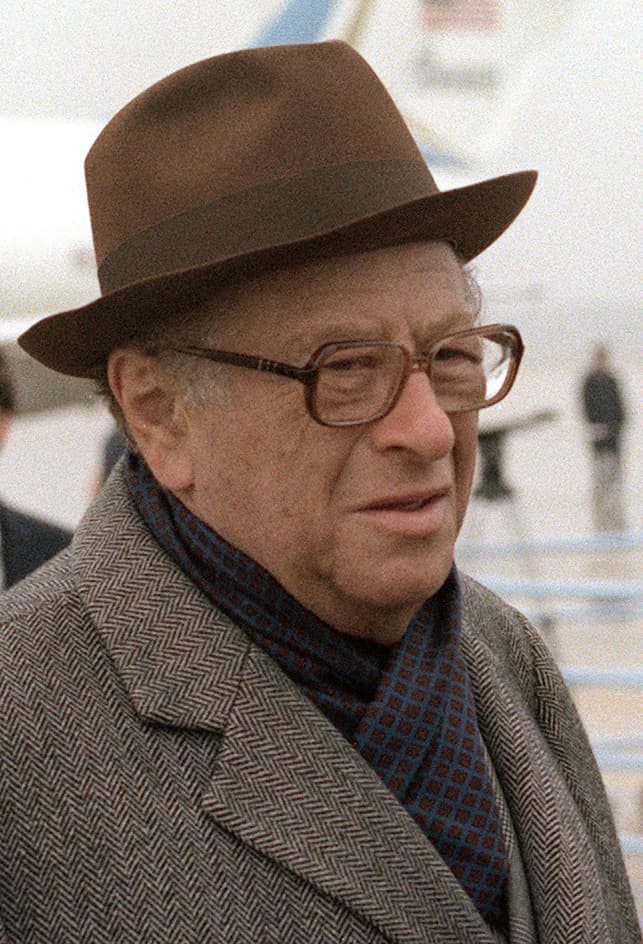
Bruno Kreisky (German: [ˈbʁuːno ˈkʁaɪ̯ski]; 22 January 1911 – 29 July 1990) was an Austrian social democratic politician who served as foreign minister from 1959 to 1966 and as chancellor from 1970 to 1983. Aged 72, he was the oldest chancellor after World War II. Kreisky's 13-year tenure was the longest of any chancellor in republican Austria and, as an influential political figure in Western European social democracy, he worked closely with like-minded leaders Willy Brandt of West Germany and Olof Palme of Sweden in the Socialist International.
Bruno Kreisky (German: [ˈbʁuːno ˈkʁaɪ̯ski]; 22 January 1911 – 29 July 1990) was an Austrian social democratic politician who served as foreign minister from 1959 to 1966 and as chancellor from 1970 to 1983. Aged 72, he was the oldest chancellor after World War II.
Kreisky's 13-year tenure was the longest of any chancellor in republican Austria and, as an influential political figure in Western European social democracy, he worked closely with like-minded leaders Willy Brandt of West Germany and Olof Palme of Sweden in the Socialist International.
0 comentarii0 reacții
Bruno Kreiskya adăugat o fotografie
acum 3 luni
R.I.P Bruno
Life and political career Kreisky was born in the Margareten district of Vienna in 1911, to a non-observant Jewish family. His parents were Max (Markus) Kreisky (1876, Klattau – 1944) and Irene Kreisky née Felix (1884, Třebíč – 1969). His father worked as a textile manufacturer. Shocked by the level of poverty and violence in Austria during the 1920s, he joined the youth wing of the Socialist Party of Austria (SPÖ) in 1925 at age 15. In 1927, he joined the Young Socialist Workers against the wishes of his parents. In 1929, he began studying law at the University of Vienna at the advice of Otto Bauer, who urged him to study law rather than medicine, as he had originally planned. He remained politically active during this period. In 1931, he left the Jewish religious community, becoming agnostic. He took part in the 1934 February Uprising as a courier. In 1934, when the Socialist Party was banned by the Dollfuss dictatorship, he became active in underground political work. He was arrested in 1935 and sentenced to one year in prison for his underground political activity. In March 1938, the Austrian state was incorporated into Germany through the Anschluss, and in…
0 comentarii0 reacții
Bruno Kreiskya adăugat o fotografie
acum 3 luni
R.I.P Bruno
Political views and programs In office, Kreisky and his close ally, Justice Minister Christian Broda, pursued a policy of liberal reform in a country which had a tradition of conservative Roman Catholicism. He legalized abortion in the first three months of pregnancy, decriminalized homosexuality, and required children born out of wedlock to be given the same rights as those born within marriage. Nevertheless, he sought to bridge the gap between the Catholic Church and the Austrian Socialist movement and found a willing collaborator in the then Cardinal Archbishop of Vienna, Franz König. Kreisky promised to reduce the mandatory military service from nine to six months. After his election, military service was reduced to eight months. During Kreisky's premiership, a wide range of progressive reforms was carried out. Amongst other reforms, employee benefits were expanded, the workweek was cut to 40 hours, and legislation providing for equality for women was passed. Kreisky's government established language rights for the country's Slovene and Croatian minorities. Following the 1974 oil shock, Kreisky committed Austria to developing nuclear power to reduce dependence on fossil fuels, although this policy was eventually abandoned after a referendum held in 1978. In 1979, restrictions on redundancy and the dismissal…
0 comentarii0 reacții
Bruno Kreiskya adăugat o fotografie
acum 3 luni
R.I.P Bruno
Legacy
Today, Kreisky's chancellorship is the subject of both controversy and nostalgia. Many of his former supporters see in Kreisky the last socialist of the old school and look back admiringly at an era when the standard of living was noticeably rising, when the welfare state was in full swing and when, by means of a state-funded programme promoting equality of opportunity, working class children were encouraged to stay on at school and eventually receive higher education. All this resulted in a decade of prosperity and optimism about the future. Critics of the modern SPÖ who believe the party has abandoned its historic principles have used the phrase "Kreisky, schau oba!" (transl. Kreisky, look down on us!).
Conservatives criticise Kreisky's policy of deficit spending, expressed in his famous comment during the 1979 election campaign that he preferred that the state run up high debts rather than see people become unemployed. They hold Kreisky responsible for Austria's subsequent economic difficulties.
Despite this criticism, Kreisky did much to transform Austria during his time in office, with considerable improvements in working conditions, a dramatic rise in the average standard of living, and a significant expansion of the welfare state.