


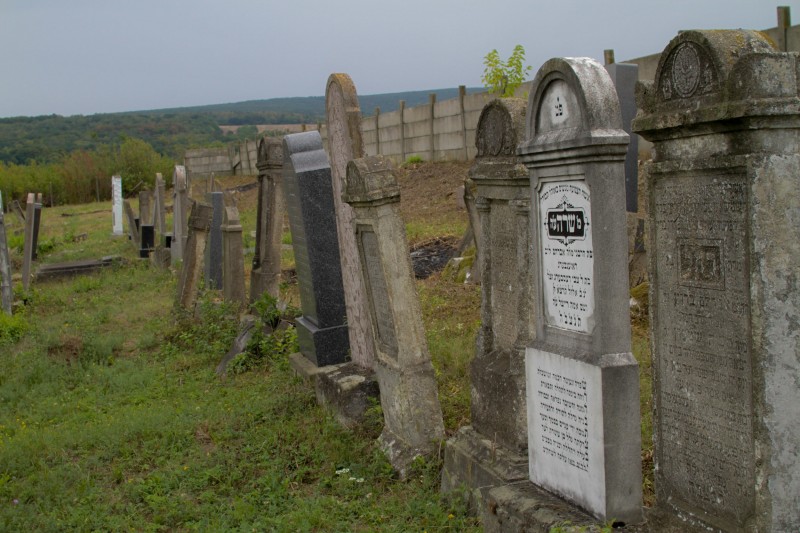
Abaújszántó or Szántó in short is a town in Northeastern Hungary, 23 miles from Miskolc in the area of Borsod-Abaúj-Zemplén, that was always part of Hungarian territory. In 1941 out of the general population of 4,908 there were 681 Jewish community members. On May 1944 they were deported to Auschwitz-Birkenau. A memorial listing the names of the victims is located both in the Abaújszántó and Miskolc cemeteries. The tombstones face east, and stand erect according to the Ashkenazi custom. The gravestones with their decorations are characteristic representations of religious symbols and Jewish folk-art. The cemetery is a treasure field of historical knowledge. It includes testimonies, sometimes the only remaining ones, relating to the once lived local Jewish population, as in Abaújszántó. The history of the Abaújszántó Jewish community dates back to 1738. Prior to that Jewish settlers lived outside the town walls. The cemetery is in existence since 1793 when the Hevra Kaddisha (Jewish Burial Society), with ninety members, was founded. Located in 20 Dobó Utca, a walking distance from the synagogue and the center of the town. Nearby is also the Catholic cemetery. The stone markers or matzevot, frequently carry precise dates and information on relatives that are not preserved by any other means. Cemetery records are among the most important genealogical sources yielding valuable data. Many of the markers have words and images that speak directly of the family member who is being honored. Tombstones make biographical and historical statements as they reflect family life. In the 17th thorough 19th centuries the tombstones included more information than the name and date of death. Often a description on a man's life, his occupation and his town would be written. A woman's tombstone would contain such information as name, date of death, name of her father, as a married woman, often "wife of..." the phrase "a woman of valor" and a symbol, a candelabrum. Entering the gate on the first level is the grave of Abaújszántó and Hungary's important rabbi, Elazar Loew (1758-1837), known as Shemen Rokeh from the title of a book he authored. The rabbis following him in Abaújszántó Rabbinate expected to be buried next to their respected Rabbi, who had presided before them. People visited the grave of Rabbi Elazar Loew at times of peril and peace. Rabbi Loew's name was known also among the area's gentiles and they prayed occasionally by the Rabbi's tomb. In a separate group on the first level, not far from their husbands, are the graves of the Rebbetzins (Wives of the Rabbis). While the names are almost unreadable, the colorful stones and the wording on the Matzevot are poignant reminders of their dedication as they stood at the side of their respectful husbands. As a spiritual link between the living and the dead, the tombstones became the site of pilgrimage and supplication for help from the deceased. Many of the markers have words and images that speak directly of the family member who is being honored. As the lower section was filled, the cemetery extended to the higher level, reached by steps. Overlooking the surrounding valleys from the cemetery's high elevation, the view is especially beautiful. There are the open meadows and unlimited distance of visibility. On the first line at the higher level are the graves of the Zimmerman family who made the town an important exporter of the famous Tokay wine. Reading the gravestones one could observe the tragedy that accompanied the family's success. There is the beautiful three-dimensional black marble tombstone of their eighteen-year-old daughter, Erzsébet. Not far from the Zimmermans is the grave of Moses Mór Szász, my great-grandfather. Within a Mogen David is the carving of a water pitcher representative of the ritual function of a Levite. The graceful gravestone erected in 1916 was a statement, a written message that reached me many years later, after surviving Auschwitz. The words "good name " carved in stone, were the esteemed attribute of the departing old man. His full name and eulogy were expressed in an acrostic pattern. Each line begins with a Hebrew letter, eventually forming the name בן נתן משה Moshe, the son of Nathan. Standing by the grave and reading the words of the Matzevah, my heart overflew with thanks and gratitude. The graves of my two great grandmothers, Sara Szász and Golda Reinitz are in another section of the cemetery. The three graves are my only remnants of a world scattered by the winds of hate. Finding them I received a message of love and belonging. Higher on top, on the second level, are buried Rabbi Nathan Yizhak and his son Lipot Aryeh Lipschitz. They served the Abaujszanto Jewish community. With devoted joint efforts and financial expenses Eli Szamosi and Miksa Winkler photographed the graves. They dedicated their work to the memory of Mrs. Elza Reich Szamosi, Eli's mother. Mrs. Szamosi, deported from Abaújszántó, survived Auschwitz, Markkleeberg and other camps. The Cemetery list was prepared by the kind volunteer work of Ms. Madeleine Isenberg and Mr. Peter Absolon . They, together with Mr. Szamosi and Mr. Winkler deserve our greatest thanks and appreciation. Their Mitzva of Hesed Shel Emet is an act of truthful and pure loving kindness. Zahava Szász Stessel, Ph.D. See also: Zahava Szász Stessel, : The History of Abaújszántó, Fairleigh Dickinson University and Associated University Presses, 1995. Zahava Stessel, "Traces of a Jewish Community in Rural Hungary," The Jewish Press, 25 March 1988, 50C.
- Δημόσια Ομάδα
- 1 Δημοσιεύσεις
- 1 τις φωτογραφίες μου
- 0 Videos
- 0 Προεπισκόπηση
ΠΛΗΡΟΦΟΡΙΕΣ:
- Cemetery QR JPG File:
https://rip.live/content/uploads/photos/2025/07/hungary/borsodabaujzemplen/abaujszanto_gonci_jaras/abaujszanto_jewish_cemetery_7364/cemetery/qr/abaujszanto_jewish_cemetery_7364_qr.jpg - Country:
Hungary - Region:
Borsod-Abaúj-Zemplén - City:
Abaújszántó, Gönci járás - Local Address:
Dobó István u. 20 - Map Link:
https://maps.google.com/maps/dir/?api=1&destination=48.28138,21.19518





 English
 Arabic
 French
 Spanish
 Portuguese
 Deutsch
 Turkish
 Dutch
Dutch
 Italiano
 Russian
 Română
 Portuguese (Brazil)

Πρόσφατες ενημερώσεις