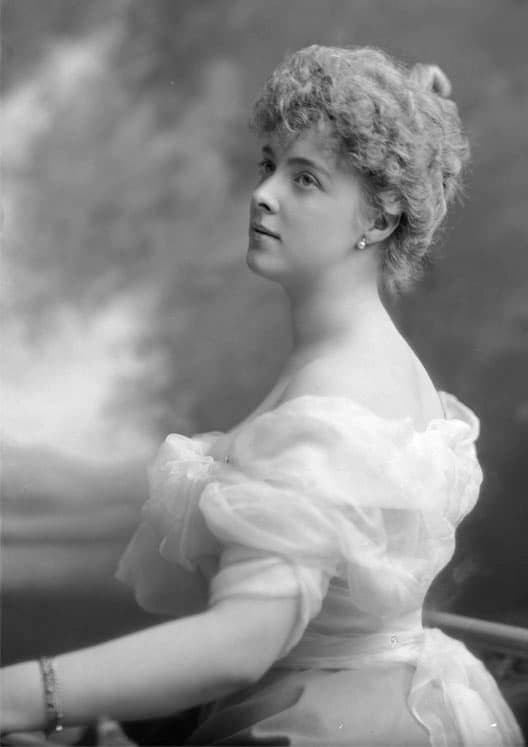
Daisy, Princess of Pless (born Mary Theresa Olivia Cornwallis-West; 28 June 1873 – 29 June 1943) was a noted society beauty in the Edwardian period. Daisy and her husband Prince Hans Heinrich XV von Hochberg were the owners of large estates and coal mines in Silesia (now in Poland) which brought an enormous fortune to the Hochbergs. During her marriage, she was a member of one of the wealthiest European noble families. She sought to prevent World War I by bringing together world leaders for peaceful discussions.
Daisy, Princess of Pless (born Mary Theresa Olivia Cornwallis-West; 28 June 1873 – 29 June 1943) was a noted society beauty in the Edwardian period.
Daisy and her husband Prince Hans Heinrich XV von Hochberg were the owners of large estates and coal mines in Silesia (now in Poland) which brought an enormous fortune to the Hochbergs. During her marriage, she was a member of one of the wealthiest European noble families. She sought to prevent World War I by bringing together world leaders for peaceful discussions.
0 comentarii0 reacții
Daisy, Princess of Plessa adăugat o fotografie
acum 3 luni
R.I.P Daisy,
Early life
Born Mary Theresa Olivia Cornwallis-West at Ruthin Castle in Denbighshire, Wales, she was the daughter of Col. William Cornwallis-West (1835–1917) and his wife, Mary "Patsy" FitzPatrick (1856–1920). Her father was a patrilineal great-grandson of John West, 2nd Earl De La Warr. Her mother was a daughter of Reverend Frederick FitzPatrick, a descendant of Barnaby Fitzpatrick, 1st Baron Upper Ossory (and thus the Kings of Osraige) and Lady Olivia Taylour, daughter of the 2nd Marquess of Headfort.
Her sister Constance (Shelagh) was also a famous beauty and wife of one of the richest men in the world, Hugh Grosvenor, 2nd Duke of Westminster; and the sisters' brother George Cornwallis-West was the second husband of Lady Randolph Churchill, mother of Sir Winston Churchill.
0 comentarii0 reacții
Daisy, Princess of Plessa adăugat o fotografie
acum 3 luni
R.I.P Daisy,
Personal life and family On 8 December 1891, in London, she married Hans Heinrich XV, 3rd Prince of Pless, Count of Hochberg, Baron of Fürstenstein (1861–1938), one of the wealthiest heirs in the German Empire. As the Cornwallis-West family was impoverished, the Hochbergs paid for and organised the wedding at St Margaret's Church in Westminster. Notable witnesses were Edward, Prince of Wales (later King Edward VII) and his wife Princess Alexandra of Denmark.During their honeymoon, the Princess was given the longest pearl necklace in the world by her husband. The Princess was the châtelaine of Fürstenstein Castle and Pless Castle in Silesia, where she kept a domesticated wolf. The couple had four children: Daughter (25 February 1893 – 11 March 1893). Hans Heinrich XVII William Albert Edward (2 February 1900 – 26 January 1984), 4th Prince of Pless, Count von Hochberg and Baron of Fürstenstein. Married twice but had no issue. Alexander Frederick William George Conrad Ernest Maximilian (1 February 1905 – 22 February 1984), 5th Prince of Pless, Count von Hochberg and Baron of Fürstenstein. Polish military officer. Unmarried and childless. Bolko Conrad Frederick (23 September 1910 – 22 June 1936), who later caused a scandal by marrying his…
0 comentarii0 reacții
Daisy, Princess of Plessa adăugat o fotografie
acum 3 luni
R.I.P Daisy,
Peace campaigning and war work
During her marriage Daisy, known in German as the Fürstin von Pless, became a social reformer and militated for peace with her friends German Emperor Wilhelm II and King Edward VII of the United Kingdom.
During World War I she was suspected by Germans of being a British spy and was criticised by British people for treating German soldiers as a Red Cross nurse.
0 comentarii0 reacții
Daisy, Princess of Plessa adăugat o fotografie
acum 3 luni
R.I.P Daisy,
Honours
The Princess of Pless was a Dame of the Order of Theresa of Bavaria and of the Order of Isabella the Catholic of Spain, and was awarded the German Red Cross Decoration.
0 comentarii0 reacții
Daisy, Princess of Plessa lăsat un gând
acum 3 luni
Inter-war life
After her divorce at Berlin on 12 December 1922, Daisy was dependent upon alimony. In the same year Princess acquired Polish citizenship. Later she published a series of memoirs that were widely read in the United Kingdom, the United States, and, in the German language, in Continental Europe.
The Princess introduced pasteurised milk stations for children and founded a school for disabled children. She organised a cooperative for lace workers.
'The Private Diaries of Princess Daisy of Pless – 1873–1914, edited by Major Desmond Chapman-Huston, were first published in London by John Murray in 1931. This was the second selection from her diaries and, according to his introduction were from a series of diaries totalling 600,000 words. The diaries describe the Princess's life as a member of the European aristocracy, and include sometimes frank descriptions of significant pre-war political and social figures.
0 comentarii0 reacții
Daisy, Princess of Plessa lăsat un gând
acum 3 luni
World War II
Daisy moved to Wałbrzych, then known as Waldenburg, in 1941. To ease the Hochberg's debts, the Fürstenstein castle was sold by the family to the Nazi German government in 1943.
0 comentarii0 reacții
Daisy, Princess of Plessa lăsat un gând
acum 3 luni
Death and commemoration
Daisy had multiple sclerosis and used a wheelchair toward the end of her life. She celebrated her 70th birthday on 23 June 1943 with champagne and a colliery band performance. She died the next day, at Waldenburg, Silesia (now Wałbrzych, Poland).
The Princess was initially buried near the Hochberg family mausoleum. Her grave was plundered and her remains desecrated by Red Army soldiers in 1945, and she was reburied in an undisclosed location.
The Princess was commemorated by a statue near the castle Schloss Pless where she had lived for a time.
0 comentarii0 reacții
Daisy, Princess of Plessa lăsat un gând
acum 3 luni
Sources
Princess Daisy of Pless (1929). Princess Daisy of Pless by Herself. London, John Murray.
Princess Daisy of Pless (1931). Better Left Unsaid. New York: E. P. Dutton.
Princess Daisy of Pless (1936). What I Left Unsaid. New York: Cassell.
Chapman-Huston, D (1931). The Private Diaries of Princess Daisy of Pless - 1873 - 1914. London: John Murray.{{cite book}}: CS1 maint: publisher location (link) republished 1950
Koch, John (2003). Daisy Princess of Pless 1873-1943: A Discovery. W. John Koch Publishing. ISBN 0-9731579-0-9.