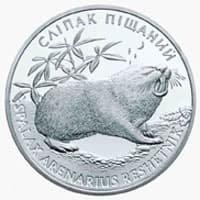
Evdokia Reshetnik (Ukrainian: Євдокія Решетник; 1 March 1903 O.S./14 March 1903 (N. S.) – 22 October 1996) was a Ukrainian zoologist and ecologist. She was a specialist in the mole-rats and ground squirrels of Ukraine, and was the first scientist to describe the sandy blind mole-rat of southern Ukraine in 1939. She played a key role in keeping the National Museum of Natural History at the National Academy of Sciences of Ukraine operable in the inter-war and immediate post-war periods, in spite of arrests by both the Gestapo and Soviet authorities. She was one of the people involved in hiding s
Evdokia Reshetnik (Ukrainian: Євдокія Решетник; 1 March 1903 O.S./14 March 1903 (N. S.) – 22 October 1996) was a Ukrainian zoologist and ecologist. She was a specialist in the mole-rats and ground squirrels of Ukraine, and was the first scientist to describe the sandy blind mole-rat of southern Ukraine in 1939. She played a key role in keeping the National Museum of Natural History at the National Academy of Sciences of Ukraine operable in the inter-war and immediate post-war periods, in spite of arrests by both the Gestapo and Soviet authorities. She was one of the people involved in hiding specimens of the museum to prevent them being taken by the Germans. She is known for arguing that ecology, species distribution, populations, utility, and variability, should be weighed before making determinations that labeled certain animals as pests and harmful to the environment. Though she was responsible for maintaining the historiography of scientific development in Ukraine, her own legacy was lost until the twenty-first century.
0 comentarii0 reacții
Evdokia Reshetnika adăugat o fotografie
acum 3 luni
R.I.P Evdokia
Early life and education Evdokia Grigoryevna Reshetnik was born on 14 March 1903 (N. S.) in the village of Koshmanovka in the Poltava Oblast of the Russian Empire, in what is now Ukraine. Her father, Grigory Yefimovich Reshetnik, was a prosperous peasant who died before being de-Kulaked. He owned a sizeable acreage on which he raised cattle. Probably because of her father's early death, Reshetnik was raised from childhood by her older sister and brother-in-law in Poltava. There she attended both primary school and seven years in gymnasium. In 1918, she began a three-year program in pedagogy, completed her practical work teaching at the local orphanage, and earned her teaching credentials from the Poltava Pedagogical University, under the rules of the Russian Institute of Public Education, in 1920. Continuing as a student there, Reshetnik studied biology until 1924, with classmates Oksana Ivanenko, Pavlo Tychyna, and her future husband, Yakov Khomenko. While she was studying, she simultaneously continued to teach at the orphanage. She graduated with a specialty in biology in 1924, and was hired to work at the Osnovianskyi District worker's school on the outskirts of Kharkiv as a zoology instructor. Khomenko worked as a philologist and translator at the…
0 comentarii0 reacții
Evdokia Reshetnika lăsat un gând
acum 3 luni
Pre-war and war years (1935–1946) In 1935, when the capital of Ukraine was transferred from Kharkiv to Kyiv, Reshetnik's husband was transferred with his employer and she followed him. She found employment as a researcher at the Kyiv Zoo. In 1936, she was designated as a senior researcher at the I. I. Schmalhausen Institute of Zoology of the National Academy of Sciences of Ukraine, for which she served as secretary. In 1939, she published her paper describing Spalacidae (mole-rats) in Ukraine and the following year earned a Candidate degree in 1940, although her diploma would not be awarded until 1946. While on a research trip the following year in Chișinău, Bessarabia, the war caused Reshetnik to return to Kyiv. Boarding the academic evacuation train for Ufa, she disembarked at Poltava, where her son was staying with her sister. She was also reunited with her husband at the train station. The curfew made it impossible for her to pick up her son and continue on the evacuation train, so they remained in Poltava until October 1941, when the Germans invaded the city. They then went back to Kyiv on horseback, a difficult and lengthy journey. After arriving in Kyiv, Reshetnik discovered…
0 comentarii0 reacții
Evdokia Reshetnika lăsat un gând
acum 3 luni
Post-war (1946–1986) At the end of the war, Reshetnik was awarded a research specialist designation in zoology in 1946 and was hired to work at the Institute of Zoology of the Academy of Sciences, where she remained until 1950. During this time, she published two papers on her earlier study of ground squirrels. One of them, which was published in 1946, identified new subspecies of the speckled ground squirrel (Citellus suslica ognevi and Citellus suslica volhynensis). In her works, Reshetnik pointed out that rodents could be valuable for their skins as well as their fat, which was widely used during the war as a food source. She published extensive analyses about the ecology, species distribution, populations, and variability of the types of rodents throughout Ukraine. In these works, she argued that the economic or usefulness of rodents should be weighed against the potential damage they might do. When the Soviets were restored to power, a period of repression began in Ukraine. In 1948, Reshetnik's son was arrested for membership in the Organization of Ukrainian Nationalists and deported to Mordovia. Soon after, her husband was also arrested and imprisoned. Both of them were required to serve eight-year sentences. She faced several…
0 comentarii0 reacții
Evdokia Reshetnika lăsat un gând
acum 3 luni
Death and legacy
Reshetnik died on 22 October 1996, in Kyiv and was buried Sovsky Cemetery. Despite her name being remembered in Ukraine because of the papers she had published, Reshetnik's biography was not retold until the twenty-first century.
0 comentarii0 reacții
Evdokia Reshetnika lăsat un gând
acum 3 luni
Selected works Reshetnik is primarily known for her research on rodents, particularly mole-rats and ground squirrels. She published over twenty papers between 1939 and 1965 detailing new species and subspecies, including a unique blind mole-rat, Spalax arenarius, which she first identified in 1939 and is endemic to Ukraine. Her work evaluated the ecology, varying shapes, and distribution of their populations. Решетник, Є. Г. (1937). "До екології жайворонків в умовах району Асканія-Нова" [The Ecology of Larks in the Conditions of the Askania-Nova Region]. Збірник праць зоологічного музею (in Ukrainian) (20). Kharkiv, Ukrainian SSR: National Zoological Museum: 3–40. Решетник, Є. Г. (1939). "До систематики i географічного поширення сліпаків (Spalacidae) в УРСР" [The Systematic and Geographical Distribution of Spalacids (Spalacidae) in the Ukrainian SSR]. Збірник праць зоологічного музею АН УРСР (in Ukrainian) (23). Kyiv, Ukrainian SSR: Zoological Museum of the Academy of Sciences: 3–21. Решетник, Є. Г. (1946). "О новых подвидах крапчатого суслика Citellus suslica volhynensis subsp. nov. и Citellus suslica ognevi subsp. nov" [On a New Subspecies of the Speckled Ground Squirrel Citellus suslica volhynensis subsp. nov. and Citellus suslica ognevi subsp. nov.]. Бюллетень МОИП (in Ukrainian). 51 (6). Moscow, USSR: Moscow Society of Naturalists: 25–27. Решетник, Є. Г. (10 March 1994).…