


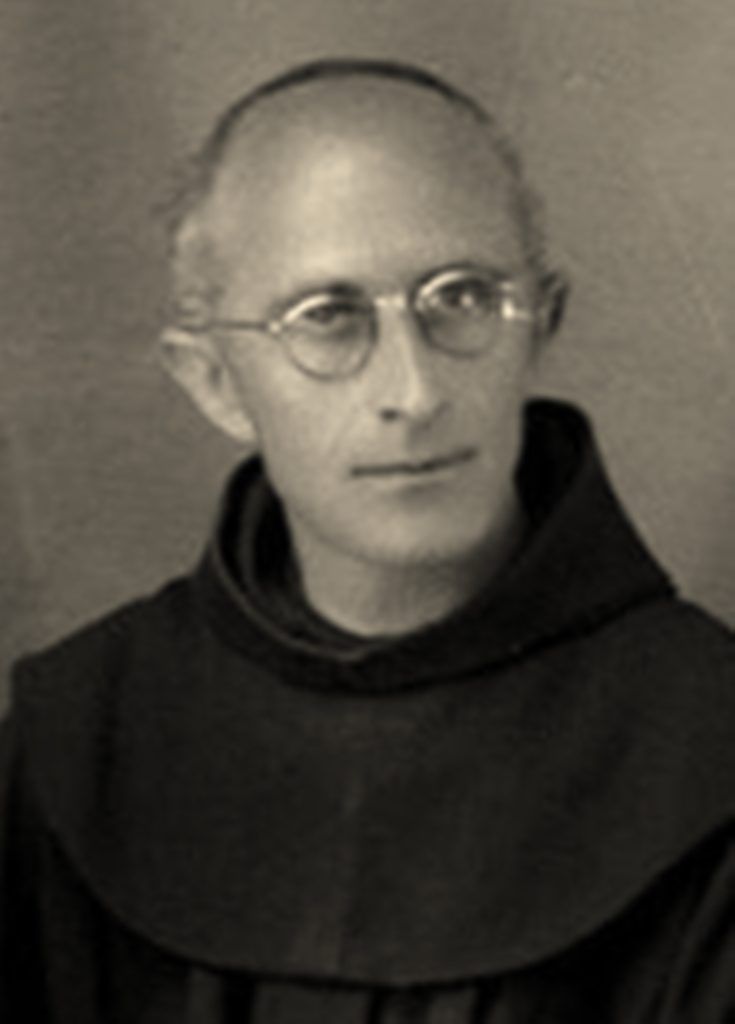
Blessed Gjon Shllaku OFM (Kolë Shllaku) Kolë (Albanian for Nicholas) Shllaku was born in Shkodër in Albania on 27 July 1907, to Loros Shllaku and Marë Ashtës. Since primary school, he attended the college held by the Friars Minor in his city. He entered as a postulant of the same Order in the convent of Troshan, at fifteen; with religious profession he assumed the name of Fra Gjon (in Italian, Giovanni). He was sent to theological studies in Holland, where he was ordained priest in 1931. Later, from 1932 to 1936, he attended the theological faculty of Leuven (Belgium), earning a doctorate in theology. Returning to Scutari, he taught Philosophy and French at the high school Illyrikum, of which he had previously been a pupil. His intellectual and spiritual caliber soon became known among his students and beyond. With the Italian occupation of Albania, he chose the road to exile in Yugoslavia. A year later he returned home, taking over the magazine "Hyll Drites" ("Ylli i Mëngjesit"). In his openly polemical articles, he pointed out the risks of Marxist and Fascist ideologies. Nonetheless, he invited his young students to non-violent resistance and not to give in to revenge. In 1940, at the death of Fr Gjergj Fishta, a leading exponent of Albanian Franciscanism, Fr Gjon took his place as the moral leader of the religious community. He then organized a series of lectures on Marxist materialism, where he responded point by point to the controversies, remaining faithful to the teaching of the Church. Meanwhile, the Albanian political situation began to change with the seizure of power by Enver Hoxha and with the increasingly blatant persecution of believers of all faiths. The fury was particularly fierce, among Catholics, towards the Jesuits and the Franciscans; the latter were targeted for their attempts to consolidate the Albanian popular soul. Fr Gjon had immediately sensed the aims of the new regime and had been warned by some Catholics, aggregated to the communists for fear or ambition, that his name was on the list of priests to be killed. To the young people who surrounded him in search of advice he could then answer: "Now this will be my path and I will not be the first nor the last, unfortunately. We pray that God will give us the strength and courage to face martyrdom". The excuse to silence it occurred when the Albanian Union was discovered, which was nothing but the pseudonym with which two students from Shkodër Seminary, Mark Çuni and Gjergj Bici, had signed some flyers with which they had tried to fight the communist propaganda. Initially printed on their own in secret with the mimeograph of the Seminary, they were then issued by the typography of the friars; however, none of the superiors, either Jesuits or Franciscans, knew about it. Fr Gjon was then arrested during the winter of 1945. After weeks of torture, in January 1946, along with other prisoners, he was subjected to a trial that, in reality, had the written conclusion. The charges that were addressed were that of being the head of the Albanian Union, of collaborating with the resistance of the inhabitants of the mountains to the north of the country and of planning the foundation of the Albanian Christian Democracy. In addition, the alleged organization of the "Black Plot" against the government was added, in complicity with the Vatican, Great Britain and the United States. On 22 February 1946, after a show trial, the sentences were read. Eight were sentenced to death by shooting: Fr Gjon Shllaku , Fr Giovanni Fausti , Fr Daniel Dajani , seminarians Mark Çuni and Gjergj Bici, lay people Gjelosh Lulashi , Fran Mirakaj , and Qerim Sadiku . The others accused with them were sentenced to prison, for a period that could go from five years to the whole of life, in fact, if they had even minimally transgressed. For Gjergj Bici, the sentence was later commuted into years of forced labor, while Fran Mirakaj is reported to have died in September 1946. At dawn on 4 March 1947, the remaining six were transported to the Catholic Cemetery of Shkodër (Varrezat e Rrmajit), where they were executed. At 6 am, the order was given to the eight soldiers of the platoon, armed with machine guns, to "FIRE". Fr Gjon then pronounced his last words: "Give my farewell to my Franciscan brothers and to all those I know and who know me". On 5 November 2016, beatification was celebrated at the Square of the Katedralja e Shën Stefanit in Shkodër, presided by Cardinal Angelo Amato.
- Name: Gjon Kolë Shllaku
- Не определен
- Birth: 27/07/1907 (Shkodër, Shkodër Municipality, Shkodër, Albania)
- Death: 04/03/1946 (Shkodër, Shkodër Municipality, Shkodër, Albania)
- Died at 38
- 1 Записей
- 1 Фото
- 0 Видео
- Lived in Shkodër, Shkodër Municipality
Cemetery Info
- Memorial QR JPG File:
https://rip.live/content/uploads/photos/2025/04/albania/shkoder/shkoder_shkoder_municipality/varrezat_e_rrmajit_2591/graves/gjon_kole_shllaku_50368/qr/gjon_kole_shllaku_50368_qr.jpg - Cemetery Title:
Varrezat e Rrmajit - Cemetery Link:
https://rip.live/cemetery/varrezat_e_rrmajit_2591 - Country:
Albania - Region:
Shkodër - City:
Shkodër, Shkodër Municipality - Local Address:
Rruga Hile Mosi - Map Link:
https://maps.google.com/maps/dir/?api=1&destination=42.070418,19.527501






 English
 Arabic
 French
 Spanish
 Portuguese
 Deutsch
 Turkish
 Dutch
Dutch
 Italiano
 Română
 Portuguese (Brazil)
 Greek
Greek
