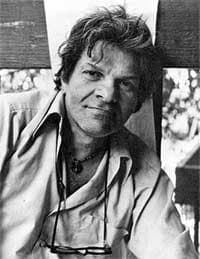
Gregory Nunzio Corso (March 26, 1930 – January 17, 2001) was an American poet. Along with Jack Kerouac, Allen Ginsberg, and William S. Burroughs, he was part of the Beat Generation, as well as one of its youngest members.
Gregory Nunzio Corso (March 26, 1930 – January 17, 2001) was an American poet. Along with Jack Kerouac, Allen Ginsberg, and William S. Burroughs, he was part of the Beat Generation, as well as one of its youngest members.
0 comentarii0 reacții
Gregory Corsoa adăugat o fotografie
acum 3 luni
R.I.P Gregory
Early life
Born Nunzio Corso at New York City's St. Vincent's Hospital, Corso later selected the name "Gregory" as a confirmation name. Within Little Italy and its community he was "Nunzio," while he dealt with others as "Gregory." He often would use "Nunzio" as short for "Annunziato," the announcing angel Gabriel, hence a poet. Corso identified with not only Gabriel but also Hermes, the divine messenger.
Corso's mother, Michelina Corso (born Colonna), was born in Miglianico, Abruzzo, Italy, and immigrated to the United States at the age of nine, with her mother and four other sisters. At 16, she married Sam Corso, a first-generation Italian American, also teenage, and gave birth to Nunzio Corso the same year. They lived at the corner of Bleecker and MacDougal streets, the heart of Greenwich Village and upper Little Italy.
0 comentarii0 reacții
Gregory Corsoa adăugat o fotografie
acum 3 luni
R.I.P Gregory
Childhood Sometime in his first year, Corso's mother mysteriously abandoned him, leaving him at the New York child care home, a branch of the Catholic Church Charities. Corso's father, Sam "Fortunato" Corso, a garment center worker, found the infant and promptly put him in a foster home. Michelina came to New York from Trenton but her life was threatened by Sam. One of Michelina's sisters was married to a New Jersey mobster who offered to give Michelina her "vengeance," that is to kill Sam. Michelina declined and returned to Trenton without her child. Sam consistently told Corso that his mother had returned to Italy and deserted the family. He was also told that she was a prostitute and was "disgraziata" (disgraced) and forced into Italian exile. Sam told the young boy several times, "I should have flushed you down the toilet." It was 67 years before Corso learned the truth of his mother's disappearance. Corso spent the next 11 years in foster care in at least five different homes. His father rarely visited him. When he did, Corso was often abused: "I'd spill jello, and the foster home people would beat me. Then my father would visit, and he'd beat…
0 comentarii0 reacții
Gregory Corsoa lăsat un gând
acum 3 luni
Adolescence At age 13, Corso was asked to deliver a toaster to a neighbor. While he was running the errand, a passerby offered money (around 94 dollars) for the toaster, and Corso sold it. He used the money to buy a tie and white shirt, and dressed up to see The Song of Bernadette, a movie about the mystical appearance of the Virgin Mary to Bernadette Soubirous at Lourdes. On returning from the movie, the police apprehended him. Corso claimed he was seeking a miracle, namely to find his mother. Corso had a lifelong affection for saints and holy men: "They were my only heroes." Nonetheless, he was arrested for petty larceny and incarcerated in The Tombs, New York's infamous jail. Corso, though only 13 years old, was celled next to an adult, criminally insane murderer who had stabbed his wife repeatedly with a screwdriver. The exposure left Corso traumatized. Neither Corso's stepmother nor his paternal grandmother would post his $50 bond. With his own mother missing and unable to make bail, he remained in the Tombs. Later, in 1944 during a New York blizzard, a 14-year-old freezing Corso broke into his tutor's office for warmth, and fell asleep on…
0 comentarii0 reacții
Gregory Corsoa lăsat un gând
acum 3 luni
Corso at Clinton Correctional While being transported to Clinton, Corso, terrified of prison and the prospect of rape, concocted a story of why he was sent there. He told hardened Clinton inmates he and two friends had devised the wild plan of taking over New York City by means of walkie-talkies, projecting a series of improbable and complex robberies. Communicating by walkie-talkie, each of the three boys took up an assigned position—one inside the store to be robbed, one outside on the street to watch for the police, and a third, Corso, the master-planner, in a small room nearby dictating the orders. According to Corso, he was in the small room giving the orders when the police came. In light of Corso's youth, his imaginative yarn earned him bemused attention at Clinton. Richard Biello, a capo, asked Corso who he was connected with, that is what New York crime family did he come from, talking such big crimes as walkie-talkie robberies. "I'm independent!" Corso shot back, hoping to keep his distance from the mob inmates. A week later, in the prison showers, Corso was grabbed by a handful of inmates, and the 18-year-old was about to be raped. Biello happened…
0 comentarii0 reacții
Gregory Corsoa lăsat un gând
acum 3 luni
Cambridge, Massachusetts In 1954, Corso moved to Cambridge, Massachusetts, where several important poets, including Edward Marshall (poet) and John Wieners, were experimenting with the poetics of voice. The center for Corso's life there was not "the School of Boston," as these poets were called, but Harvard University's Widener Library. He spent his days there reading the great works of poetry and also auditing classes in the Greek and Roman Classics. Corso's appreciation of the classics had come from the Durants' books that he had read in prison. At Harvard, he considered becoming a classics scholar. Corso, penniless, lived on a dorm room floor in Elliott house, welcomed by students Peter Sourian, Bobby Sedgwick (brother of Edie), and Paul Grand. He would dress up for dinner and not be noticed. Members of the elite Porcellian Club reported Corso to the Harvard administration as an interloper. Dean Archibald MacLeish met with Corso intending to expel him, but Corso showed him his poems and MacLeish relented and allowed Corso to be a non-matriculating student—a poet in residence. Corso's first published poems appeared in the Harvard Advocate in 1954, and his play In This Hung-up Age—concerning a group of Americans who, after their bus…
0 comentarii0 reacții
Gregory Corsoa lăsat un gând
acum 3 luni
To Paris and the "Beat Hotel" In 1957, Allen Ginsberg traveled with Peter Orlovsky to visit William S. Burroughs in Morocco. They were joined by Kerouac, who was researching the French origins of his family. Corso, already in Europe, joined them in Tangiers and, as a group, they made an ill-fated attempt to take Burroughs' fragmented writings and organize them into a text (which later would become Naked Lunch). Burroughs was strung out on heroin and became jealous of Ginsberg's unrequited attraction for Corso, who left Tangiers for Paris. In Paris, Corso introduced Ginsberg and Orlovsky to a Left Bank lodging house above a bar at 9 rue Gît-le-Cœur, that he named the Beat Hotel. They were soon joined by William Burroughs and others. It was a haven for young expatriate painters, writers, and musicians. There, Ginsberg began his epic poem Kaddish, Corso composed his poems Bomb and Marriage, and Burroughs (with Brion Gysin's help) put together Naked Lunch from previous writings. This period was documented by the photographer Harold Chapman, who moved in at about the same time, and took pictures of the residents of the hotel until it closed in 1963. Corso's Paris sojourn resulted in his third…
0 comentarii0 reacții
Gregory Corsoa lăsat un gând
acum 3 luni
Poetry
Corso's first volume of poetry The Vestal Lady on Brattle was published in 1955 (with the assistance of students at Harvard, where he had been auditing classes). Corso was the second member of the Beats to be published, despite the fact that he was the youngest member of the group. (Jack Kerouac's The Town and the City was published in February 1950.) His poems were first published in the Harvard Advocate. In 1958, Corso had an expanded collection of poems published as number 8 in the City Lights Pocket Poets Series: Gasoline & The Vestal Lady on Brattle. Corso's notable poems include the following: "Bomb,""Elegiac Feelings American," "Marriage," and "The Whole Mess... Almost."
0 comentarii0 reacții
Gregory Corsoa lăsat un gând
acum 3 luni
Marriage "Marriage" (1960) is perhaps Corso's signature poem. It is a 111-line work that lacks a consistent narrative thread. Instead, it offers a rambling debate about the advantages and disadvantages of marriage. It employs a free verse style, with no set meter, no set rhyme scheme, and varying line lengths. Corso acknowledges the length of some of the lines, but argues "they just flow, like a musical thing within me." "Marriage" was among his "title poems," along with "Power," "Army," and others that explore a concept. "Should I get married?" (1), the speaker begins. Could marriage bring about the results that the speaker is looking for? Coming "home to her" (54) and sitting "by the fireplace and she in the kitchen/aproned young and lovely wanting my baby/ and so happy about me she burns the roast beef" (55–57). Idealizing marriage and fatherhood initially, Corso's speaker embraces reality in the second half of the poem admitting, "No, I doubt I'd be that kind of father" (84). Recognizing that the act of marriage is in itself a form of imprisonment, "No, can't imagine myself married to that pleasant prison dream" (103), Corso's speaker acknowledges in the end that the possibility of marriage…
0 comentarii0 reacții
Gregory Corsoa lăsat un gând
acum 3 luni
"Marriage" excerpt:
Corso's sometimes surreal word mash-ups in the poem—"forked clarinets," "Flash Gordon soap," "werewolf bathtubs"—caught the attention of many. Ethan Hawke recited the poem in the 1994 film Reality Bites, and Corso later thanked Hawke for the resulting royalty check.
0 comentarii0 reacții
Gregory Corsoa lăsat un gând
acum 3 luni
Bomb According to Catharine Seigel, Corso's "Bomb" (published in 1958), was one of the earliest poems to confront the existence of the nuclear bomb. The poem was published as a multiple-paged broadside, with the text shaped as a mushroom cloud. The first 30 lines create a round mushroom top, while lines 30-190 create the pillar of debris and destruction rising up from the ground. Corso recalled the tradition of patterned or shape poetry, but made the irreverent choice to create the shape of the cloud that results from the detonation of a nuclear bomb. Previous uses of shape poetry include angel wings and altars, which Siegel says makes Corso's choice "ironically appropriate." The poem appeared in the volume "The Happy Birthday of Death," which featured a black and white photograph of the mushroom cloud over Hiroshima, Japan. Corso makes extensive use of onomatopoeia toward the end of the poem, with all-caps font exclaiming "BOOM BOOM BOOM BOOM BOOM" (166). Siegel describes these interruptions as "attempting to sound the reign of a nuclear, apocalyptic chaos." According to Corso himself, "When it's read, it's a sound poem. "Bomb" was controversial because it mixed humor and politics. The poem was initially misinterpreted by…
0 comentarii0 reacții
Gregory Corsoa lăsat un gând
acum 3 luni
Corso in other poetry
In contrast to Corso's use of marriage as a synecdoche for a Beat view of women, postmodern feminist poet Hedwig Gorski chronicles a night with Corso in her poem "Could not get Gregory Corso out of my Car" (1985, Austin, Texas) showing the womanizing typical for heterosexual Beat behavior. Gorski criticizes the Beat movement for tokenism towards women writers and their work, with very few exceptions, including Anne Waldman, and post-beats like Diane DiPrima and herself. Male domination and womanizing by its heterosexual members, along with tokenism by its major homosexual members characterize the Beat Literary Movement. Beats scoffed at the Feminist Movement which offered liberalizing social and professional views of women and their works as did the Beat Movement for men, especially homosexuals. Corso however always defended women's role in the Beat Generation, often citing his lover, Hope Savage, as a primary influence on him and Allen Ginsberg.
0 comentarii0 reacții
Gregory Corsoa lăsat un gând
acum 3 luni
Relationship with the Beat Movement
The battle against social conformity and literary tradition was central to the work of the Beats. This group of poets questioned mainstream politics and culture, and they were concerned with changing consciousness and defying conventional writing. Corso's poems "Marriage" and "Bomb" demonstrate his willingness to provide an unconventional, humorous, and irreverent perspective on serious or controversial topics.
Ted Morgan described Corso's place in the Beat literary world: "If Ginsberg, Kerouac and Burroughs were the Three Musketeers of the movement, Corso was their D'Artagnan, a sort of junior partner, accepted and appreciated, but with less than complete parity. He had not been in at the start, which was the alliance of the Columbia intellectuals with the Times Square hipsters. He was a recent adherent, although his credentials were impressive enough to gain him unrestricted admittance ..." It has taken 50 years and the death of the other Beats, for Corso to be fully appreciated as a poet of equal stature and significance.
0 comentarii0 reacții
Gregory Corsoa lăsat un gând
acum 3 luni
Later years In later years, Corso disliked public appearances and became irritated with his own "Beat" celebrity. He never allowed a biographer to work in any "authorized" fashion, and only posthumously was a volume of letters published under the specious artifice of An Accidental Autobiography. He did, however, agree to allow filmmaker Gustave Reininger to make a cinema vérité documentary, Corso: The Last Beat, about him. Corso had a cameo appearance in The Godfather Part III where he plays an outraged stockholder trying to speak at a meeting. After Allen Ginsberg's death, Corso was depressed and despondent. Gustave Reininger convinced him to go "on the road" to Europe and retrace the early days of "the Beats" in Paris, Italy and Greece. While in Venice, Corso expressed on film his lifelong concerns about not having a mother and living such an uprooted childhood. Corso became curious about where in Italy his mother, Michelina Colonna, might be buried. His father's family had always told him that his mother had returned to Italy a disgraced woman, a whore. Filmmaker Gustave Reininger quietly launched a search for Corso's mother's Italian burial place. In an astonishing turn of events, Reininger found Corso's mother Michelina not…
0 comentarii0 reacții
Gregory Corsoa lăsat un gând
acum 3 luni
Posthumous
In 2017 the international quarterly Four by Two magazine, in collaboration with Raymond Foye, ran a series of previously unpublished poems by Corso, one of them handwritten and accompanied by small paintings, as well as two postcards of his watercolors portraying William Burroughs and Edgar Allan Poe.
0 comentarii0 reacții
Gregory Corsoa lăsat un gând
acum 3 luni
Quotes "…a tough young kid from the Lower East Side who rose like an angel over the roof tops and sang Italian song as sweet as Caruso and Sinatra, but in words.… Amazing and beautiful, Gregory Corso, the one and only Gregory, the Herald."—Jack Kerouac – Introduction to Gasoline "Corso's a poet's Poet, a poet much superior to me. Pure velvet... whose wild fame's extended for decades around the world from France to China, World Poet.—Allen Ginsberg, "On Corso's Virtues" "Gregory's voice echoes through a precarious future.... His vitality and resilience always shine through, with a light that is more than human: the immortal light of his Muse.... Gregory is indeed one of the Daddies."—William S. Burroughs "The most important of the beat poets... a really true poet with an original voice"—Nancy Peters, editor of City Lights "Other than Mr. Corso, Gregory was all you ever needed to know. He defined the name by his every word or act. Always succinct, he never tried. Once he called you 'My Ira' or 'My Janine' or 'My Allen,' he was forever 'Your Gregory'."—Ira Cohen "...It comes, I tell you, immense with gasolined rags and bits of wire and old bent nails, a…