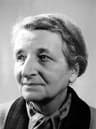
Hermine "Erminia" Speier (28 May 1898 in Frankfurt am Main – 12 January 1989 in Montreux) was a German archaeologist. One of the few female archaeologists of her time, she was the first female employee of the Vatican Museums and one of the first professional women to be employed by the Vatican. She was a pioneering contributor to the collections of archaeological photographs and is often credited as being the first archaeological photo-archivist.
Hermine "Erminia" Speier (28 May 1898 in Frankfurt am Main – 12 January 1989 in Montreux) was a German archaeologist. One of the few female archaeologists of her time, she was the first female employee of the Vatican Museums and one of the first professional women to be employed by the Vatican. She was a pioneering contributor to the collections of archaeological photographs and is often credited as being the first archaeological photo-archivist.
0 comentarii0 reacții
Hermine Speiera adăugat o fotografie
acum 3 luni
R.I.P Hermine
Biography
Hermine Speier was born on 28 May 1898, in Frankfurt am Main into a wealthy Jewish family. She attended Frankfurt's Viktoriaschule, passing her matriculation examination in Wiesbaden after attending a private school. In the winter semester of 1918/19 she enrolled at the University of Frankfurt, studying history, German literature and philosophy. In the summer semester of 1919 she transferred to the University of Giessen, and in the winter semester 1919/20 continued at the University of Heidelberg. In Giessen, she also attended a teachers' training course and was introduced to classical archaeology at the college run by Gerhart Rodenwaldt. In Heidelberg she changed her major to archaeology. She studied under teachers such as Eberhard Gothein, Friedrich Gundolf, Karl Jaspers, Hermann Oncken, Hans Driesch and Karl Ludwig Hampe. After 1920, when Ludwig Curtius was appointed to the university, he became her most important teacher and patron, helping her to focus on archaeology. Besides Curtius, teachers such as Franz Boll, Alfred von Domaszewski, Karl Meister and especially Bernhard Schweitzer gave her a broad-based knowledge of antiquity.
0 comentarii0 reacții
Hermine Speiera lăsat un gând
acum 3 luni
Early career Speier graduated with a doctorate in archaeology and a double minor in ancient history and classical philology in 1925 under Curtius with a dissertation titled Die Gruppen angelehnter Figuren im V. und IV. Jahrhundert. The work was published seven years later in Rome under the title Two figure groups in the fifth and fourth century BC. The work contrasts differences in images between the Archaic and Hellenistic periods of Greek art. Working in the tradition of Johann Joachim Winckelmann's methodology, she used scientific analysis to show that art reflected the historical development of culture and government. Curtius was so impressed with her work, that he stated: "If it were possible, I would give her the best mark for this excellent performance, but it is reserved for those of the male nature". She was the only woman to achieve a doctorate under Curtius. After graduating she began working as an assistant to Bernhard Schweitzer in Königsberg until 1928, when Curtius recruited her to help with the photographic archive at the German Archaeological Institute (German: Deutsches Archäologisches Institut) (DAI) in Rome. Curtius was at that time the Director of the Institute and was still in the process of constructing the…
0 comentarii0 reacții
Hermine Speiera lăsat un gând
acum 3 luni
Vatican archivist The first task was to divide the 20,000 photographic negatives into three separate collections named Classical Archaeology, Medieval and Modern Times, and Ethnographic Missions. Then she and her colleagues, archaeologist Filippo Magi and the art historian Deoclecio Redig de Campos, began to classify the images, and deal with the constant flow of incoming new photographs. In 1935, the Marchese Benedetto Guglielmo donated a private Etruscan art collection to Pope Pius XI. Speier was assigned to organize the collection. Of particular importance, she established two halls with 17 original Greek sculptures from the collection and worked on the Roman refurbishment of the Greek vase collection and the Antiquarium. During the mid-1930s, Speier spent considerable time in Germany traveling annually to visit her family. In 1937, her letters to her lover, Italian General, airship pioneer and Arctic explorer Umberto Nobile, indicated that she was in Frankfurt for an extended period, and then in 1938, she spent time in Basel and Geneva before returning to Frankfurt. Hitler's first meeting with Mussolini took place in Rome in May 1938, but Speier was not back in Rome until July. Then in September, she was in the Tuscan town of Chianciano Terme. Pope Pius…
0 comentarii0 reacții
Hermine Speiera lăsat un gând
acum 3 luni
Personal life Speier was never married despite several betrothals. She lived near the Vatican on the Janiculum in a comfortable apartment with a roof terrace which had been put at her disposal by her lifelong patron Erich Boehringer. She held a cultural salon there, inviting guests such as Marie Luise Kaschnitz, who dedicated a poem to Speier; de:Engelbert Kirschbaum, a noted archaeology professor; Paul Augustin Mayer, a German Cardinal and Oriol Schädel, head of the Library of the Piazza di Monte Citorio, among others of the German and Italian intelligentsia. Speier was an active member of the German Archaeological Institute and the Pontifical Academy of Archaeology. In 1973, she was awarded the Cross of Merit of Germany. She received the Pro Ecclesia et Pontifice medal from the Vatican. Speier died on 12 January 1989 in Montreux, Switzerland, and was buried in the Campo Santo Teutonico, the Vatican's Teutonic Cemetery. Her grave bears a piece of a Tarentum clay relief which she had wanted to publish about as early as 1937 in the Festschrift Corolla Ludwig Curtius. She had been unable to do so as Jews were excluded from the publication. Finally in 1955 she exhibited the piece from her private…
0 comentarii0 reacții
Hermine Speiera lăsat un gând
acum 3 luni
Selected works Speier, Hermine (1932). Zweifiguren-Gruppen im fünften und vierten Jahrhundert vor Christus (in German). Rome: Deutsches Archäologisches Institut. OCLC 45101115. Speier, H (1949). "Die Vatikanische Necropole unter den "Groten" des Petersdomes". Wort und Wahrheit (in German). 4 (2). Vienna, Austria: 481–489. Speier, Hermine (1950). Sonderdruck aus Vermaechtnis der Antiken Kunst. Fragment eines Pferdekopfes aus dem Westgiebel des Parthenon (in German). Heidelberg, Germany: Kerle Verlag. OCLC 80398457. Speier, Hermine (1950). "Die neuen Ausgrabungen unter der Peterskirche in Rom". In Herbig, Reinhard (ed.). Vermächtnis der antiken Kunst: Gastvorträge zur Jahrhundertfeier der Archäologischen Sammlungen der Universität Heidelberg (in German). Heidelberg, Germany: Kerle. OCLC 260101773. Speier, H (1952). "Memoria Sancti Petri, die Auffindung des Petrusgrabes". Wort und Wahrheit (in German). 7 (1). Vienna, Austria: 262–272. Speier, Hermine (1954). Die Iliupersisschale aus der Werkstatt des Euphronios (in German). Stuttgart, Germany: W. Kohlhammer. OCLC 878483537. Speier, Hermine (1955). Fragment eines tarentinischen Tonreliefs in römischem Privatbesitz (in German). Stuttgart, Germany: W. Kohlhammer. OCLC 43656407. Speier, Hermine (1963). Führer durch die öffentlichen Sammlungen klassischer Altertümer in Rom/ 1, Die päpstlichen Sammlungen im Vatikan und Lateran. Wolfgang Helbig Guides (in German). Vol. 1. Tübingen, Germany: Wasmuth. OCLC 310505646. Speier, Hermine (1966). Führer durch die öffentlichen Sammlungen klassischer Altertümer…
0 comentarii0 reacții
Hermine Speiera lăsat un gând
acum 3 luni
Bibliography Bittel, Kurt; Deutsches Archäologisches Institut (1979). Beiträge zur Geschichte des Deutschen Archäologischen Instituts 1929 bis 1979. von Zabern. ISBN 978-3-8053-0396-5. De Marco, Angelus A. (1964). The Tomb of Saint Peter: A Representative and Annotated Bibliography of the Excavations. Leiden, The Netherlands: Brill Archive. GGKEY:EHF48W247B5. Ermolaev, Alekseĭ Mikhaĭlovich; Dibner, Vitaliĭ Davydovich (2009). Arctic Scientist, Gulag Survivor: The Biography of Mikhail Mikhailovich Ermolaev, 1905-1991. Calgary, Canada: University of Calgary Press. ISBN 978-1-55238-256-1. Fattorini, Emma (2011). Hitler, Mussolini and the Vatican: Pope Pius XI and the Speech That was Never Made. Cambridge, England: Polity. ISBN 978-0-7456-4488-2. Fries, Jana Esther; Gutsmiedl-Schümann, Doris (2013). Ausgräberinnen, Forscherinnen, Pionierinnen: Ausgewählte Porträts früher Archäologinnen im Kontext ihrer Zeit. Münster, Germany: Waxmann Verlag. ISBN 978-3-8309-7872-5. The Metropolitan Museum of Art, New York (1982). Schultz, Ellen; Horbar, Amy (eds.). The Vatican collection the Papacy and art ; [Ausstellung] Metropolitan Museum of Art, New York vom 26.2.1983 - 12.6.1983 ; [Bestand] Vatikan, Rom. New York City, New York: Abrams. ISBN 0-8109-1710-6. Palagia, Olga (1998). The Pediments of the Parthenon. Leiden, The Netherlands: Brill. ISBN 90-04-11198-0. Rozett, Dr Robert; Spector, Dr Shmuel (2013). Encyclopedia of the Holocaust. London and New York: Routledge. ISBN 978-1-135-96950-9. Sailer, Gudrun (2015). Monsignorina. Die deutsche Jüdin…