

Igor Kaczurowskyj a adăugat o fotografie
acum 3 luni
R.I.P
Igor
Igor
Igor Kaczurowskyj (Ukrainian: Ігор Качуровський; 1 September 1918 – 18 July 2013) was a Ukrainian poet, translator, writer, academic and radio journalist.
0 comentarii0 reacții
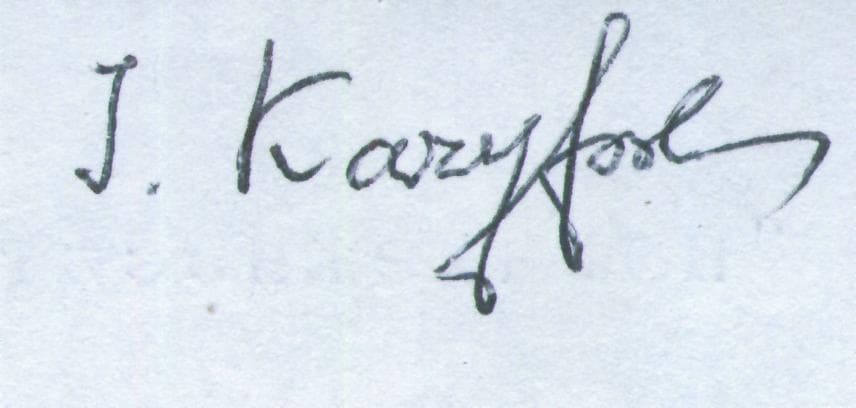 🔍 Mărește
In memoriam
Igor Kaczurowskyj (Ukrainian: Ігор Качуровський; 1 September 1918 – 18 July 2013) was a Ukrainian poet, translator, writer, academic and radio journalist.
Igor Kaczurowskyj a adăugat o fotografie
acum 3 luni
Igor Kaczurowskyj (Ukrainian: Ігор Качуровський; 1 September 1918 – 18 July 2013) was a Ukrainian poet, translator, writer, academic and radio journalist.
Igor Kaczurowskyj a adăugat o fotografie
acum 3 luni
Early life and education Igor Vasilyevich Kaczurowskyj was born on 1 September 1918 in Nizhyn, Ukrainian State (present-day Ukraine) to a Ukrainian Jewish family. Kaczurowskyj's mother, Yevgeniya Oleksandrivna Kachurovskaya (Ukrainian: Євгенія Олександрівна Качуровська; née Sakovich), was a member of the Ukrainian nobility and graduate of the Women's Higher Courses. His father, Vasyl Antonovich Kachurovsky (Ukrainian: Василь Антонович Качуровський), held a law degree from Saint Vladimir Imperial University of Kiev and an economics degree in absentia from a university in Moscow. During the Ukrainian People's Republic Kaczurowskyj's father was a member of the Central Rada, serving as assistant state secretary and later as the financial officer of Nizhyn district. Kaczurowskyj first lived in the village of Kruty however, in order to avoid Soviet repression the Kaczurowskyj family initially moved to Nizhyn in November 1930 before settling in Mala Vyska in spring 1931. In 1932, the family relocated to Kursk, Russian SFSR (present-day Russia). In 1937 Kaczurowskyj completed his secondary education and began attending the Kursk State Pedagogical Institute, studying under Boris Jarkho and Petro Odarchenko. Kaczurowskyj graduated in 1941.
Igor Kaczurowskyj a lăsat un gând
acum 3 luni
Austria The Kaczurowskyj family returned to Kruty in 1942 but later in 1943 escaped through Western Ukraine into the Slovak Republic. The family later relocated to Allied-occupied Austria (present-day Austria) and from 1945 onwards lived in Camp 373, a Displaced Persons Camp in Spittal an der Drau. In 1946, Kaczurowskyj's poem "How good it is that you are not with me" (Ukrainian: Як це добре, що ти не зі мною) was published in Ostanni Novyny (Ukrainian: Останні новини), a Ukrainian language newspaper in Salzburg. In 1947, Kaczurowskyj won an award for the short story "Passport" (Ukrainian: Пашпорт) from the publishing house "Novi Dni" (Ukrainian: Нові дні), and began co-operating with the magazine "Kettle-drums" (Ukrainian: Літаври). In 1948, Kaczurowskyj's first collection of poetry "Over the Bright Source" (Ukrainian: Над світлим джерелом) was published. During this period Kaczurowskyj was one of the founding members of the Salzburg based Union of Ukrainian Scholars, Writers and Artists.
Igor Kaczurowskyj a lăsat un gând
acum 3 luni
Argentina Towards the end of 1948 Kaczurowskyj and his family emigrated to Argentina and settled near Buenos Aires. Kaczurowskyj first worked as a labourer on a port railway repair crew and later as a port janitor, whilst studying Spanish in his spare time. During this period Kaczurowskyj edited the magazine "Porohy" ("Dnipro-Waterfalls"), wrote for the periodicals "Ovyd" ("Outlook"), "Mitla" ("The Broom"), "Novi Dni" ("New Days"). In 1958–62 he assisted the Instituto Grafotécnico (a Literary Institution); 1963–64 he lectured on Ancient Ukrainian literature at the Pontifical Catholic University of Argentina, in 1968 on Russian literature at the Universidad del Salvador, both in Buenos Aires.
Igor Kaczurowskyj a lăsat un gând
acum 3 luni
Germany In 1969 he moved to Munich (German Federal Republic), remaining nevertheless a citizen of Argentina. In the 1970–80s he wrote and broadcast over two-thousand scripts, as a literary commentator (program specialist) at the "Ukrainian Desk" of the broadcasting service Radio Free Europe/Radio Liberty. At the Ukrainian Free University (Munich), he obtained his PhD degree for his thesis "Old Slavic beliefs and their connections with Indo-Iranian religions"; from 1973 on he lectured at the UFU, from 1982 as an ordinary professor; at the Faculty of Philosophy he held lectures on Metre (poetry)versification, stylistics, theory of literary genres, history of the Ukrainian literature of the 1920–30s, History of Medieval European literature. He was a member of the Association of Ukrainian Writers in Exile "Slovo" ("The Word"), the Union of Argentine Writers SADE (Sociedad Argentina de Escritores), National Writers' Union of Ukraine (since 1992).
Igor Kaczurowskyj a lăsat un gând
acum 3 luni
Poetry Igor Kaczurowskyj is the author of the following books of verse: "Nad Svitlym Dzherelom" ("At The Luminous Fountain), Salzburg 1948; "V Dalekiy Havani" ("In The Far Harbor"), Buenos Aires 1956; "Pisnya Pro Bilyi Parus" ("White Sail Song"), Munich 1971; "Svichada Vichnosty" ("Mirrors of Eternity"), Munich 1990; "Osinni Piznyotsvity" ("Autumn Crocuses"), Kyiv 2000, 2001). The last was published in one volume, along with the poem "Selo" ("The Village"; 1st edition: Neu-Ulm 1960; 4th edition with the title "Selo v Bezodni" ("The Village in an Abyss"; Kyiv 2006). The final collection of selected poems named "Liryka" was published in Lviv (2013). As a poet Kaczurowskyj was a follower of the Kyiv neoclassicists, a literary disciple of Mykhailo Orest (along with Orest, he is supposed to be one of the representatives of the post-neoclassical movement, or younger neoclassicists). Similar to Mykola Zerov and the poets of his literary school, Kaczurowskyj was a master in "poetry of the second degree" (in his own terminology "transpositive poetry") such a "poetry of culture" which is considered by Dmytro Nalyvayko as one of the major attributes of classicism as a type of artistic thought (section "Stara Evropa" ("Ancient Europe") in the book "Svichada vichnosty"). At the…
Igor Kaczurowskyj a lăsat un gând
acum 3 luni
Prose His prose writings comprise the novel "Shlyakh nevidomoho" ("The Way of an Unknown"), Munich 1956, which later was translated into English by Yuriy Tkach ("Because Deserters Are Immortal", Doncaster, Australia 1979) and into German by Lidia Kriukow ("Der Weg eines Unbekannten: Geschichte eines ukrainischen Deserteurs", Frankfurt am Main 2018); the novel "Dim nad krucheyu" ("House on a Cliff"), Munich 1966; these books consist of episodes, relating the adventures of a young Ukrainian intellectual during the Second World War, between two demoniac forces, the Soviets, and Hitler's nationalists, some reviewers, such as Caroline Egerton of "The Age", Melbourne, and Petro Soroka, Ukraine, remarking their anti-existencialist motives; a shorter story "Zaliznyi kurkul'" ("The Iron Landowner"), Munich 1959, Poltava 2005; a series of short stories, among which: "Po toy bik bezodni" ("Beyond the Abyss"), published in English in: "Urania" (A Journal of Creative Writing and Literary Studies), Kanpur, India, vol. I, #I, 1987; "Krynytsya bez vahadla" ("A Pit Without A Pendulum"); "Ochi Atosa" ("The Eyes Of Athos [a dog]"); "Tsybulyane vesillya" ("The Onion-Wedding"), etc., all his prose writings being published, jointly, in one volume with the title "Shlyakh nevidomoho", Kyiv 2006 (442 pages). Kaczurowskyj's memoirs are published in his book "Kruty moho…
Igor Kaczurowskyj a lăsat un gând
acum 3 luni
Translations Kaczurowskyj was fluent in Ukrainian and Russian. Igor Kaczurowskyj's translations of poetry had primarily appeared as parts of his aforementioned books of verse. Also, separate books of translations were published, such as: Francesco Petrarca "Vybrane" ("Selected Poems)", Munich 1982; "Zolota haluzka" ("Golden Branch"), being a collection of Iberian and Ibero-American poetry, from Spanish, Portuguese, and Catalan languages, Buenos Aires–Munich 1991; "Okno v ukrainskuyu poeziyu" ("A Window To Ukrainian Poetry"), Ukrainian poems in Russian translations, Munich–Kharkiv–Nizhyn 1997; "Stezhka kriz' bezmir" ("A Path Through The Immens"), 100 German poems, 750–1950, Paris–Lviv–Zwickau 2000; "Pisnya pro Rolanda" ("Song of Roland"), from Old French, maintaining the original syllabic metre, Lviv 2008; "Choven bez rybalky" by Alejandro Casona, a theatrical piece, translated from Spanish ("Boat Without Fisherman"), Buenos Aires 2000; "Nobelivs'ka lektsiya z literatury" ("Nobel Literature Lesson") by Aleksandr Solzhenitsyn, Neu Ulm 1973. The compilatory volume of his translations, "Kruh ponadzemnyi" ("The Super-Terrestrial Circle"), Kyiv 2007 (526 pages) comprises approximately 670 poems and fragments of over 350 authors, translated from 23 old and modern languages, first of all from Spanish (fragments of "Cantar de mio Cid", works of José Asunción Silva, Rubén Darío, Amado Nervo, Juan Ramón Jiménez, Alfonsina Storni, Gabriela Mistral, Federico García Lorca,…
Igor Kaczurowskyj a lăsat un gând
acum 3 luni
Scientific work In literary theory, Kaczurowskyj's major aim was the development of the principles put forward by Boris Yarkho and Volodymyr Derzhavyn. He is the author of several textbooks of theory of literature, which was the main subject — along with History of Literature — of his lectures and scientific papers. They are: "Novela yak zhanr" ("The Short Story as a Genre"), Buenos Aires 1958; "Strofika" ("A Study of Stanzas"), Munich 1967;
Igor Kaczurowskyj a lăsat un gând
acum 3 luni
"Fonika" ("Phonic"), Munich 1984; "Narys komparatyvnoyi metryky" ("An Outline on Comparative Meters"). Munich 1985; second edition: Kyiv 1994; Stylistic: "Osnovy analizy movnykh form" ("Basic Analysis of Linguistic Patterns"), 1. "Leksyka" ("Lexis"), Munich–Nizhyn 1994, 2. "Figury i tropy" ("Figures and Tropes"), Munich–Kyiv 1995; "Generyka i Arkhitektonika" ("Literary Genres and Structure"): 1. "Literatura evropeys'koho serednyovichchya" ("European Literature of the Middle Ages"), a great work, with numerous translations into Ukrainian, analysis, etc., and an "Introduction" by Ivan Dzyuba, 380 pp., richly illustrated, Kyiv 2005, 2. "Zasady naukovoho literaturoznavstva" ("Principles of Literary Sciences") and "Zhanry novoho pys'menstva" ("New Literature Genres"), Kyiv 2008. A synthesis of Kaczurowskyj's research work as a historian of Ukrainian literature, may be found in his book "Promenysti syl'vety" ("Shining Silhouettes") – lectures, papers, articles, essays, treatises, the main purpose of this work being to recall to mind the wrongly forgotten gifted authors of Ukrainian literature, especially those of the Second World War generation, and to relieve the minds of readers and researchers from the stereotype concepts regarding famous representatives of Ukrainian literature (Taras Shevchenko, Ivan Franko, Lesya Ukrayinka). Selected broadcasting scripts on arts and literature from "Radio Liberty" were compiled in a volume: "150 vikon u svit" ("150 Windows to…
Igor Kaczurowskyj a lăsat un gând
acum 3 luni
Personal life and death On 20 June 1968, Kaczurowskyj married Lydia Kryukova-Kachurovskaya (Ukrainian: Лідія Крюкова-Качуровська; 1935–2020), a translator and art critic, with whom he had one son. Through his marriage to Kryukova-Kachurovskaya, Kaczurowskyj was the son-in-law of the artist Boris Kriukow and the painter Olga Gurski. On 18 July 2013 Kaczurowskyj died in Munich aged 94. Kaczurowskyj's ashes were buried in Kruty on 22 Novemner 2013.
Igor Kaczurowskyj a lăsat un gând
acum 3 luni
Awards 1982 — Ivan Franko Fund (Chicago, United States) prize, awarded for the translation of Francesco Petrarca's book "Selected". 1994 — Maksym Ryls'kyi Prize, for his work as a translator. 2002 — award of the SUCHASNIST magazine and the League of Ukrainian Patrons of Art, for his essay "Gothic Literature And Its Genres" 2003 — Volodymyr Vynnychenko Prize, for his outstanding intellectual contribution to the development of Ukrainian culture. 2006 — Volodymyr Svidzins'kyi Literary Award, for his activity as a poet and translator. 2006 — National Taras Shevchenko Prize of Ukraine, for his book "Promenysti syl'vety (lectures, papers, articles, conferences, essays, treatises)", Munich 2002; 2nd ed. in the "Library of the Shevchenko Committee" series, Kyiv 2008.