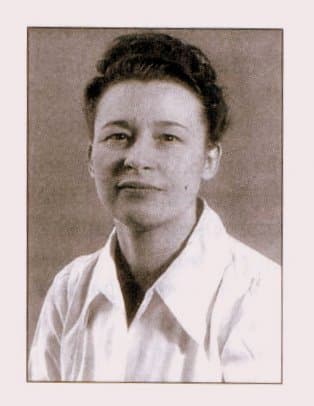
Ilona Banga (1906–1998) was a Hungarian biochemist known for co-discovering actomyosin and working to characterize how actin and myosin interact to produce muscle contraction. She and her husband József Mátyás Baló discovered the first elastase – an enzyme capable of degrading the protein elastin which gives tissues like veins their flexibility. She also contributed to work that earned Albert Szent-Györgyi the Nobel Prize in Physiology or Medicine in 1937, including by developing methods for the purification and characterization of large quantities of vitamin C. During World War II she saved t
Ilona Banga (1906–1998) was a Hungarian biochemist known for co-discovering actomyosin and working to characterize how actin and myosin interact to produce muscle contraction. She and her husband József Mátyás Baló discovered the first elastase – an enzyme capable of degrading the protein elastin which gives tissues like veins their flexibility. She also contributed to work that earned Albert Szent-Györgyi the Nobel Prize in Physiology or Medicine in 1937, including by developing methods for the purification and characterization of large quantities of vitamin C. During World War II she saved the equipment of the Institute of Chemistry of the University of Szeged.
0 comentarii0 reacții
Ilona Bangaa adăugat o fotografie
acum 3 luni
R.I.P Ilona
Early life and education
Banga was born February 3, 1906, in the southeastern Hungarian town of Hódmezővásárhely. She was interested in becoming a medical doctor but chose instead to study chemistry because her mother didn't think medical doctor was a proper profession for a woman.
She started studies in Szeged, continued at the University of Vienna and received an MSc in chemistry from the University of Debrecen in 1929. At the University of Debrecen she carried out Physiology research under the guidance of professor Fritz Verzár.
0 comentarii0 reacții
Ilona Bangaa lăsat un gând
acum 3 luni
Career After graduating, she joined the laboratory of Albert Szent-Györgyi at the University of Szeged's Institute for Medicinal Chemistry as a research assistant – she was the first associate for this future Nobel laureate. Banga worked with Szent-Györgyi for almost fifteen years, resulting in 25 joint publications. Banga later spent time working abroad in Liege, Belgium, and Oxford, England. While in Oxford she worked with another future Nobel laureate, Severo Ochoa to study vitamin B1. In 1945, Albert Szent-Györgyi moved his lab from Szeged to Budapest and Banga followed him there. She later became chief of the Chemical Laboratory of the First Institute of Pathological Anatomy in Budapest, where she studied arteriosclerosis and aging with her husband József Baló. She retired in 1970. After retiring she remained engaged in the scientific community, serving as a scientific advisor to the Gerontology Institute from 1971 to 1986. Banga was never made a professor, even though (in 1950) she received her DSc degree, making her eligible. She was, however, the first woman to achieve the rank of docent (comparable to associate professor) at the University of Szeged (1940). She authored two scientific texts, including Structure and Function of Elastin and Collagen, and was…
0 comentarii0 reacții
Ilona Bangaa lăsat un gând
acum 3 luni
Research Banga's initial work as Szent-Györgyi's associate involved studying carbohydrate metabolism. She developed methods for the large-scale purification of ascorbic acid (vitamin C) from Hungarian paprika – work that entailed extracting the vitamin from close to a metric ton of paprika. After winning the Nobel Prize in Physiology or Medicine in 1937 (for work to which Banga contributed), Albert Szent-Györgyi switched his lab's focus to researching muscle contraction, motivated by the findings of Engelhardt and Ljubimova that the muscle protein myosin wasn't merely a structural protein – it had phosphatase (ATPase) activity. Banga confirmed these findings and further characterized myosin's ability to split ATP. In the process, she co-discovered actomyosin. In order to get myosin to analyze, Banga extracted it from rabbit muscles – she minced rabbit muscles and extracted myosin from them following an established high salt protocol. One time she ran out of time to do the extraction and left the minced muscle sitting in saline overnight and when she came back the next morning it had changed from its usual thin liquid appearance to a thick, viscous solution. They found that if they added ATP to it the viscosity would decrease. Further work by another lab member,…
0 comentarii0 reacții
Ilona Bangaa lăsat un gând
acum 3 luni
Personal life
Banga married the pathologist József Mátyás Baló in Szeged in 1945, working closely with him on research on arteriosclerosis until his death in 1979. The couple had a son, Mátyás Jr., who became an academic dermatologist. Banga died March 11, 1998.
0 comentarii0 reacții
Ilona Bangaa lăsat un gând
acum 3 luni
Honors and awards
Banga was awarded the Kossuth Prize in 1955 for her discovery of elastase – it was offered to her in 1952 but in what's believed to be an oversight, her husband and co-discoverer József Mátyás Baló was not included so, responding that the work was a joint effort, she declined the offer, accepting it in 1955 when the offer was made to the pair of them. She was the first awardee of the University of Szeged's Albert Szent-Györgyi Commemorative Medal (1986) and was elected to the Leopoldina Academy in Halle, East Germany in 1962.
0 comentarii0 reacții
Ilona Bangaa lăsat un gând
acum 3 luni
Selected works
"Myosin and Muscular Contraction" – in this report, Banga et al. describe their groundbreaking experiments leading to the discovery of actomyosin I Studies from the Institute of Medical Chemistry University Szeged 5–15
Banga, I.; Szent-Györgyi, Albert (1934). "The large scale preparation of ascorbic acid from Hungarian pepper (Capsicum annuum)". Biochemical Journal. 28 (5): 1625–1628. doi:10.1042/bj0281625. ISSN 0264-6021. PMC 1253379. PMID 16745554.
These archives contain Studies from the Institute of Medical Chemistry University Szeged – reports published by Banga and others in the Szent-Gyorgi laboratory during WWII "Actin Cytoskeleton Research Group – Archives". actin.aok.pte.hu. Retrieved 2019-10-22.