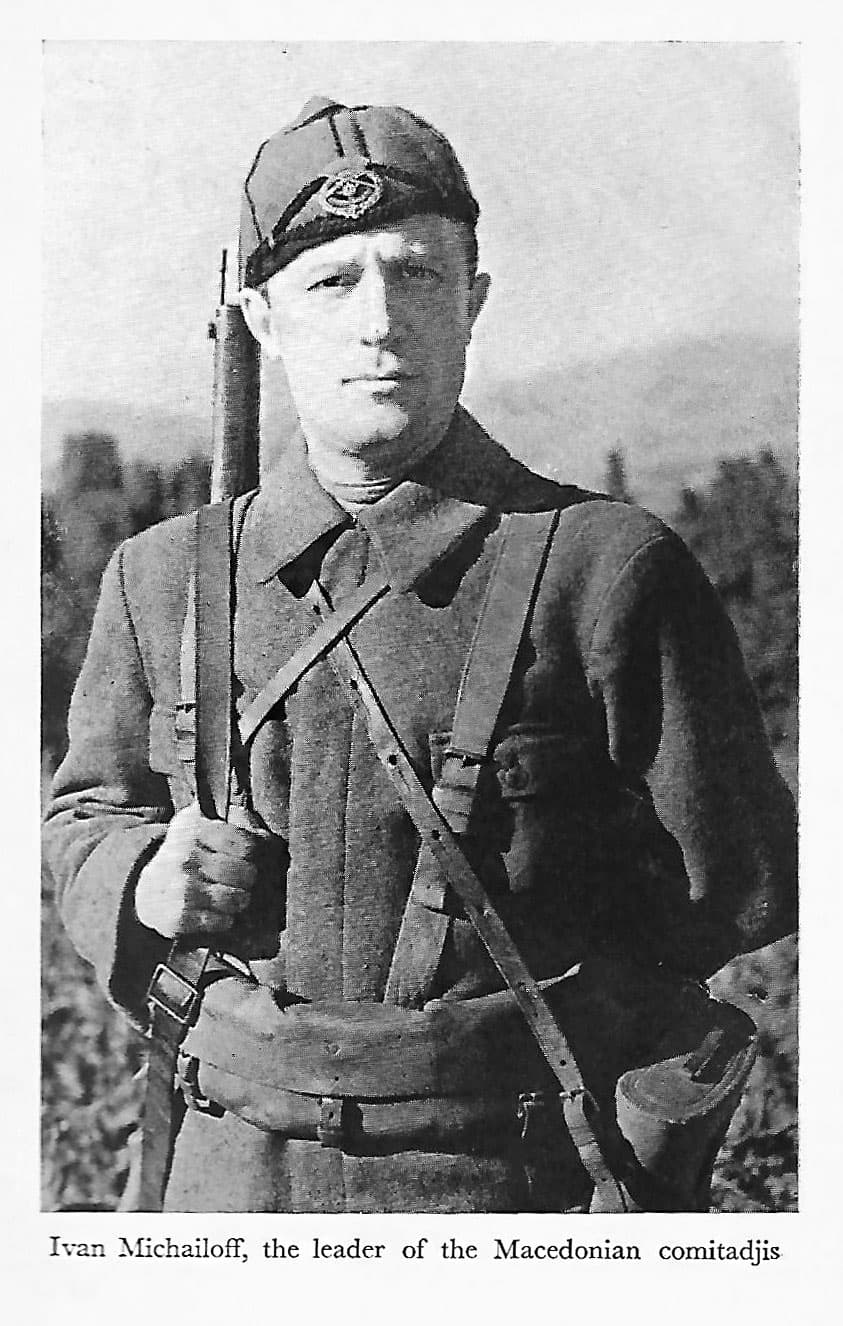
Ivan Mihaylov Gavrilov (Bulgarian: Иван Михайлов Гаврилов; Macedonian: Иван Михајлов Гаврилов; 26 August 1896 – 5 September 1990), also known as Vancho Mihaylov (Bulgarian: Ванчо Михайлов; Macedonian: Ванчо Михајлов), was a Macedonian Bulgarian revolutionary in interwar Macedonia and the last leader of the Internal Macedonian Revolutionary Organization (IMRO). Under Mihaylov, IMRO became notoriously anti-communist and identified itself closely with Bulgarian nationalism, thus eliminating not only the enemies of the Bulgarian national idea in Macedonia but also its left-wing opponents within th
Ivan Mihaylov Gavrilov (Bulgarian: Иван Михайлов Гаврилов; Macedonian: Иван Михајлов Гаврилов; 26 August 1896 – 5 September 1990), also known as Vancho Mihaylov (Bulgarian: Ванчо Михайлов; Macedonian: Ванчо Михајлов), was a Macedonian Bulgarian revolutionary in interwar Macedonia and the last leader of the Internal Macedonian Revolutionary Organization (IMRO). Under Mihaylov, IMRO became notoriously anti-communist and identified itself closely with Bulgarian nationalism, thus eliminating not only the enemies of the Bulgarian national idea in Macedonia but also its left-wing opponents within the Macedonian liberation movement. Mihaylov changed the organization's tactics from guerrilla campaigns to individual terrorist acts. Numerous attacks were carried out by IMRO against Yugoslav officials under his leadership, the most spectacular of which was the assassination of Alexander I of Yugoslavia, in collaboration with Croatian Ustaše. He actively cooperated with revanchist powers, such as Mussolini's Fascist Italy, Admiral Horthy's Hungary and Hitler's Nazi Germany. During the last stage of the war, he tried to realize IMRO's plan to create an Independent Macedonia but ultimately refused to move forward due to the lack of German military support and his reluctance to take a course that would lead to civil war. During the Cold War, Mihaylov lived in Italy while the…
0 comentarii0 reacții
Ivan Mihailova adăugat o fotografie
acum 3 luni
R.I.P Ivan
Early years
Ivan Mihaylov was born on 26 August 1896 in the village of Novo Selo (today a quarter of Štip, North Macedonia), in the Kosovo vilayet of the Ottoman Empire. Mihaylov studied at the Bulgarian Men's High School in Thessaloniki up until the Second Balkan War (1913), when the school was closed by the new Greek administration. He later continued his schooling at a Serbian school in Skopje, then in the Kingdom of Serbia. A scholarship was offered to him by the Serbian Ministry of Education to pursue a degree at a European university, but he declined. During the First World War, he enlisted in the Bulgarian Army, which occupied the region at the time. After the end of the war, Mihaylov emigrated to Bulgaria, settling in Sofia. Here he began studying law at the Sofia University. It was at this time that he was offered to work as personal secretary to the then IMRO leader Todor Aleksandrov.
0 comentarii0 reacții
Ivan Mihailova adăugat o fotografie
acum 3 luni
R.I.P Ivan
Leader of the IMRO On 31 August 1924, Todor Aleksandrov was assassinated under unclear circumstances and IMRO soon came under the control of Mihaylov, who by then had become a prominent figure in Bulgarian politics. IMRO's leadership was quick to blame Aleksandrov's death on the communists, while they claimed that Mihaylov may have actually been responsible for the murder. These events created friction between factions within the organization and led to several high-profile murders, including that of Petar Chaulev (who led the Ohrid uprising in 1913) in Milan. During the interwar period, IMRO took action against several former members of IMRO's Sandanist (left-wing) faction. Gjorche Petrov was killed in Sofia in 1922. Todor Panitsa, who had killed the right-wing Boris Sarafov and Ivan Garvanov, was assassinated in Vienna in 1924 by Mihaylov's future wife, Mencha Karnichiu." Dimo Hadjidimov, Georgi Skrizhovski, Aleksandar Bujnov, Chudomir Kantardjiev, and many others were killed in a series of murders, all taking place in 1925. Mihaylov's group of young IMRO cadres soon fell into conflict with the older members of the organization. The latter were in favour of the old tactics of incursions by armed bands into Yugoslavia and Greece, whereas the former favoured more flexible…
0 comentarii0 reacții
Ivan Mihailova adăugat o fotografie
acum 3 luni
R.I.P Ivan
1934 – 1944 After 1934, Mihaylov lived in Turkey, Poland and Hungary and finally settled in the Croatian capital Zagreb, which at that time was part of the Independent State of Croatia, a fascist puppet-state. In 1941, during World War II, most of Vardar Macedonia and a half of Greek Macedonia were annexed by Bulgaria and along with various other regions, becoming part of Greater Bulgaria. Mihaylov refused to return to the Bulgarian-occupied part of Macedonia and remained in Croatia until the end of the war. With his help in 1943, some armed detachments – Ohrana, which included Bulgarian Slav-speakers in Italian- and German-occupied Greek Macedonia were organised. It was apparent that Mihaylov had broader plans which envisaged the creation of a Macedonian state under a German control. It was also anticipated that the IMRO volunteers would form the core of the armed forces of a future Independent Macedonia in addition to providing administration and education in the Florina, Kastoria and Edessa districts. Refusal to create a pro-Nazi Puppet State In August 1943, Ivan Mihaylov left Zagreb incognito for Germany where he was to visit the main headquarters of Hitler and the headquarters of the Sicherheitsdienst, where he spoke to…
0 comentarii0 reacții
Ivan Mihailova adăugat o fotografie
acum 3 luni
R.I.P Ivan
During the Cold War In 1944, he was forced to flee again, this time to Italy. The Bulgarian communist leader Georgi Dimitrov ordered the assassination of Mihaylov. The new regimes in Bulgaria, Yugoslavia and Greece persecuted his followers as fascists and traitors. After World War II the ruling Bulgarian Communists declared the population in Bulgarian Pirin Macedonia as ethnic Macedonian and teachers were brought in from Yugoslavia to teach the locals in the recently codified Macedonian language. The organizations of the IMRO in Bulgaria were completely destroyed. Former IMRO members were hunted by the communist Militsiya and many of them were imprisoned, repressed, exiled or killed. On the other hand, former Mihaylovists were also persecuted by the Belgrade-controlled authorities on accusations of collaboration with the Bulgarian occupation, Bulgarian nationalism, anti-communist and anti-Yugoslav activities, etc. Josip Broz Tito and Georgi Dimitrov worked on a project to merge Bulgaria and Yugoslavia into a Balkan Federative Republic under control of the Balkan Communist Federation. These policies were reversed after the Tito–Stalin split in June 1948, when Bulgaria, being subordinated to the interests of the Soviet Union took a stance against Yugoslavia. After the Second World War many former "Ohranists" were convicted of military…
0 comentarii0 reacții
Ivan Mihailova lăsat un gând
acum 3 luni
Legacy Although the Internal Macedonian Revolutionary Organization (IMRO) was no longer active, Mihaylov remained the leader of the Macedonian Liberation Movement and was supported by the Macedonian Patriotic Organization of US and Canada, of Fort Wayne, Indiana. He wrote four books of memoirs and regularly wrote articles for The Macedonian Tribune, the oldest continuously published Macedonian émigré newspaper. Until the end of his life, Mihaylov continued his interest in the fate of the Macedonians (whom he considered ethnically Bulgarian) and was committed to an autonomous or independent Macedonian state. In Bulgaria, Mihaylov is regarded as an important revolutionary from the third generation of freedom fighters who continued the struggle for political autonomy or independence in the Bulgarian-populated parts of Macedonia after the partition of most of the region of Macedonia between Serbia and Greece after the First World War. His memory is honoured and his name is taken from streets and schools in the country. In North Macedonia, Ivan Mihaylov has been regarded as a controversial pro-Bulgarian revolutionary. The Constitutional court of the country banned in 2001 the Radko Association, a Bulgarian organization bearing the nickname of Ivan Mihaylov as separatist. In 2023 the Bulgarian Cultural Club in Bitola called…
0 comentarii0 reacții
Ivan Mihailova lăsat un gând
acum 3 luni
Mihaylov and the Macedonian question There are different opinions about Mihaylov's activity in Bulgaria, but scholars agree that he was a staunch defender of the idea of the strong Bulgarian character of the Slav-speaking population in Macedonia. He envisioned an independent united Macedonian multiethnic state with a predominantly ethnic Bulgarian population, a "Switzerland on the Balkans," as he wrote. According to his personal secretary, Vida Boeva, he was constantly canvassing by means of petitions, letters of protest, and memos addressed to the UN from the Macedonian Patriotic Organisation, emphasizing that the Macedonian Republic was a colony of Serbia under another name. Mihaylov declared that Macedonia is Bulgarian and that the Slavs in Macedonia are Bulgarian. The people that ruled Macedonia, he insisted, were either serbophiles or grecophiles. He believed that the Macedonians are part of the Bulgarian nation and that the founders of IMRO were people who accepted the idea of a San Stefano Bulgaria. According to Macedonian historian Ivan Katardžiev, Mihaylov's interpretation of the term "Macedonian" was that it was a generalizing, regional term, including different ethnicities such as Bulgarians, Aromanians, and Albanians, but not ethnic Macedonians. Katardžiev regarded his IMRO as "a purely Bulgarian affair" and him as…