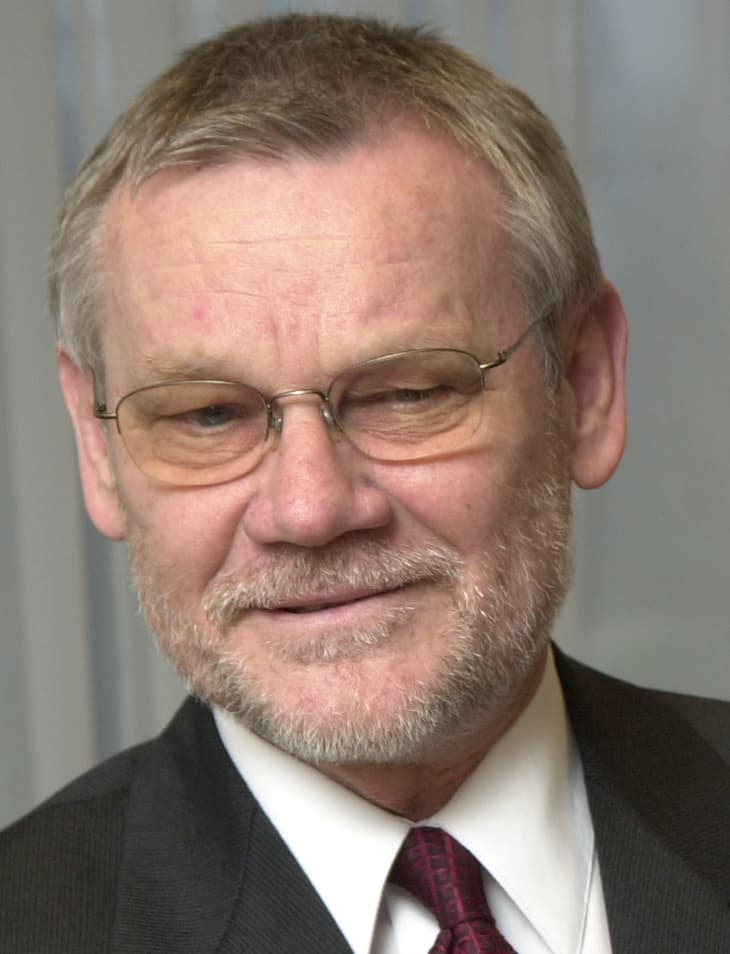
Ivica Račan (pronounced [îʋit͡sa rât͡ʃan]; 24 February 1944 – 29 April 2007) was a Croatian politician who served as Prime Minister of Croatia from 2000 to 2003, heading two centre-left coalition governments. Račan became the first prime minister of Croatia not to be a member of the Croatian Democratic Union, namely the opposition coalition headed by his Social Democratic Party won the 2000 parliamentary election and came to power for the first time since independence. He was the leader of the party, the successor of the League of Communists of Croatia, from 1990 to 2007. Before becoming prime
Ivica Račan (pronounced [îʋit͡sa rât͡ʃan]; 24 February 1944 – 29 April 2007) was a Croatian politician who served as Prime Minister of Croatia from 2000 to 2003, heading two centre-left coalition governments.
Račan became the first prime minister of Croatia not to be a member of the Croatian Democratic Union, namely the opposition coalition headed by his Social Democratic Party won the 2000 parliamentary election and came to power for the first time since independence. He was the leader of the party, the successor of the League of Communists of Croatia, from 1990 to 2007.
Before becoming prime minister, Račan served in the capacity of Leader of the Opposition on two occasions: firstly, from the first multi-party elections in May 1990 until the formation of a national unity government under Franjo Gregurić in July 1991; and secondly, from his defeat in the 2003 general election by Ivo Sanader until his death on 29 April 2007.
0 comentarii0 reacții
Ivica Račana adăugat o fotografie
acum 3 luni
R.I.P Ivica
Early life
Račan was born on 24 February 1944 in Ebersbach, Nazi Germany, where his mother Marija Draženović was interned in a labor camp during World War II. He and his mother survived the Allied bombing of Dresden and were buried for days in the basement of a collapsed building. After the war, Račan returned to Croatia and spent his childhood and adolescence in Slavonski Brod, before moving to Zagreb and enrolling at the University of Zagreb. In 1970 he graduated from the Zagreb Faculty of Law.
0 comentarii0 reacții
Ivica Račana adăugat o fotografie
acum 3 luni
R.I.P Ivica
Early career (1961–1989) Račan entered politics in the People's Republic of Croatia in 1961 as a member of the League of Communists of Croatia (SKH), the Croatian branch of the League of Communists of Yugoslavia (SKJ). He was president of the communist youth organization in the Slavonski Brod gymnasium. From 1963 to 1974 he worked for the Yugoslav institute of social research where he studied and researched the topic of Workers' self-management. In 1972, his professional political career began when he entered the central committee of the Croatian league of communists after 6 seats were made available because those 6 previous officials were involved in the 1971 Croatian Spring. He was a member of the SKH culture committee and the head ideology commissioner. From 1982 to 1986, he was director of the "Josip Broz Tito" political school in Kumrovec. In 1986 he was elected to represent SKH in the presidency of the Yugoslav league of communists in Belgrade. In the late 1980s during the Anti-bureaucratic revolution, tensions grew between pro-Milošević and anti-Milošević supporters so in autumn 1989 the Croatian communists elected Račan as the president of SKH because he defended the rights of republic autonomies which the Milošević establishment wanted…
0 comentarii0 reacții
Ivica Račana adăugat o fotografie
acum 3 luni
R.I.P Ivica
Opposition years (1990–1999) Under his leadership, SKH re-branded themselves as the Party of Democratic Reform (Croatian: Stranka demokratskih promjena or SDP) in February 1990 and then ran in the 1990 election as SKH-SDP, winning 26 percent of the votes and coming in second behind the right-wing Croatian Democratic Union (HDZ). During the 1990 election campaign, Račan stirred some controversy when he referred to HDZ as a "party of dangerous intentions". Although his party had lost the election, they remained the second largest party in the Sabor, and Račan thus continued his political career as the first Leader of the Opposition in the history of modern Croatia. SKH-SDP, however, quickly became a shadow of its former self – a majority of its membership, including the highest-ranking officials, defected to HDZ, while the breakup of Yugoslavia, the rebellion of ethnic Serbs and the ensuing war which broke out in 1991 further radicalised the Croatian public. In such circumstances, Račan was more concerned with the survival of his party rather than challenging Franjo Tuđman's rule, even if it meant tolerating some of Tuđman's more controversial policies, like the nationalisation of workers' owned enterprises and privatisation. In such circumstances, Račan gave up the opposition…
0 comentarii0 reacții
Ivica Račana adăugat o fotografie
acum 3 luni
R.I.P Ivica
Premiership (2000–2003) In August 1998, Račan and Budiša signed a coalition agreement and later won the 2000 elections, dislodging HDZ from power after a decade. Following the election, Račan became Prime Minister of Croatia and formed a six-party centre-left government with ministers from SDP, HSLS, the Croatian Peasant Party (HSS), the Liberal Party (LS), the Croatian People's Party (HNS), and the Istrian Democratic Assembly (IDS). Račan, like the newly elected president Stjepan Mesić, was initially hailed as a new, reformist leader who would symbolize the break with Croatia's authoritarian and nationalist past. While a democrat, Račan was, however, inefficient in running a government comprising six parties, the first coalition in modern Croatian history. His style of governance, sometimes described by the phrase "Odlučno možda" ("Decisively maybe" in English), plagued his government with factional struggles. Račan had to adopt a compromise-making attitude which limited the government's ability to commit fully to what should be done. Račan faced problems when his main coalition partner Budiša lost in the 2000 Croatian presidential election. This made Budiša lose any significant role in the government so he became frustrated and started making trouble. This led to the break-up with Budiša who took a more nationalist…
0 comentarii0 reacții
Ivica Račana lăsat un gând
acum 3 luni
Back in opposition (2003–2006) Račan's centre-left coalition lost its majority in parliament following the November 2003 election. SDP did not create a big coalition like in the previous elections which cost them the votes. HSS decided to go alone and join the party which won the elections. Those tactics proved to be devastating for them. The coalition with HNS was rejected by Račan for reasons unknown which also proved to be a mistake. Račan conceded the defeat soon after election results were announced. His former coalition partners attacked him for conceding victory so early because they thought that they could try to enforce another great coalition but Račan said that it was unlikely to happen and even if it would happen, there would be no stability in such a great gathering. He officially ceased to be prime minister on 23 December 2003 when the Croatian Parliament approved his successor, Ivo Sanader of the HDZ, to take up that post. SDP remained the most popular opposition party in opinion polls, and Ivica Račan was viewed as the leader of Croatian opposition. While viewed as indecisive as prime minister, he proved to be very skilful in maintaining SDP party leadership for over…
0 comentarii0 reacții
Ivica Račana lăsat un gând
acum 3 luni
Illness and death On 31 January 2007, Račan announced that he would temporarily leave public life for health reasons. SDP vice-president Željka Antunović took over as chairperson of the party. His health began to deteriorate and was diagnosed with cancer in his shoulder. In February, Račan underwent two surgeries to remove cancer from his kidney, urinary tract, and shoulder. On 4 April it was announced that tests showed metastases in his brain. On 11 April he stepped down as leader of SDP. Translation of his resignation follows: Colleagues, friends, comrades! Faced with a difficult illness I continue my fight for life but it is time to thank you for our joint work and your support in my political career. We were building together a Social democratic party and I am proud of what we have achieved. I am proud of the social democratic values – morals, work, honesty, tolerance – that we have forever engraved into the political life of our country. I have done as much as I knew and all that I could. With this, I resign from the party presidency and you will have to continue without me. Find a new strength at the election convention for…
0 comentarii0 reacții
Ivica Račana lăsat un gând
acum 3 luni
Personal life
Račan married three times and had two sons, Ivan and Zoran, from his first marriage. His first wife Agata Špišić was a judge with the Croatian Constitutional Court. His second wife Jelena Nenadić was a librarian in the Kumrovec political school during the 1980s, and his third wife Dijana Pleština was a professor of political science at the College of Wooster in Ohio. He was a self-declared agnostic.
0 comentarii0 reacții
Ivica Račana lăsat un gând
acum 3 luni
Bibliography
East, Roger; Thomas, Richard J. (2003). Profiles of People in Power: The World's Government Leaders (1st ed.). London, UK: Europa Publications. ISBN 978-1-85743-126-1.
Stallaerts, Robert (2010). Historical Dictionary of Croatia (3rd ed.). Lanham, MD: Scarecrow Press. ISBN 978-0-8108-6750-5.