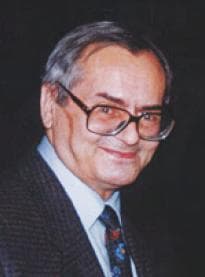
Jerzy Kazimierz Baksalary (25 June 1944 – 8 March 2005) was a Polish mathematician who specialized in mathematical statistics and linear algebra. In 1990 he was appointed professor of mathematical sciences. He authored over 170 academic papers published and won one of the Ministry of National Education awards.
Jerzy Kazimierz Baksalary (25 June 1944 – 8 March 2005) was a Polish mathematician who specialized in mathematical statistics and linear algebra. In 1990 he was appointed professor of mathematical sciences. He authored over 170 academic papers published and won one of the Ministry of National Education awards.
0 comentarii0 reacții
Jerzy Baksalarya adăugat o fotografie
acum 3 luni
R.I.P Jerzy
Biography
Early life and education (1944 – 1988)
Baksalary was born in Poznań, Poland on 25 June 1944. From 1969 to 1988, he worked at the Agricultural University of Poznań.
In 1975, Baksalary received a PhD degree from Adam Mickiewicz University in Poznań; his thesis on linear statistical models was supervised by Tadeusz Caliński. He received a Habilitation in 1984, also from Adam Mickiewicz University, where his Habilitationsschrift was also on linear statistical models.
0 comentarii0 reacții
Jerzy Baksalarya lăsat un gând
acum 3 luni
Career (1988 – 2005)
In 1988, Baksalary joined the Tadeusz Kotarbiński Pedagogical University in Zielona Góra, Poland, being the university's rector from 1990 to 1996. In 1990, he became a "Professor of Mathematical Sciences", a title received from the President of Poland. For the 1989–1990 academic year, he moved to the University of Tampere in Finland. Later on, he joined the University of Zielona Góra.
0 comentarii0 reacții
Jerzy Baksalarya lăsat un gând
acum 3 luni
2005 death and legacy
Baksalary died in Poznań on 8 March 2005. His funeral was held there on 15 March 2005. There, Caliński praised Baksalary for his "contributions to the Poznań school of mathematical statistics and biometry".
Memorial events in honor of Baksalary were also held at two conferences after his death:
The 14th International Workshop on Matrices and Statistics, held at Massey University in New Zealand from 29 March to 1 April 2005.
The Southern Ontario Matrices and Statistics Days, held at the University of Windsor in Canada from 9 to 10 June 2005.
0 comentarii0 reacții
Jerzy Baksalarya lăsat un gând
acum 3 luni
Research
In 1979, Baksalary and Radosław Kala proved that the matrix equation
0 comentarii0 reacții
Jerzy Baksalarya lăsat un gând
acum 3 luni
{\displaystyle AX-YB=C}
has a solution for some matrices X and Y if and only if
0 comentarii0 reacții
Jerzy Baksalarya lăsat un gând
acum 3 luni
{\displaystyle A^{-}}
denotes some g-inverse of the matrix A.) This is equivalent to a 1952 result by W. E. Roth on the same equation, which states that the equation has a solution iff the ranks of the block matrices
0 comentarii0 reacții
Jerzy Baksalarya lăsat un gând
acum 3 luni
{\displaystyle {\begin{bmatrix}A&0\\0&B\\\end{bmatrix}}}
are equal.
In 1980, he and Kala extended this result to the matrix equation
0 comentarii0 reacții
Jerzy Baksalarya lăsat un gând
acum 3 luni
{\displaystyle AXB+CYD=E}
, proving that it can be solved if and only if
is adopted for any matrix M.)
In 1981, Baksalary and Kala proved that for a Gauss-Markov model
0 comentarii0 reacții
Jerzy Baksalarya lăsat un gând
acum 3 luni
{\displaystyle \{y,X\beta ,V\}}
, where the vector-valued variable has expectation
0 comentarii0 reacții
Jerzy Baksalarya lăsat un gând
acum 3 luni
{\displaystyle X\beta }
and variance V (a dispersion matrix), then for any function F, a best linear unbiased estimator of
0 comentarii0 reacții
Jerzy Baksalarya lăsat un gând
acum 3 luni
{\displaystyle C(X)\subset C(TF')}
. The condition is equivalent to stating that
0 comentarii0 reacții
Jerzy Baksalarya lăsat un gând
acum 3 luni
{\displaystyle r(\cdot )}
denotes the rank of the respective matrix.
In 1995, Baksalary and Sujit Kumar Mitra introduced the "left-star" and "right-star" partial orderings on the set of complex matrices, which are defined as follows. The matrix A is below the matrix B in the left-star ordering, written