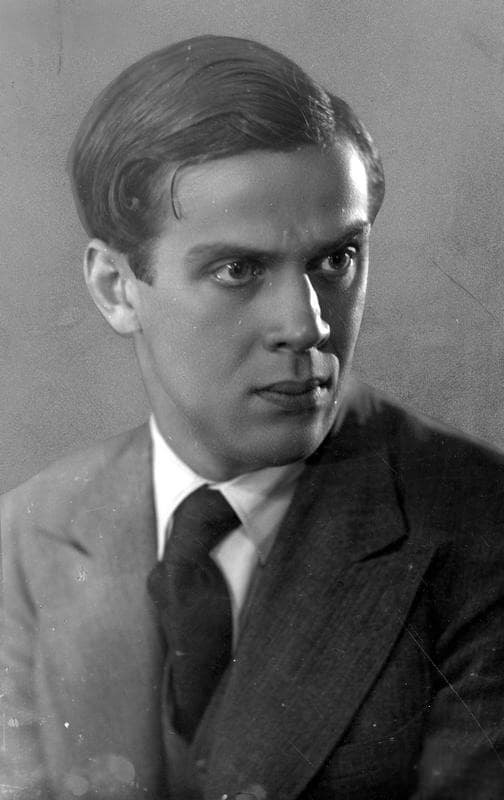
Józef Stanisław Łobodowski (Polish pronunciation: [ˈjuzɛf wɔbɔˈdɔfskʲi]) (19 March 1909 – 18 April 1988) was a Polish poet and political thinker. His poetic works are broadly divided into two distinct phases: the earlier one, until about 1934, in which he was sometimes identified as "the last of the Skamandrites", and the second phase beginning about 1935, marked by the pessimistic and tragic colouring associated with the newly nascent current in Polish poetry known as katastrofizm (catastrophism). The evolution of his political thought, from the radical left to radical anticommunism, broadly
Józef Stanisław Łobodowski (Polish pronunciation: [ˈjuzɛf wɔbɔˈdɔfskʲi]) (19 March 1909 – 18 April 1988) was a Polish poet and political thinker. His poetic works are broadly divided into two distinct phases: the earlier one, until about 1934, in which he was sometimes identified as "the last of the Skamandrites", and the second phase beginning about 1935, marked by the pessimistic and tragic colouring associated with the newly nascent current in Polish poetry known as katastrofizm (catastrophism). The evolution of his political thought, from the radical left to radical anticommunism, broadly paralleled the trajectory of his poetic oeuvre. To the contemporary reading public Łobodowski was also known as the founder and editor of several avant-garde literary periodicals, of a newspaper, translator, novelist, prose writer in the Polish and Spanish languages, radio personality, and preeminently a prolific opinion writer with sharply defined political views active before, during and after the Second World War in the Polish press (since 1940 only in the émigré press). Łobodowski described himself as a Ukrainophile and devoted three of his books to Ukrainian themes, including two collections of poetry (Pieśń o Ukrainie and Złota hramota). He spoke out in defence of ethnic minorities in Poland before and…
0 comentarii0 reacții
Józef Łobodowskia adăugat o fotografie
acum 3 luni
R.I.P Józef
Early life Łobodowski was born on 19 March 1909 in the lands of Partitioned Poland on the Purwiszki farmstead of his father, Władysław Łobodowski, a colonel in the Imperial Russian Army, and his wife Stefanja Łobodowska, née Doborejko-Jarząbkiewicz. Of the Łobodowskis' four children — three daughters and one son — two daughters died in childhood, leaving Józef and his surviving (elder) sister Władysława. In 1910 the Łobodowskis were obliged to sell their country estate and moved to Lublin. In 1914, owing to the outbreak of the First World War, Władysław Łobodowski was transferred together with his family to Moscow as a measure taken by the Imperial Russian Army to shield its officer corps from the hostilities of war. It is to this period of his early schooling in Moscow that Łobodowski owed his excellent knowledge of the Russian language. However, the upheavals of the Bolshevik Revolution of 1917 soon forced the family to flee for their lives to Yeysk in the Kuban region of the Ciscaucasia, where — drastically reduced in their means — they suffered severe privations for five years, including hunger. In this place and in these conditions Łobodowski passed the formative years of his life between the…
0 comentarii0 reacții
Józef Łobodowskia lăsat un gând
acum 3 luni
Suicide attempt During the military service he was performing at a reserve officers' cadet school (szkoła podchorążych rezerwy) in the Polish town of Równe in the Volhynia in 1933–1934 Łobodowski made an unsuccessful attempt on his life by shooting himself. The act was witnessed by others. He was hospitalized, and in the aftermath of the incident arrested (10 March 1934) on charges of possessing "leftist propaganda" (that apparently meant his own poems in manuscript, which were found during a search of his belongings performed in his absence) and placed in military prison for three weeks. The intervention of his literary friends who mobilized some of the greatest names in Polish literature on his behalf, including the well-connected writer Kazimiera Iłłakowiczówna (1892–1983) but also Ewa Szelburg-Zarembina (1899–1986) and others, was instrumental in bringing about his release from jail and in making the whole affair die a sudden death without a court martial or other long-lasting adverse consequences for Łobodowski. Łobodowski's explanation of the reasons for his suicide attempt given subsequently to Iłłakowiczówna and reported in her memoirs as attributable to disappointed love (presumably for Zuzanna Ginczanka) has been treated with scepticism by critical opinion since its publication in 1968. While Łobodowski…
0 comentarii0 reacții
Józef Łobodowskia lăsat un gând
acum 3 luni
Polemics with Wasilewska During this period Łobodowski changed some of his political views, a fact which is signalled most dramatically in his polemical exchanges with Wanda Wasilewska, a writer of a staunch communist, pro-Soviet, Stalinist stance that she will maintain unshaken even in the face of the Soviet Union's (later) alliance with Hitler and their joint attack on Poland at the beginning of the Second World War. In an article published in 1935 in the most prestigious literary periodical in Poland at the time, the Wiadomości Literackie weekly — as part of his ongoing war of words with Wasilewska — Łobodowski made the following statement which posits self-criticism as the essential element of moral courage, and which thus holds special significance for this period of his ideological transition and the whole rest of his life: A distinction must be made between on the one hand a heroism of life, which consists in a determined fight [for one's ideals] and the rejection of all compromise, and on the other hand a heroism of mind that has no fear of criticism and of a continuous reappraisal of its primary assumptions. It often so happens that people who bravely go to jail for…
0 comentarii0 reacții
Józef Łobodowskia lăsat un gând
acum 3 luni
New direction in poetry Critical acclaim and wide recognition as an important voice in literature brought him the collections of poetry Rozmowa z ojczyzną ("A Conversation with the Fatherland"; 1935; 2nd ed., corr. & enl., 1936), much appreciated by Zuzanna Ginczanka, and Demonom nocy ("To the Demons of the Night"; 1936), which won him a coveted prize of the Polish Academy of Literature in 1937 but in private was sharply criticized by Ginczanka. The general adulation showered on him by both the reading public and the critics was tempered by the dissenting voice of Ignacy Fik who wrote of Łobodowski ad personam as "a character most alien to the Polish psyche, a pagan Scythian, a Romantic shot through with anarchism and nihilism, an expansive Russian nature whose longings for his Marzanna are inspired by boredom. And where Łobodowski ends, [Czesław] Miłosz takes over...". Another carping critic, Ludwik Fryde, for his part, accused Łobodowski of "actorship, playacting". However, by 1937 such barbs served as a confirmation of Łobodowski's presence in the public spotlight with his firmly established fame. It has been observed that the latter works for the first time sound a note — from now on to be the characteristic…
0 comentarii0 reacții
Józef Łobodowskia lăsat un gând
acum 3 luni
Marriage with Jadwiga Kuryłło
On 1 March 1938 Józef Łobodowski married Jadwiga Kuryłło at St. John the Baptist Cathedral in Lublin. Depside what Jadwiga's surname might suggest, she was born to a rooted Polish Roman Catholic family. At the time of marriage, Józef was 29 and Jadwiga 26, but they had started their relationship when Jadwiga was still in high school. They became separated when WWII broke up in 1939. Due to the postwar communist reality in Poland, which Józef Łobodowski actively opposed from abroad, they had no contact after the war. Jadwiga divorced Józef on 9 April 1950, just before she remarried. When they were together, Jadwiga participated in Józef's work. After they became separated, Jadwiga tried to preserve Józef's work that she had managed to gather, but most of that was confiscated by Germans. She donated the remaining pieces to the Lublin Museum after the war.
0 comentarii0 reacții
Józef Łobodowskia lăsat un gând
acum 3 luni
Relationship with Zuzanna Ginczanka Józef Łobodowski had a relationship with a Jewish poet Zuzanna Ginczanka. That was opposed by his mother and his sister. Łobodowski first met Zuzanna Ginczanka — in his words, "a precociously mature woman... with eyes scintillating like the vast expanse of the sea shimmering in the sun" — at the multicultural Polish locality of Równe in Volhynia (now within the borders of Ukraine), where he had the uncommon good fortune to have been performing his military service in the autumn of 1933, when Ginczanka was 16 and he 24. When Józef married Jadwiga Kuryłło, Zuzanna ended the relationship. After the War, while living in Madrid, Łobodowski would receive a small parcel posted from Pamplona containing the gift of a golden diamond-studded tie pin, with a small note skewered on it, which read: "From the mother of Zuzanna". What remains for posterity is the extraordinary volume of understated erotic lyrics modelled stylistically on the Song of Songs, with an introduction important for historical reasons, which Łobodowski will dedicate to Ginczanka posthumously late in his own life (at the age of 78): his collection Pamięci Sulamity ("In Remembrance of the Shulamite Woman"), brimming as it is with love…
0 comentarii0 reacții
Józef Łobodowskia lăsat un gând
acum 3 luni
Second World War During the last few years preceding the outbreak of the Second World War Łobodowski lived in Łuck, in what was then Poland, moving to Warsaw in April 1938 after his marriage. He was called up in August 1939, a few days before the outbreak of the Second World War, and saw action during the September Campaign in Wiśnicz, Łańcut, and several other places, including a locality known as Dublany (then in Poland, now in Ukraine), which he memorialized in the poem entitled "Dublany" (first published in France in 1941). After the Soviet invasion of Poland on 17 September 1939, while waiting with the remnants of his brigade at Tatarów (now Tatariv in Ukraine) to cross the border into Hungary, he wrote the memorable lines of the "Noc nad granicą" (A Night on the Frontier). The next day, 19 September 1939, they crossed the Polish border through the Yablonitsky Pass: this was the moment Łobodowski would leave his homeland for ever. The veterans of his unit were interned in various places throughout the territory of Hungary, Łobodowski ending up at first at a camp at Tapolca near Lake Balaton. His subsequent wartime peregrinations are not well known; he…
0 comentarii0 reacții
Józef Łobodowskia lăsat un gând
acum 3 luni
Arrest in Paris On 20 February 1940 Łobodowski, then aged 30, was arrested by the French police in Paris in circumstances that to this day have not been properly established. The event involved the confiscation of some of his personal effects, including manuscripts, during the search of his hotel room. Some of these materials have never been returned. Those materials included anticommunist propaganda leaflets apparently secretly authored by Łobodowski for the Polish government-in-exile (then based in Paris), which were intended to be dropped from airplanes over the Soviet-occupied parts of Poland for the purpose of fomenting subversion among the Red Army — and as such they were the reason for his detention at the Cherche-Midi military prison over a period of some six months after the Polish government minister responsible for ordering the leaflets in question (Professor Stanisław Kot) denied involvement when interpellated by the French authorities. Łobodowski will use the scurrilously offensive satirical verse "Na Profesora Kota" (On Professor Kot) to lampoon the minister in question in his 1954 collection Uczta zadżumionych ("The Banquet of the Plague-stricken"), calling him again a "cynical swindler" in a parting shot fired one last time towards the end of his life. According to…
0 comentarii0 reacții
Józef Łobodowskia lăsat un gând
acum 3 luni
Post-War period While Łobodowski was a frequent victim of censorship by the Sanacja régime before the War, his legal problems then were to be eclipsed by the very effective, blanket blacklisting of all his writings by the communist censorship of the post-War Poland, which accorded him "a place of honour on the blackest of blacklists" — in the words of the literary critic Michał Chmielowiec. This resulted virtually in his being rendered, while still one of the best-known names in Polish literature, into an "unperson" in the Eastern Bloc. The blackout continued into the 1980s. Łobodowski believed that in every country in which a criminal political system holds dominion all those participating in any capacity in governance are responsible to some degree for the crimes committed in its name. For this reason he regarded with empirical scepticism and moral contempt such events as the Khrushchev Thaw and the Perestroika, for example, arguing that their authors, Nikita Khrushchev and Mikhail Gorbachev respectively, had not satisfactorily explained their own complicity in the crimes of the previous Soviet régimes which they later purported to criticize as the wrongdoing of others rather than their own. The great communist empire was for him a satanic…
0 comentarii0 reacții
Józef Łobodowskia lăsat un gând
acum 3 luni
Postscript
Unlike many other poets, Łobodowski was very good at reading his own poems in public, and they gained at his recitation.
He was influenced by Juliusz Słowacki, Henryk Sienkiewicz (prose), Julian Tuwim, Kazimierz Wierzyński, Józef Czechowicz, Władysław Broniewski, and Stefan Żeromski.
0 comentarii0 reacții
Józef Łobodowskia lăsat un gând
acum 3 luni
W przeddzień (1932)
Rozmowa z ojczyzną (1935; 2nd ed., 1936)
0 comentarii0 reacții
Józef Łobodowskia lăsat un gând
acum 3 luni
Złota hramota (1954)
Pieśń o Ukrainie (1959; bilingual edition: text in Polish and Ukrainian)
0 comentarii0 reacții
Józef Łobodowskia lăsat un gând
acum 3 luni
Selected poetry in periodicals
"Modlitwa na satyrę" (A Prayer For Satire; Wiadomości: tygodnik (London), vol. 1, No. 38/39 (38/39), 29 December 1946, p. 1)
"Serbrna śmierć" (Silver Death; Wiadomości: tygodnik (London), vol. 2, No. 51/52 (90/91), 28 December 1947, p. 1)
"Erotyk" (Erotic Poem; Wiadomości: tygodnik (London), vol. 2, No. 51/52 (90/91), 28 December 1947, p. 1)
"Dwie pochwały Heleny Fourment" (Two Eulogies in praise of Hélène Fourment; Wiadomości: tygodnik (London), vol. 12, No. 40 (601), 6 October 1957, p. 1)
"Nowe wiersze" (New Poems; Wiadomości: tygodnik (London), vol. 31, No. 7 (1559), 15 February 1976, p. 1)
"Kolęda dla Papieża" ("A Christmas Carol for the Pope"; Wiadomości: tygodnik (London), vol. 34, No. 51/52 (1760/1761), 23–30 December 1979, p. 1)
0 comentarii0 reacții
Józef Łobodowskia lăsat un gând
acum 3 luni
Prose
Por nuestra libertad y la vuestra: Polonia sigue luchando (1945)
0 comentarii0 reacții
Józef Łobodowskia lăsat un gând
acum 3 luni
Terminatorzy rewolucji (1966)
Pro relihii︠u︡ bez pomazanni︠a︡: likvidatory Uniï (1972)