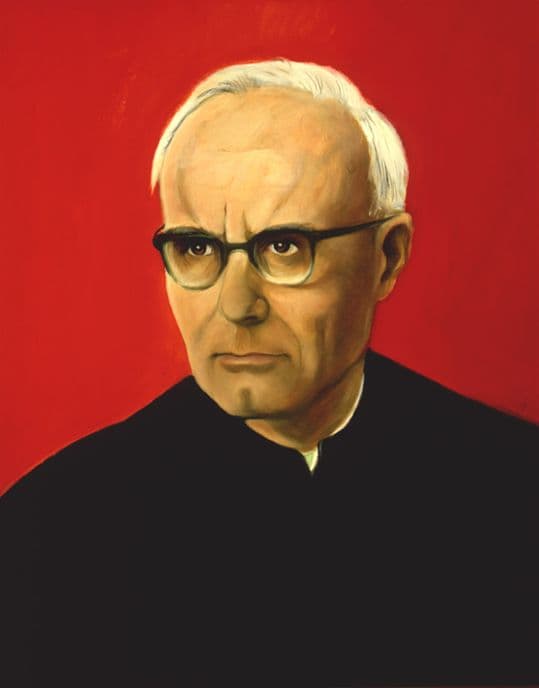
Karl Rahner (German: [ˈʁaːnɐ]; 5 March 1904 – 30 March 1984) was a German Jesuit priest and theologian who, alongside Henri de Lubac, Hans Urs von Balthasar, and Yves Congar, is considered to be one of the most influential Catholic theologians of the 20th-century. He was the brother of Hugo Rahner, also a Jesuit scholar. Before the Second Vatican Council, Rahner worked alongside Yves Congar, Henri de Lubac, and Marie-Dominique Chenu, theologians associated with the emerging school of theological thought known as Nouvelle théologie. The Council was influenced by Rahner's theology and his unders
Karl Rahner (German: [ˈʁaːnɐ]; 5 March 1904 – 30 March 1984) was a German Jesuit priest and theologian who, alongside Henri de Lubac, Hans Urs von Balthasar, and Yves Congar, is considered to be one of the most influential Catholic theologians of the 20th-century. He was the brother of Hugo Rahner, also a Jesuit scholar.
Before the Second Vatican Council, Rahner worked alongside Yves Congar, Henri de Lubac, and Marie-Dominique Chenu, theologians associated with the emerging school of theological thought known as Nouvelle théologie. The Council was influenced by Rahner's theology and his understanding of Catholic faith.
0 comentarii0 reacții
Karl Rahnera adăugat o fotografie
acum 3 luni
R.I.P Karl
Early life and education
Karl Rahner's parents, Karl and Luise (née Trescher) Rahner, had seven children, of whom Karl was the fourth. His father was a professor in a local college and his mother had a profound religious personality, which influenced his home atmosphere. Karl attended primary and secondary school in Freiburg entering the Society of Jesus upon graduation.
0 comentarii0 reacții
Karl Rahnera adăugat o fotografie
acum 3 luni
R.I.P Karl
Career He began his Jesuit formation in the North German Province of the Jesuits in 1922, four years after his older brother Hugo entered the same order. Deeply affected by the spirituality of Ignatius of Loyola during the initial phase of his formation (1922–24), he concentrated the next phase of his formation (1924–27) on Catholic scholastic philosophy and the modern German philosophers: he seems to have been particularly interested in Immanuel Kant and two contemporary Thomists, the Belgian Jesuit Joseph Maréchal and the French Jesuit Pierre Rousselot, who were to influence Rahner's understanding of Thomas Aquinas in his later writings. As a part of his Jesuit training, Rahner taught Latin to novices at Feldkirch (1927–29), then began his theological studies at the Jesuit theologate in Valkenburg aan de Geul in 1929. This allowed him to develop a thorough understanding of patristic theology, also developing interests in spiritual theology, mysticism, and the history of piety. Rahner was ordained a priest on 26 July 1932, and then made his final year of tertianship, the study and taking of Ignatius' Spiritual Exercises, at St. Andrä in Austria's Lavanttal Valley. Because Rahner's superiors wished him to teach philosophy at Pullach, he returned home to…
0 comentarii0 reacții
Karl Rahnera adăugat o fotografie
acum 3 luni
R.I.P Karl
Relationship with Luise Rinser
From 1962 to his death in 1984, Rahner engaged in a 22-year-long correspondence with German author Luise Rinser. During this period, the couple sent roughly 4,000 letters to each other, some disclosing romantic feelings. Rinser's letters to Rahner were published in 1994.
0 comentarii0 reacții
Karl Rahnera adăugat o fotografie
acum 3 luni
R.I.P Karl
Work
Rahner's output is extraordinarily voluminous. In addition to the above-mentioned writings, his other major works include: the ten-volume encyclopaedia, Lexicon für Theologie und Kirche; a six-volume theological encyclopaedia, Sacramentum Mundi, and many other books, essays, and articles. In addition to his own work, the reference texts that Rahner edited also added significantly to the general impact of his own theological views.
The basis for Rahner's theology is that all human beings have a latent ("unthematic") experience of God in any perception of meaning or "transcendental experience". It is only because of this proto-revelation that recognising a distinctively special revelation (such as the Christian Gospel) is possible. His theology influenced the Second Vatican Council and was ground-breaking for the development of what is generally seen as the modern understanding of Catholicism. Until the early 2000s his thought also shaped Catholic theology in the United States. A popular anecdote, that resonates with those who find some of Karl Rahner's works difficult reading, comes from his brother Hugo who quipped that in his retirement he'd try to "translate his brother's works ... into German!"
0 comentarii0 reacții
Karl Rahnera lăsat un gând
acum 3 luni
Foundations of Christian Faith
Written near the end of his life, Rahner's Foundations of Christian Faith (Grundkurs des Glaubens) is the most developed and systematic of his works, most of which were published in the form of essays.
0 comentarii0 reacții
Karl Rahnera lăsat un gând
acum 3 luni
Economic and immanent Trinity
Among the most important of his essays was The Trinity, in which he argues that "the economic Trinity is the immanent Trinity, and the immanent Trinity is the economic Trinity" (sometimes called 'Rahner's rule'). That is to say, God communicates Himself to humanity ("economic" Trinity) as He really is in the divine Life ("immanent" Trinity).
Rahner was emphatic that the identity between "economic" Trinity and "immanent" Trinity does not lead to Modalism, because God could not communicate Himself to humanity as threefold (dreifaltig) unless He were threefold in reality. Nonetheless, some theologians and Christian philosophers (e.g., Jürgen Moltmann) have found his teaching to tend strongly in a Modalist direction.
0 comentarii0 reacții
Karl Rahnera lăsat un gând
acum 3 luni
God's self-communication
Rahner maintained that the fulfillment of human existence consists in receiving God's self-communication, and that the human being is actually constituted by this divine self-communication. He identifies grace with the self-communication of God. In this vein, he writes: God wishes to communicate himself, to pour forth the love which he himself is. That is the first and the last of his real plans and hence of his real world too. Everything else exists so that this one thing might be: the eternal miracle of infinite Love. And so God makes a creature whom he can love: he creates man. He creates him in such a way that he can receive this Love which is God himself, and that he can and must at the same time accept it for what it is: the ever astounding wonder, the unexpected, unexacted gift [...] Thus in this second respect God must so create man that love does not only pour forth free and unexacted, but also so that man as real partner, as one who can accept or reject it, can experience and accept it as the unexacted event and wonder not owed to him, the real man.
0 comentarii0 reacții
Karl Rahnera lăsat un gând
acum 3 luni
Transfinalization
Rahner was a critic of substance theory and was concerned about the finality of liturgy. He proposed instead to rename transubstantiation into transfinalization. John Hardon defined "transfinalization" as:
The view of Christ's presence in the Eucharist that the purpose or finality of the bread and wine is changed by the words of consecration. They are said to serve a new function, as sacred elements that arouse the faith of the people in the mystery of Christ's redemptive love.
Pope Paul VI in the encyclical Mysterium fidei, mentioning the term 'transfinalization' one time, without citing Rahner's name, stated:
[...]it is not permissible to[...] discuss the mystery of transubstantiation without mentioning what the Council of Trent had to say about the marvelous conversion of the whole substance [...] as if they involve nothing more than "transignification," or "transfinalization" as they call it...
Haldon states that in Mysterium fidei Pope Paul VI "condemned" the notion of "transfinalization", which was one of the "principal errors about the Real Presence that were already current in his day".
0 comentarii0 reacții
Karl Rahnera lăsat un gând
acum 3 luni
Awareness of God
The basis for Rahner's theology is that all human beings have a latent ("unthematic") awareness of God in any experiences of limitation in knowledge or freedom as finite subjects. Because such experience is the "condition of possibility" for knowledge and freedom as such, Rahner borrows the language of Kant to describe this experience as "transcendental". This transcendental experiential factor reveals his closeness to Maréchal's transcendental Thomism.
Such is the extent of Rahner's idea of the "natural knowledge of God"—what can be known by reason prior to the advent of "special" revelation—that God is only approached asymptotically, in the mode of what Rahner calls "absolute mystery". While one may try to furnish proofs for God's existence, these explicit proofs ultimately refer to the inescapable orientation towards mystery which constitute—by transcendental necessity—the very nature of the human being.
0 comentarii0 reacții
Karl Rahnera lăsat un gând
acum 3 luni
God as Absolute Mystery
Rahner often prefers the term "mystery" to that of "God". He identifies the God of Absolute Being as Absolute Mystery. At best, philosophy approaches God only asymptotically, evoking the question whether attempts to know God are in vain. Can the line between the human asymptote and the Mystery asymptote connect?
In Rahner's theology, the Absolute Mystery reveals himself in self-communication. Revelation, however, does not resolve the Mystery; it increases cognizance of God's incomprehensibility. Experiences of the mystery of themselves point people to the Absolute Mystery, "an always-ever-greater Mystery." Even in heaven, God will still be an incomprehensible mystery.
0 comentarii0 reacții
Karl Rahnera lăsat un gând
acum 3 luni
Homanisation and Incarnation Rahner examines evolution in his work Homanisation (1958, rev. 1965). The title represents a term he coined, deriving it from "hominization", the theory of man's evolutionary origins. The book's preface describes the limits of Catholic theology with respect to evolution, further on giving a summary of official church teaching on the theory. He then continues in the next sections to propound "fundamental theology" in order to elucidate the background or foundation of church teaching. In the third section he raises some philosophical and theological questions relating to the concept of becoming, the concept of cause, the distinction between spirit and matter, the unity of spirit and matter, the concept of operation, and the creation of the spiritual soul. In his writing, Rahner does not simply deal with the origin of man but with his existence and his future, issues that can be of some concern to evolutionary theory. Central for Rahner is the theological doctrine of grace, which for Rahner is a constituent element of man's existence, so that grace is a permanent modification of human nature in a supernatural "existential", to use a Heidegger term. Accordingly, Rahner doubts the real possibility of a state of pure…
0 comentarii0 reacții
Karl Rahnera lăsat un gând
acum 3 luni
Multiple Incarnations
Rahner has been open to the prospect of extraterrestrial intelligence, the idea that cosmic evolution has yielded sentient life forms in other galaxies. Logically, this raises for Rahner some important questions of philosophical, ethical, and theological significance: he argues against any theological prohibition of the notion of extraterrestrial life, while separating the existential significance of such life forms from that of angels. Moreover, Rahner advances the possibility of multiple Incarnations, but does not delve into it: given the strong Christological orientation of his theology, it does not appear likely he would have propended for repetitions of the Incarnation of Christ.
0 comentarii0 reacții
Karl Rahnera lăsat un gând
acum 3 luni
Incarnation-grace
For Rahner, at the heart of Christian doctrine is the co-reality of incarnation-grace. Incarnation and grace appear as technical terms to describe the central message of the Gospel: God has communicated Himself. The self-communication of God is crucial in view: grace is not something other than God, not some celestial 'substance,' but God Himself. The event of Jesus Christ is, according to Rahner, the centre-point of the self-communication of God. God, insists Rahner, does not only communicate Himself from without; rather, grace is the constitutive element both of the objective reality of revelation (the incarnate Word) and the subjective principle of our hearing (the internal Word and the Holy Spirit). To capture the relation between these aspects of grace, Rahner appropriates the Heideggerian terminology of "thematization:" the objective mediation is the explicit "thematization" of what is always already subjectively proffered – the history of grace's categorical expression without, culminating in the event of Jesus Christ, is the manifestation of what is always already on offer through the supernatural existential, which enters amid a transcendental horizon within.
0 comentarii0 reacții
Karl Rahnera lăsat un gând
acum 3 luni
Mode of grace
Rahner's particular interpretation of the mode in which grace makes itself present is that grace is a permanent modification of human nature in a supernatural existential (a phrase borrowed from Heidegger). Grace is perceived in light of Christianity as a constitutive element of human existence. For this reason, Rahner denies the possibility of a state of pure nature (natura pura, human existence without being-involved with grace), which according to him is a counterfactual.
0 comentarii0 reacții
Karl Rahnera lăsat un gând
acum 3 luni
Language about God: univocity and equivocation
Like others of his generation, Rahner was much concerned with refuting the propositional approach to theology typical of the Counter-Reformation. The alternative he proposes is one where statements about God are always referring back to the original experience of God in mystery. In this sense, language regarding being is analogically predicated of the mystery, inasmuch as the mystery is always present but not in the same way as any determinate possible object of consciousness. Rahner would claim Thomas Aquinas as the most important influence on his thought, but also spoke highly of Heidegger as "my teacher", and in his elder years Heidegger used to visit Rahner regularly in Freiburg.
Some have noted that the analogy of being is greatly diminished in Rahner's thought. Instead, they claim, equivocal predication dominates much of Rahner's language about God. In this respect, similarity between him and other Thomist-inspired theologians is seen as problematic. Others, however, identify Rahner's primary influence not in Heidegger but in the Neo-Thomists of the early 20th century, especially the writings of Joseph Maréchal.