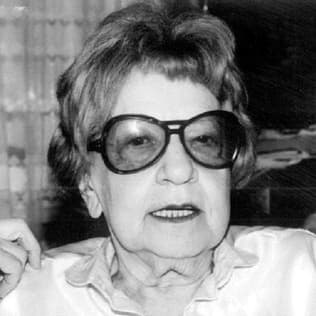
Kató Lomb (8 February 1909 – 9 June 2003) was a Hungarian interpreter, translator and one of the first simultaneous interpreters in the world. Originally educated in chemistry and physics, her interest soon led her to languages. Native in Hungarian, she could interpret fluently in nine or ten languages (in four, without preparation), translated technical literature, and read belles-lettres in six languages. She understood journalism in a further 11 languages. She stated that she worked professionally with 16 languages (Bulgarian, Chinese, Danish, English, French, German, Hebrew, Italian, Japan
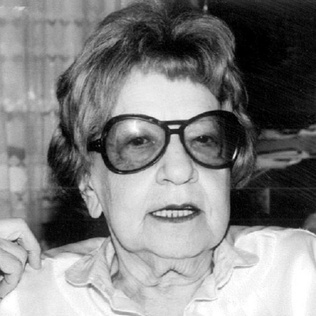
Kató Lomb (8 February 1909 – 9 June 2003) was a Hungarian interpreter, translator and one of the first simultaneous interpreters in the world.
Originally educated in chemistry and physics, her interest soon led her to languages. Native in Hungarian, she could interpret fluently in nine or ten languages (in four, without preparation), translated technical literature, and read belles-lettres in six languages. She understood journalism in a further 11 languages. She stated that she worked professionally with 16 languages (Bulgarian, Chinese, Danish, English, French, German, Hebrew, Italian, Japanese, Latin, Polish, Romanian, Russian, Slovak, Spanish and Ukrainian), which she learnt from self-study due to her interest in them.
According to her own account, her life was highlighted not primarily by her use of languages, but by her study of them. This was described in her books, conversations and interviews. As an interpreter, she visited 40 countries on five continents, and documented her experiences in her book (Egy tolmács a világ körül, "An Interpreter Around the World" ISBN 963-280-779-0).
0 comentarii0 reacții
Kató Lomba lăsat un gând
acum 3 luni
Languages In her interview with the Hetek newspaper (1998), Lomb listed the following 16 languages as those she worked in professionally: Bulgarian, Chinese, Danish, English, French, German, Hebrew, Italian, Japanese, Latin, Polish, Romanian, Russian, Slovak, Spanish, Ukrainian In the foreword to the first edition of her book How I Learn Languages (1970), she wrote: "I only have one mother tongue: Hungarian. Russian, English, French, and German live inside me simultaneously with Hungarian. I can switch between any of these languages with great ease, from one word to the next. Translating texts in Italian, Spanish, Japanese, Chinese, and Polish generally requires me to spend about half a day brushing up on my language skills and perusing the material to be translated. The other six languages I know only through translating literature and technical material." In the fourth edition of How I Learn Languages (1995), she wrote: "I would simply like to tell how I, over 25 years, got to the point of being able to speak 10 languages, translate technical documents and enjoy fiction in six more, and understand written journalism in 11 more or so." In her book Harmony of Babel (1988), she wrote: "How many languages do I speak?…
0 comentarii0 reacții
Kató Lomba lăsat un gând
acum 3 luni
Learning method and principles Lomb's guiding principle was interest: The word, coming from Latin interesse (originally meaning "to be between"), has a double meaning, referring to the material profit or the mental attraction, together: motivation. She wrote, "This means that I can answer these questions: How much am I interested in it? What do I want with it? What does it mean for me? What good is it for me?" She didn't believe in natural "language talent". She tended to express the language skill and its fruitfulness with a fraction, with motivation in the numerator (as well as invested time—although, as she wrote, "If there is true motivation, one can pinch off some ten minutes a day even with the busiest job"), and inhibition in the denominator (the fear of starting to speak, of being clumsy, of being laughed at). In her conviction, the stronger the motivation, and the more one could put aside inhibition, the sooner one could possess a language. As she put it, she drove three autos in the world of languages, namely autolexia, autographia and autologia. (from Greek, auto- meaning self, and -lexia, -graphia and -logia referring to reading, writing and speaking respectively.) Autolexia means reading…
0 comentarii0 reacții
Kató Lomba lăsat un gând
acum 3 luni
Quotes Szilard Kato, the daughter of a prominent local physician, was born and raised in Pecs, where she went to the University to earn her degrees. She moved to Budapest after age 21, where she met and married Laub (later the family changed the name to Lomb) Frigyes, an engineer from a prominent family of electrical engineers. As a young adult, she became interested in other languages while in the family's bomb shelter as Russian troops were advancing on Budapest. She was quoted by her family as having said the following: "Kids, we are going to have to learn Russian now...". She managed to acquire a Russian typewriter and started learning the language. This single step started her on the road to a long and illustrious career in languages. As the Russian liberation unfolded, she served for a time as the translator for the Russian Commander of Budapest. In later years she became a professional interpreter. She acquired high levels of proficiency in 17 languages without extended stays in the countries where the languages were spoken. I interviewed Dr. Lomb (her PhD was in Chemistry) in depth ten years ago in Budapest. She attributed her success to massive amounts of…
0 comentarii0 reacții
Kató Lomba lăsat un gând
acum 3 luni
– From:
Krashen, S. and Kiss, N., Notes on a polyglot (1996), pg. 207–210
Krashen, S., "Explorations in Language Acquisition and Use: The Taipei Lectures", Portsmouth, NH; Heinemann Publishing Company (2003)
About six years ago I met a woman in Hungary named Lomb Kato, a professional translator who had acquired 17 languages. At the time we met she was 86. Her last words to me changed my life: "Stephen, you are so young. So many years left, so many languages to acquire!" (I was 54 at the time.) What an inspiration! Since then I have plunged back into second language acquisition.
– Stephen Krashen (source 1, source 2)
0 comentarii0 reacții
Kató Lomba lăsat un gând
acum 3 luni
In Hungarian
Így tanulok nyelveket (Egy tizenhat nyelvű tolmács feljegyzései) – "This is how I learn languages (Notes of a sixteen-language interpreter)", 1970, 1972, 1990, 1995 (ISBN 963-602-617-3)
Egy tolmács a világ körül – "An interpreter around the world", 1979 (ISBN 963-280-779-0)
Nyelvekről jut eszembe... – "Languages remind me...", 1983 (ISBN 963-500-230-0)
Bábeli harmónia (Interjúk Európa híres soknyelvű embereivel) – "Harmony of Babel (interviews with famous multilingual people in Europe)", 1988 (ISBN 963-282-023-1)
0 comentarii0 reacții
Kató Lomba lăsat un gând
acum 3 luni
In English
Polyglot: How I Learn Languages, 2008 (ISBN 978-1-60643-706-3). The first two editions (2008) are available online for download (PDF) at tesl-ej.org. The 2011 edition, with updates not available in the PDF versions, is available from Amazon and Lulu [dot] com.
Harmony of Babel: Profiles of Famous Polyglots of Europe – 2nd Edition, 2018 (ISBN 978-1-5323-6611-6). The second edition has an Editor's Preface (new) and the transcript of an interview Dr. Lomb gave to Hungarian TV in 1974, translated by Ádám Szegi. The book is available from Lulu [dot] com. The book is available online for download (PDF) at tesl-ej.org.
Harmony of Babel: Profiles of Famous Polyglots of Europe, 2013 (ISBN 978-1-4675-3912-8). The book is available online for download (PDF) at tesl-ej.org. The printed book is available from Amazon and Lulu [dot] com.
With Languages in Mind: Musings of a Polyglot, 2016 (ISBN 978-1-4951-4066-2). The book is available online for download (PDF) at tesl-ej.org. The printed book is available from Amazon and Lulu [dot] com.
0 comentarii0 reacții
Kató Lomba lăsat un gând
acum 3 luni
Other languages
Как я изучаю языки (Kak ya izuchayu yaziki), 1978, 1996 (in Russian)
わたしの外国語学習法 (Watashi no gaikoku-go gakushū-hō) ISBN 4-7943-0159-6, ISBN 4-480-08543-2, ISBN 978-4-480-08543-6 (in Japanese)
Par valodām man nāk prātā, 1990 (ISBN 5-7966-0477-5) (in Latvian)
Kaip aš mokausi kalbų, 1984 (in Lithuanian)
《我是怎样学外语的》 (Wǒ shì zěnyàng xué wàiyǔ de), 1982 (in Chinese)
《我是如何学习外语的》 (Wǒ shì rúhé xuéxí wàiyǔ de), 1983 (in Chinese)
Kuidas ma keeli õpin – ehk Kuutteist keelt oskava tõlgi märkmed (Tallinn: Verb, 2016; ISBN 9789949969074; translated by Sander Liivak) (in Estonian)
언어 공부 - 16개 국어를 구사하는 통역사의 외국어 공부법, 2017 (ISBN 9788955619447) (in Korean)
The Chinese editions were translated from the Russian version.
(Translations in more languages also might exist)