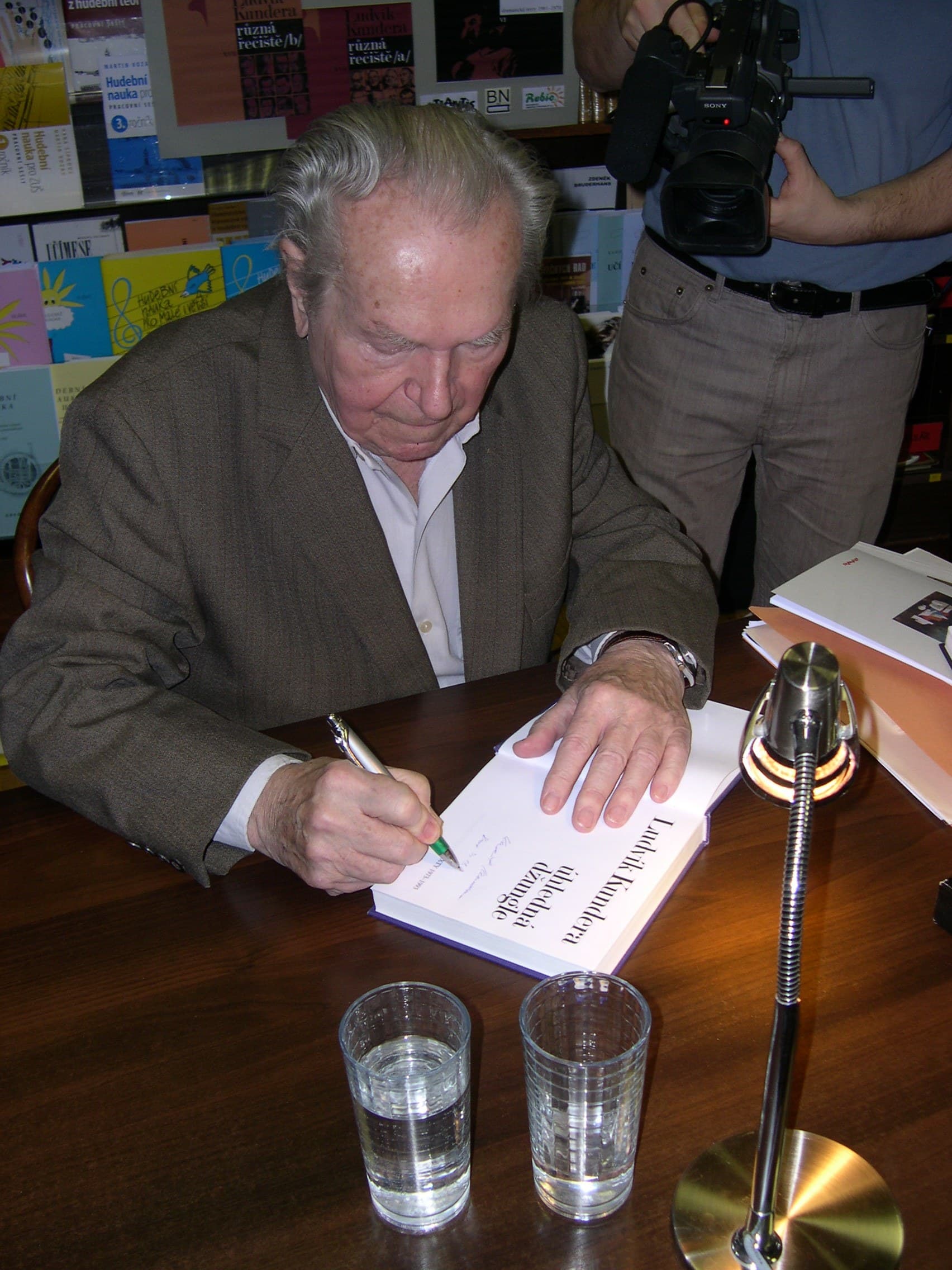
Ludvík Kundera (22 March 1920 – 17 August 2010) was a Czech writer, translator, poet, playwright, editor and literary historian. He was a notable exponent of Czech avant-garde literature and a prolific translator of German authors. In 2007, he received the Medal of Merit for service to the Republic. In 2009, he was awarded the Jaroslav Seifert Award, presented by the Charter 77 Foundation. Kundera was a cousin of Czech-French writer Milan Kundera and nephew of the pianist and musicologist also named Ludvík Kundera.
Ludvík Kundera (22 March 1920 – 17 August 2010) was a Czech writer, translator, poet, playwright, editor and literary historian. He was a notable exponent of Czech avant-garde literature and a prolific translator of German authors. In 2007, he received the Medal of Merit for service to the Republic. In 2009, he was awarded the Jaroslav Seifert Award, presented by the Charter 77 Foundation. Kundera was a cousin of Czech-French writer Milan Kundera and nephew of the pianist and musicologist also named Ludvík Kundera.
0 comentarii0 reacții
Ludvík Kunderaa adăugat o fotografie
acum 3 luni
R.I.P Ludvík
Biography Kundera was born in Brno, Czechoslovakia He studied at the Faculty of Arts of Charles University in Prague and later continued his studies at Masaryk University in Brno. During World War II, he was abducted to a forced labour in Germany. After the war, he worked as an editor in several newspapers and magazines, including Blok, Rovnost and Host do domu. In 1945, he co-founded the surrealist group Skupina RA (Group RA). His first book of poetry, Konstantina, was published in 1946. That same year he befriended the poet František Halas, whom he considered his teacher and mentor. From the mid-1950s he concentrated solely on writing and translating. From 1968 to 1970 he worked as a dramaturgist in the Mahen Theatre, a part of the National Theatre in Brno. Additionally, he collaborated with the National Theatre as a playwright. In 2005, Mahen Theatre premiered his play about the Czech composer Leoš Janáček. During the period of normalization (in the 1970s and '80s) Kundera was banned from being published. He left the Mahen Theatre in reaction to the dismissal of his collaborators who openly expressed disagreement with the political transformation in Czechoslovakia after the Prague Spring. Because of that, he…
0 comentarii0 reacții
Ludvík Kunderaa lăsat un gând
acum 3 luni
Translations Nobi, Ludwig Renn, Prague, Státní nakladatelství dětské knihy 1957. Země snivců (Die andere Seite) Alfred Kubin; R, Nakladatelství mladých, Kladno 1947 Proměna (Die Fahrt nach Stalingrad) Franz Fühmann, Prague, Naše vojsko 1957. Trini, Ludwig Renn, Prague, Mladá fronta 1957. Mrtví nestárnou, (Die Toten bleiben jung), Anna Seghers, Prague, SNKLHU 1957. Nox et solitudo (Nox et solitudo), Ivan Krasko, Prague, SNKLHU 1958. Píseň o lásce a smrti korneta Kryštofa Rilka, Rainer Maria Rilke, Prague, Naše vojsko 1958. Myšlenky (selection), Bertolt Brecht Prague, Československý spisovatel 1958. Dvanáct nocí, Peter Huchel, Prague, Mladá fronta 1958. Sto básní. Výbor z lyriky, Bertolt Brecht, Prague, SNKLHU 1959. Lukulův výslech, (Das Verhör des Lukullus), Bertolt Brecht, Divadelní hry 2, Prague, SNKLHU 1959. Raubíři (Die Räuberbande), Leonhard Frank (Raubíři, Ochsenfurtské kvarteto, Prague, SNKLHU 1959; Raubíři, Ochsenfurtské kvarteto, Dvanáct spravedlivých, Prague, Odeon 1983) Kulatolebí a špičatolebí, (Die Rundköpfe und die Spitzköpfe), Bertolt Brecht, Divadelní hry 2, Prague, SNKLHU 1959. Horáti a Kuriáti (Die Horatier und die Kuriatier), Bertolt Brecht, Divadelní hry 2, Prague, SNKLHU 1959. Kdes byl, Adame? (Wo warst du, Adam?), Heinrich Böll, Prague, Naše vojsko 1961. Pohraniční stanice (Kameraden), Franz Fühmann, Prague, Naše vojsko 1961. Domácí postila Bertolta Brechta (Bertolt Brechts Hauspostille), Bertolt Brecht, Prague,…