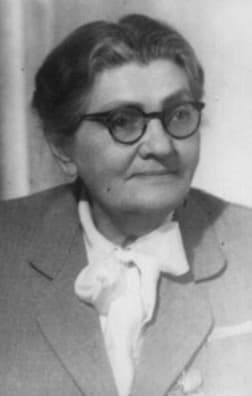
Maria Grzegorzewska (18 April 1887 – 7 May 1967) was a Polish educator who brought the special education movement to Poland. Born to a family from the Żmudź region, she was strongly influenced by her parents' beliefs in humanitarianism. After attending clandestine schools to earn her basic education from Polish rather than Russian educators, she obtained her teaching credentials in Lithuania. She continued her education at the Jagiellonian University in Kraków and in 1913 joined her countrywoman, Józefa Joteyko in Brussels to study at the International Paedological Faculty. When her studies in
Maria Grzegorzewska (18 April 1887 – 7 May 1967) was a Polish educator who brought the special education movement to Poland. Born to a family from the Żmudź region, she was strongly influenced by her parents' beliefs in humanitarianism. After attending clandestine schools to earn her basic education from Polish rather than Russian educators, she obtained her teaching credentials in Lithuania. She continued her education at the Jagiellonian University in Kraków and in 1913 joined her countrywoman, Józefa Joteyko in Brussels to study at the International Paedological Faculty. When her studies in Belgium were interrupted by World War I, Grzegorzewska made her way to Paris and earned her PhD from the Sorbonne in 1916. After the establishment of the Second Polish Republic in 1918, Grzegorzewska returned to Poland intent upon creating programs which addressed the needs of disabled children and introducing educational reforms to improve their lives. In 1919, she began working for the Ministry of Religious Affairs and Public Education, establishing facilities for the care of disabled children, schools for special education, and training programs for teachers. Using her own methodology, she designed curriculum which in 1922 was implemented at the newly founded State Institute of Special Education (Polish:…
0 comentarii0 reacții
Maria Grzegorzewskaa adăugat o fotografie
acum 3 luni
R.I.P Maria
Early life Maria Stefania Grzegorzewska was born on 18 April 1887 in Wołucza, a village in the Kingdom of Poland of the Russian Empire to Felicja (née Bogdanowicz) and Adolf Grzegorzewski. Both of her parents were from Żmudź, a region in modern-day Lithuania, and had moved to Wołucza, where they leased an estate. Her father served as the estate administrator and also oversaw neighboring farms, advocating for modernization of agricultural practices and humane treatment of workers. Her mother was involved in social projects to help local villagers and provided medical care in their community. The youngest of six siblings, including Zenon, Wanda, Helena, Witold and Władysław, Grzegorzewska was influenced by her parents' sense of duty to their community. From a young age, she developed a sense of social responsibility. In 1900, when Grzegorzewska began her education in Poland, Russification programs caused many parents to send their children to clandestine private schools so that they could study Polish culture and language. She studied at a boarding school in Warsaw operated by Mrs. Kotwicki for four years and then entered Paulina Hewelke's school, completing an additional three years of schooling before graduating in 1907. She immediately entered a one-year, university preparatory course…
0 comentarii0 reacții
Maria Grzegorzewskaa adăugat o fotografie
acum 3 luni
R.I.P Maria
Life abroad In 1913, Grzegorzewska arrived at the International Paedological Faculty of Brussels and began studying with Joteyko. Taking courses in pedagogy, psychology, and sociology, she began to meet eminent scholars and scientists, like Édouard Claparède, Émile Jaques-Dalcroze, and Ovide Decroly, among others, who influenced her development. Though the faculty of the school was a mix of international scientists, she shared lodging with Polish students Józefa Berggruen, Stefania Chmielakówna and Wanda Wosińska. As part of her research, Grzegorzewska began a study in the public schools in Brussels on children's aesthetical development. Initially, Grzegorzewska was drawn to the broad range of Joteyko's knowledge and her empathy toward children and the poor. As their relationship evolved, they became companions in both their professional and private lives. In 1914, Grzegorzewska returned to Poland on a vacation to see her family and was there at the start of World War I. Traveling on a war ship through the mined North Sea, she rejoined Joteyko in London in 1915. After a short stay, the two migrated to Paris, where Joteyko began teaching at the Collège de France and Grzegorzewska enrolled at the Sorbonne. Continuing her interest in aesthetics, Grzegorzewska compiled her research from Belgium into…
0 comentarii0 reacții
Maria Grzegorzewskaa adăugat o fotografie
acum 3 luni
R.I.P Maria
Return to Poland In May 1919, Grzegorzewska and Joteyko returned to Poland, soon after the establishment of the Second Polish Republic. After a few months began working as an assistant in the Ministry of Religious Affairs and Public Education. She was tasked with managing the development of special education for schools, institutions and educators. At the time, the only special education facilities in the country consisted of bureaus for the blind in Bydgoszcz and Lviv, a bureau for the deaf in Warsaw, and supplementary schools to assist with support services in Warsaw and Łódź. As Joteyko had been denied placement at the University of Warsaw, Grzegorzewska helped her find work as a lecturer at the National Pedagogical Institute (Polish: Państwowy Instytut Pedagogiczny) and National Institute of the Deaf (Polish: Instytut Głuchoniemych w Warszawie)in Warsaw. Though at the time in Poland, there were limited facilities which had been established for deaf, blind, and intellectually disabled people, there was no national system to address the education of those living with physical or mental impairments. Grzegorzewska aimed to implement educational methods she designed, mandatory training for teachers, and on-going research projects to assess the system over time. Her educational method adopted a holistic…
0 comentarii0 reacții
Maria Grzegorzewskaa adăugat o fotografie
acum 3 luni
R.I.P Maria
Death and legacy Grzegorzewska died from a heart attack on 7 May 1967 at her home in Zalesie Dolne, a former town, which has been incorporated into the present city of Piaseczno, near Warsaw. She was buried in the Powązki Cemetery on the "Avenue of the Meritorious". She is remembered as the founder of the system of special education in Poland, as well as one of the people who advocated for the name of the field. Her approach of using special education to give to disabled or maladjusted children training to allow them to adapt to society and overcome the limitations of their mental and physical health marked a shift in the evolution of educational thought from treating the disability to recognizing the needs of the person. Jerzy Zawieyski based his novel The Way Home (Polish: Droga do domu) on the relationship of Grzegorzewska and Czesław. Grzegorzewska's work was known in other countries of the Eastern Bloc, like Yugoslavia, through translations and correspondence with others working in the field of disability from the 1930s. Contact with Veljko Ramadanović, who founded the first institution for disabled people in Serbia, led to students such as Božidar Karličić, Petar Meandžija, Desimir Ristović, and…