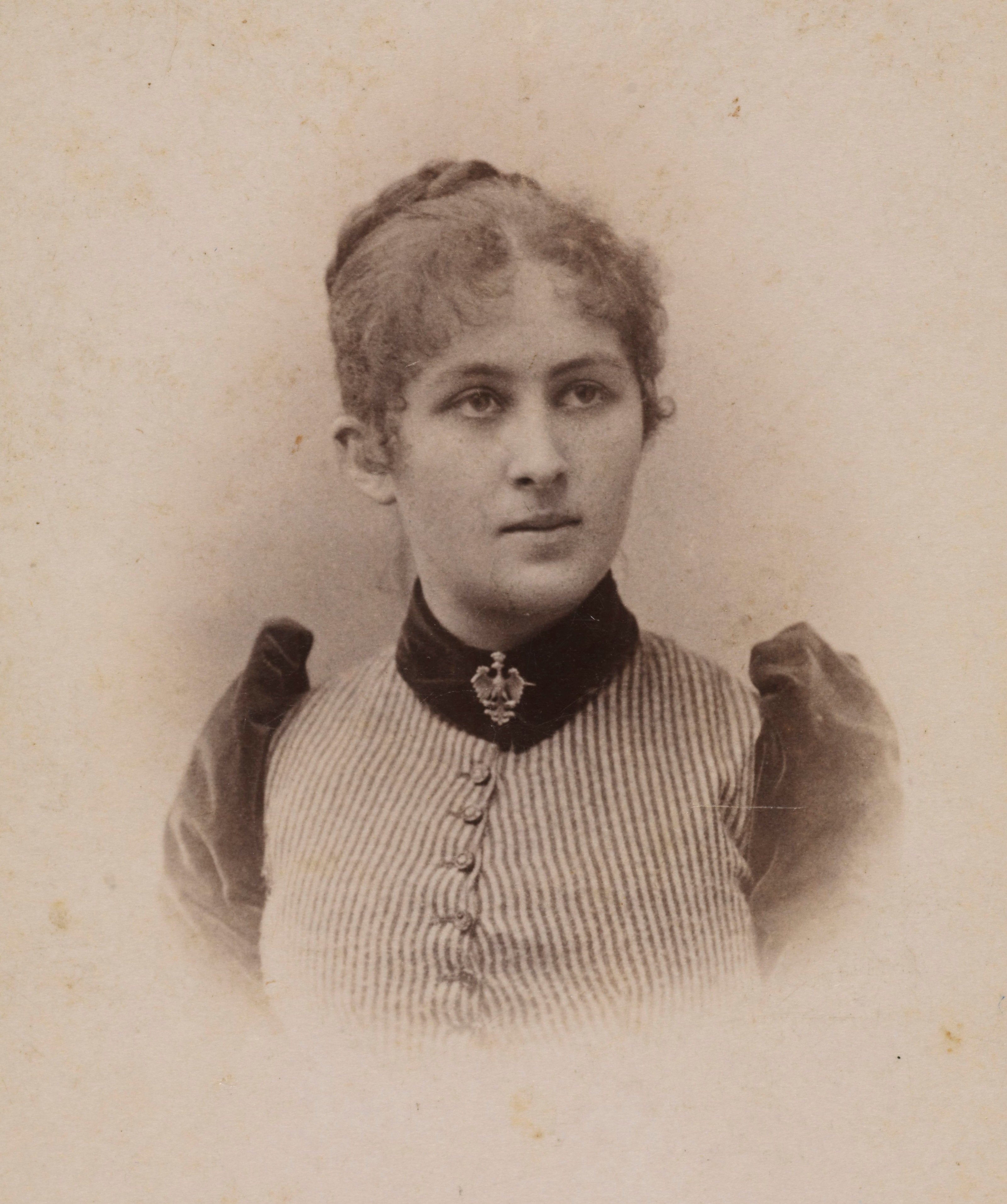
Aniela Pawlikowska, known as Lela Pawlikowska (11 July 1901 - 23 December 1980), was a Polish artist, illustrator and society portrait painter. She came to prominence in the United Kingdom in the 1950s and '60s.
Actualizări recente
Aniela Pawlikowskaa publicat o actualizare
acum 8 ore
In 1923 Lela Wolska married Michał Gwalbert Pawlikowski, a bibliophile, writer, and publisher. She joined him at the family seat of Medyka, near Przemyśl. "Medyka" was also the imprint her husband's small publishing and printing enterprise which specialised in small runs of literary works for which Lela provided the illustrations. They had three daughters and a son. The family would also spend a lot of time at their mountain chalet, "Pod Jedlami" ("The Firs"), in Zakopane. It had been designed for Michał's father, Jan Gwalbert Pawlikowski, by the modernist artist, Stanisław Witkiewicz. With her husband's active support she continued her studies in art at the Kraków Academy of Fine Arts with Wojciech Weiss and Kazimierz Sichulski. In the 1930s she exhibited widely in Lwów, Kraków, Warsaw and Zakopane and abroad in Leipzig, Rome, Florence and Turin. With the outbreak of World War II she took her four small children to Lwów where she went to live with her sister in the Wolski villa, known as "Zaświecie". In May 1940 already after the first wave of Soviet deportations of Poles to Siberia, she managed to get a laissez-passer for herself and the children into the Nazi General Government. They were taken…
0 comentarii5 vizualizări0 reacții
Aniela Pawlikowskaa publicat o actualizare
acum 8 ore
Portraiture and landscapes Pawlikowska devoted her entire life to the study of the human form and to nature. Her sketchbooks were filled with human figures, plants and animals as part of her uninterrupted daily atelier. She was an amateur botanist and an acute observer. Her landscapes, chiefly in watercolour, were initially a throwback to the 19th-century. Later they clearly referred to a growing fascination with Japanese painting and colour experimentation of the Interwar period. A separate chapter in her creative work were the studies of interiors - mainly of the palace in Medyka. After the war, knowing she could never return to her home, she immortalised those interiors from memory substituting artistic style for the eroded detail. Her portraiture that was to become the mainstay of émigré family life and support for the chalet in Poland, oscillated initially between a style redolent of secessionism and new experiments with colour and form. However, the pressures of wartime and the difficult period in Italy of necessity turned much of her artwork into a commissioned commodity. It gained popularity in high society, but at the price of a reversion into traditional academic art. From her émigré years, only a handful of works survive…
0 comentarii5 vizualizări0 reacții
Aniela Pawlikowskaa publicat o actualizare
acum 8 ore
Illustrations Her public debut, aside from the Juvenilia, were illustrations and graphic designs for a first library edition of her husband's work, Agnieszka albo o Pannie na niedźwiedziu, "Agnes or the Maiden atop the Bear", (Medyka 1925). It was a pastiche on a medieval Incunable, particularly on the Balthasar Behem Codex, well known to her and which inaugurated the publishing venture of the Medyka Library series which until it ceased in 1939, went on to produce 15 richly illustrated titles, generally the work of Pawlikowska. Among her significant contributions were two volumes by Beata Obesityńska, A Guitare and others - Gitara i tamci (Medyka 1926) and The tale of Brothers Frost. A Calendar dream - O Braciach Mroźnych. Sen kalendarzowy (Medyka 1930). Notable were her gouache colour and black and white linocut illustrations for Zofia Kossak-Szczucka's God's Madman - Szaleńcy Boży (Kraków 1929). In London Pawlikowska illustrated over a dozen titles for Veritas, a Polish religious publishing foundation.
0 comentarii5 vizualizări0 reacții
Aniela Pawlikowskaa publicat o actualizare
acum 8 ore
Works Given Pawlikowska's creativity may be defined by her highly traditional and conservative background, undoubtedly influenced by her husband's, patriotic and nationalistic views, as the main champion of her work, at a time of deep crisis for the nation coupled with exile in the Free World, she did not seek to join the Avant-garde but sought instead in her own words, to "make links between the basic elements of art and means of expression with her Polishness". Her inspiration coupled with the mature style of her creativity, enable her work to be characterised as art déco style.
0 comentarii5 vizualizări0 reacții
Aniela Pawlikowskaa adăugat o fotografie
acum 8 ore
R.I.P Aniela
Aniela Pawlikowska, known as Lela Pawlikowska (11 July 1901 - 23 December 1980), was a Polish artist, illustrator and society portrait painter. She came to prominence in the United Kingdom in the 1950s and '60s.
0 comentarii5 vizualizări0 reacții
Aniela Pawlikowskaa publicat o actualizare
acum 8 ore
Bibliography Świat Leli Pawlikowskiej. Prace z lat 1915-1965. Catalogue of the exhibition in the Kraków National Museum ed. M. Romanowska, Kraków 1997 Lela Pawlikowska w Medyce, ed. M. Trojanowska, Przemyśl 2002 Marta Trojanowska. Dama z Medyki z Londynu. Lela Pawlikowska 1901-1980, Przemyśl 2005 Marta Trojanowska. Dama z Medyki z Londynu. Lela Pawlikowska 1901-1980 Selection of works including oil, woodcut, watercolour and witty illustrations
0 comentarii5 vizualizări0 reacții
Aniela Pawlikowskaa publicat o actualizare
acum 8 ore
External links Selection of Pawlikowska's drawings from the National Museum in Kraków "Lela Pawlikowska. Drawings" 16-23.11.2016. in English, Pawlikowska Exhibition in Kraków Cloth Hall
0 comentarii5 vizualizări0 reacții
Aniela Pawlikowskaa publicat o actualizare
acum 8 ore
Fate of Medyka After the Soviet invasion of Poland in 1939, the village of Medyka, and therefore the Pawlikowski estate, found themselves annexed by the Soviet Union. With 1948 border adjustments between the new Polish People's Republic and its neighbour, Medyka found itself once again just over the Polish side of the new border. The Pawlikowski estate became state property and was turned into a State Agricultural Farm (PGR). In the 1960s it was decided to demolish the palace on the grounds that it was a vestige of the earlier "bourgeois hegemony". Fortunately, the family had taken the precaution at the outbreak of war to donate part of its valuable collections to the Ossolineum in Lwów and to take other parts to their chalet in Zakopane. The gamble paid off, as most of the archive managed to survive in scattered form. Pawlikowska and the family never returned to Medyka after the war to see the devastation of the place where they had spent the happiest time of their lives. It was a fate shared by the totality of Polish landowners in the Kresy region of Poland and marked a "caesura" in history and the obliteration not only of a way…
0 comentarii5 vizualizări0 reacții
Aniela Pawlikowskaa adăugat o fotografie
acum 8 ore
R.I.P Aniela
Aniela Pawlikowska was born to a family with a rich literary and scientific heritage. Her mother was Maryla Wolska, a Polish poet, the daughter of Wanda Młodnicka, née Monné, muse and fiancée of the painter Artur Grottger, herself a writer and translator. Her father was Wacław Wolski, engineer, inventor, author on mathematical logic, linguist, an early pioneer of the Polish petroleum industry, and associate of the Canadian petroleum entrepreneur, William Henry McGarvey. Aniela was the youngest of five children. Her older sister was the writer and poet, Beata Obertyńska. Aniela was home-schooled. One of her tutors was a family friend, the university professor of philosophy and psychology and artist, Władysław Witwicki. Aniela ("Lela") Wolska's artistic talent was noted early; she held her first solo exhibition at age nine. On that occasion, 54 of her works were exhibited by the Lwów Society of Friends of Fine Art (Towarzystwo Przyjaciół Sztuk Pięknych). Her home education did not conclude with a matriculation examination, so she attended lectures on the history of art given at Lwów University by Professors Bołoz-Antoniewicz and Władysław Podlacha as an auditor.
0 comentarii5 vizualizări0 reacții
Aniela Pawlikowskaa publicat o actualizare
acum 8 ore
Religious themes Sacred topics were central to Pawlikowska's creativity, especially of Marian inspiration. Her portfolio of ten linocuts, Bogurodzica (Mother of God), overlain with watercolours and gilded are a reference to folk woodcarvings and paintings on glass. They were published by Medyka in 1930. Commenting on this art déco series, and other single works after the war, Pawlikowska said: "those pictures are on a religious theme, but my aim was to express them in Polish, not drawing on any pattern or style, rather perhaps relying on folk art (...) the point was to reflect the world through the Marian calendar and traditions, for example, Our Lady of Sowing, Our Lady of Berries, Our Lady of Herbs... and also to convey it by the simplest artistic means through line and thereby to confer as much expression as possible". A similar intention lies behind the style of the coloured linocut of "St. Hubertus" of 1936. The period after the war saw the creation of several important religious works by Pawlikowska. Among them are the 1947 depiction of "Saint Stanisław Szczepanowski, bishop and martyr" for the altar of the Marian Fathers' chapel at Fawley Court in Buckinghamshire England, and two paintings whose fate…