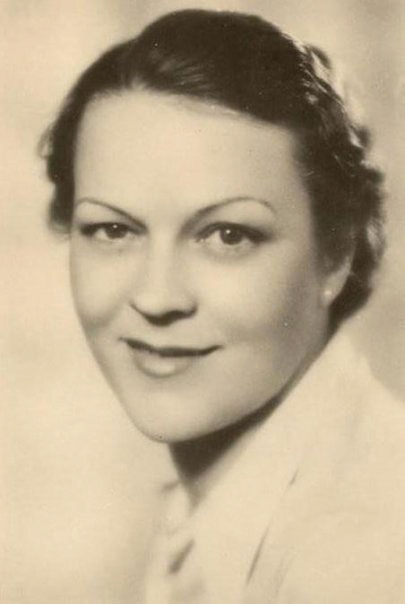
Anna Čalounová-Letenská (née Anna Svobodová) (29 August 1904 – 24 October 1942) was a Czech theatre and film actress. During the 1930s and 40s, she appeared in twenty-five films. She was murdered in the Nazi concentration camp of Mauthausen.
Actualizări recente
Anna Letenskáa adăugat o fotografie
acum 4 ore
R.I.P Anna
Anna Čalounová-Letenská (née Anna Svobodová) (29 August 1904 – 24 October 1942) was a Czech theatre and film actress. During the 1930s and 40s, she appeared in twenty-five films. She was murdered in the Nazi concentration camp of Mauthausen.
0 comentarii3 vizualizări0 reacții
Anna Letenskáa publicat o actualizare
acum 4 ore
Selected film roles 1937 - Kříž u potoka, housemaid, directed by Miloslav Jareš 1938 - Milování zakázáno, directed by Miroslav Cikán, Karel Lamač 1938 - Slávko nedej se! 1939 - Mořská panna, directed by Václav Kubásek 1939 - Ženy u benzinu 1940 - Babička, directed by František Čáp 1940 - Minulost Jany Kosinové, directed by Jan Alfréd Holman 1940 - Čekanky, directed by Vladimír Borský 1941 - Pražský flamendr, directed by Karel Špelina 1941 - Z českých mlýnů, directed by Miroslav Cikán 1942 - Valentin Dobrotivý, directed by Martin Frič 1942 - Ryba na suchu, directed by Vladimír Slavínský 1942 - Městečko na dlani, directed by Václav Binovec 1942 - Přijdu hned, directed by Otakar Vávra
0 comentarii3 vizualizări0 reacții
Anna Letenskáa adăugat o fotografie
acum 4 ore
R.I.P Anna
Anna Letenská was born in Nýřany, Plzeň Region, Austro-Hungarian Monarchy. She was brought up in a theatrical environment - both of her parents, Marie Svobodová (1871–1960) and Oldřich Svoboda (died 1939), and her sister, Růžena Nováková (1899–1984), were actors. She made her first appearance on stage at an early age. Letenská began her professional stage career in 1919 as a member of the Suková-Kramulová theatre company and went on to work with theatre companies in České Budějovice (1920–29), Olomouc (1930–31), Bratislava (1931–35), and Kladno (1935–36). While working with the theatre company of Otto Alfredi she met and befriended the operetta actor Ludvík Hrdlička, who performed under the stage name "Letenský". They wed in January 1925 and the following year had a son, Jiří (who later himself worked as an actor and radio speaker). However, the marriage was not a happy one and they divorced in 1940. They had previously moved to Prague in 1936 where after a series of short-term engagements Letenská found employment with the Vinohrady Theatre (1939–42). She performed in Czech and world theatre repertoire and was known for her comic performances in the role of down-to-earth, energetic women characters. Letenská's film debut was in Kříž u potoka…
0 comentarii3 vizualizări0 reacții
Anna Letenskáa publicat o actualizare
acum 4 ore
Once production of the film had been completed, Letenská was arrested and imprisoned. Accounts of her last days in Prague differ. Her colleague, the actor Antonín Strnad, said that Letenská was arrested and then shortly after that she was released very briefly, only so that she could terminate her contract of employment at the Vinohrady Theatre. Strnad met her in the theatre, in tears. Another actor, František Filipovský, claimed that he was probably the last person who talked to her. He met her in a tram at Wenceslas Square and asked: "Where are you going, Anka?" She replied: "Ah, they summoned me to an interrogation at Gestapo, again. What could they ask me?" Then she got out of the tram and vanished into the crowd. "I never saw her again", Filipovský said. The final version tells how Letenská was arrested by the German interrogator Heinz Jantur on 3 September 1942. She dropped a little talisman as she was getting into a Gestapo car. It was a picture of a Czech landscape. The German officers allowed her to pick it up; Letenská kissed the picture, and got into the car. According to Strnad, she gave the talisman to her cellmates shortly…
0 comentarii3 vizualizări0 reacții
Anna Letenskáa publicat o actualizare
acum 4 ore
Selected theatre roles 1937 - Guest performance in the play Těžká Barbora, Osvobozené divadlo (V+W), directed by Jindřich Honzl 1939 - Heinrich von Kleist: The Broken Jug, Frau Marthe, Vinohrady Theatre, directed by František Salzer 1939 - William Shakespeare: The Merry Wives of Windsor, Vinohrady Theatre, directed by Bohuš Stejskal 1939 - A. Pacovská: Chudí lidé vaří z vody, Marie, Vinohrady Theatre, directed by Jiří Plachý 1940 - Josef Kajetán Tyl: Strakonický dudák, Kordula, Vinohrady Theatre, directed by Gabriel Hart 1940 - K. R. Krpata: Mistr ostrého meče, Katovka-Rosina, Vinohrady Theatre, directed by František Salzer 1940 - Gerhart Hauptmann: The Beaver Coat, Mother Wolff, Vinohrady Theatre, directed by František Salzer 1941 - Alexander Ostrovsky: The Storm, Varvara, Vinohrady Theatre, directed by František Salzer 1941 - A. Pacovská: Vdovin groš, Pelikánová, Vinohradské divadlo, Vinohrady Theatre, directed by Jiří Plachý 1941 - Lila Bubelová: Slečna Pusta, Marie Poustecká, Chamber Theater, directed by Antonín Kandert 1941 - Aristophanes: Ecclesiazusae, Praxagora, Theatre Na poříčí, directed by Jiří Plachý
0 comentarii3 vizualizări0 reacții
Anna Letenskáa adăugat o fotografie
acum 4 ore
R.I.P Anna
World War II On 27 May 1942, in an action known as Operation Anthropoid, two Czechoslovak parachutists, Jozef Gabčík and Jan Kubiš, ambushed and fatally wounded Reinhard Heydrich, Deputy Reich-Protector of the Protectorate of Bohemia and Moravia, while he was being driven through the Prague suburb of Libeň. The Nazis embarked on a large-scale operation to find and capture the assassins. They searched the whole of Bohemia and Moravia, investigating over 4,750,000 inhabitants and combing 60 large forest areas. One of the assassins, Kubiš, had been wounded in the face by a fragment of the bomb thrown at Heydrich's car. He escaped and was helped by MUDr. Břetislav Lyčka, who lived in the Karlín district of Prague. After Karel Čurda's betrayal of his Resistance colleagues and friends, Lyčka and his wife Františka Lyčková were forced to split up and find separate places to hide. At the time Letenská was working on the film Přijdu hned, directed by Otakar Vávra. In 1941, she had married the architect Vladislav Čaloun. Prior to the German occupation of Czechoslovakia, Čaloun had been involved in helping people persecuted by Hlinka's Slovak People's Party. His activities came to the notice of the party's extremist supporters and…