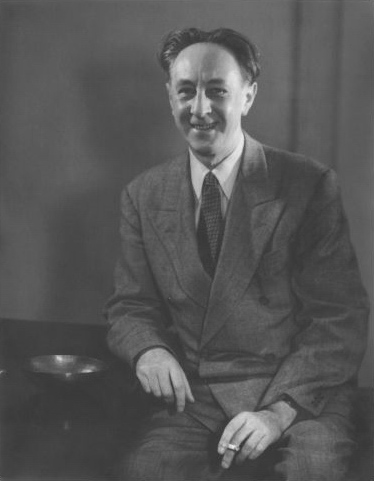
Bohuslav Jan Martinů (Czech: [ˈboɦuslaf ˈmarcɪnuː] ; December 8, 1890 – August 28, 1959) was a Czech composer of modern classical music. He wrote 6 symphonies, 15 operas, 14 ballet scores, and a large body of orchestral, chamber, vocal, and instrumental works. He became a violinist in the Czech Philharmonic Orchestra, and briefly studied under Czech composer and violinist Josef Suk. After leaving Czechoslovakia in 1923 for Paris, Martinů deliberately withdrew from the Romantic style in which he had been trained. During the 1920s he experimented with modern French stylistic developments, exempl
Actualizări recente
Bohuslav Martinůa adăugat o fotografie
acum 6 ore
R.I.P Bohuslav
Bohuslav Jan Martinů (Czech: [ˈboɦuslaf ˈmarcɪnuː] ; December 8, 1890 – August 28, 1959) was a Czech composer of modern classical music. He wrote 6 symphonies, 15 operas, 14 ballet scores, and a large body of orchestral, chamber, vocal, and instrumental works. He became a violinist in the Czech Philharmonic Orchestra, and briefly studied under Czech composer and violinist Josef Suk. After leaving Czechoslovakia in 1923 for Paris, Martinů deliberately withdrew from the Romantic style in which he had been trained. During the 1920s he experimented with modern French stylistic developments, exemplified by his orchestral works Half-time and La Bagarre. He also adopted jazz idioms, for instance in his Kitchen Revue (Kuchyňská revue). In the early 1930s he found his main fount for compositional style: neoclassicism, creating textures far denser than those found in composers treating Stravinsky as a model. He was prolific, quickly composing chamber, orchestral, choral, and instrumental works. His Concerto Grosso and the Double Concerto for Two String Orchestras, Piano and Timpani are among his best-known works from this period. Among his operas, Juliette and The Greek Passion are considered the finest. He has been compared to Prokofiev and Bartók in his innovative incorporation of Czech folk…
0 comentarii1 vizualizări0 reacții
Bohuslav Martinůa adăugat o fotografie
acum 6 ore
R.I.P Bohuslav
The setting of Martinů's birth was unusual. He was born in the tower of the St. Jakub Church in Polička, a town in Bohemia, close to the Moravian border. His father, Ferdinand, a shoemaker, also worked as the church sexton and town fire watchman. For this, he and his family were allowed to live in the tower apartment. As a small boy Bohuslav was sickly, and frequently had to be carried up the 193 steps to the tower on the back of his father or his older sister. In school he was known to be very shy, and did not participate in the plays or pageants with his classmates. But as violinist, he excelled and developed a strong reputation, giving his first public concert in his hometown in 1905. The townspeople raised enough money to fund his schooling, and in 1906 he left the countryside to begin studies at the Prague Conservatory. Whilst there he fared poorly as a student, showing little interest in the rigid pedagogy or the hours of violin practice required. He was far more interested in exploring Prague and learning on his own, attending concerts and reading books on many subjects. This was in contrast to…
0 comentarii1 vizualizări0 reacții
Bohuslav Martinůa adăugat o fotografie
acum 6 ore
R.I.P Bohuslav
1923–1940: Paris Martinů finally departed for Paris in 1923, having received a small scholarship from the Czechoslovak Ministry of Education. He sought out Albert Roussel, whose individualistic style he respected, and began a series of informal lessons with him. Roussel would teach Martinů until his death in 1937 by helping him focus and bring order to his compositions, rather than instructing him in a specific style. During his first years in Paris, Martinů incorporated many of the trends at the time, including jazz, neoclassicism, and surrealism. He was particularly attracted to Stravinsky, whose novel, angular, propulsive rhythms and sonorities reflected the industrial revolution, sports events and motorised transportation. Ballets were his favorite medium for experimentation, including The Revolt (1925), The Butterfly That Stamped (1926), Le raid merveilleux (1927), La revue de cuisine (1927), and Les larmes du couteau (1928). Martinů found friends in the Czechoslovak artistic community in Paris and would always retain close ties to his homeland, frequently returning during the summer. He continued to look to his Bohemian and Moravian roots for musical ideas. His best-known work from this time is the ballet Špalíček (1932–33), which incorporates Czech folk tunes and nursery rhymes. The prime leader of new…
0 comentarii1 vizualizări0 reacții
Bohuslav Martinůa adăugat o fotografie
acum 6 ore
R.I.P Bohuslav
Life in the United States was difficult for him initially, just as it was for many other artist émigrés in similar circumstances. Lack of knowledge of English, of funds, and of opportunities to use their talents were common to them. When they first arrived in New York, the Martinůs rented a studio apartment at the Great Northern Hotel on 57th St. They were helped by several musician friends, including pianist Rudolf Firkušný, violinist Samuel Dushkin, cellist Frank Rybka, diplomat Miloš Šafránek, and multi-lingual lawyer Jan Löwenbach. Martinů soon found that he was unable to resume composing in noisy Manhattan, so for the following season they leased a small apartment in Jamaica Estates, Queens, close to the Rybkas. This leafy, residential neighborhood was conducive for him to take long solitary walks at night, during which he would work out music scores in his head. On several occasions he would "zone out" in deep concentration about the music, becoming oblivious of his surroundings and getting lost, and would then call a friend with a car to come find him and take him back home. Thereafter, he began to compose actively. When he contacted Serge Koussevitzsky, the conductor told him that his Concerto…
0 comentarii1 vizualizări0 reacții
Bohuslav Martinůa publicat o actualizare
acum 6 ore
Further reading Beckerman, Michael Brim, and Michael Henderson (eds.). Martinů's Mysterious Accident: Essays in Honor of Michael Henderson. Hillsdale, N.Y.: Pendragon Press, 2007. ISBN 978-1-57647-111-1 (cloth); ISBN 978-1-57647-003-9 (pbk). Crump, Michael. Martinů and the symphony. London: Toccata Press, 2010. ISBN 978-0-907689-65-2. Červinková, Blanka (ed.). Bohuslav Martinů, 8.12.1890–28.8.1959: bibliografický katalog. Prague: Panton, 1990. ISBN 978-80-7039-068-9 Halbreich, Harry. Bohuslav Martinů: Werkverzeichnis, Dokumentation und Biographie. Zürich, Freiburg i. Br.: Atlantis-Verlag, 1968. Halbreich, Harry. Bohuslav Martinů: Werkverzeichnis und Biographie. Zweite, revidierte Ausgabe. Mainz: Schott Music, 2007. ISBN 978-3-7957-0565-7. Large, Brian. Martinů. London: Duckworth, 1975. ISBN 978-0-7156-0770-1. Mihule, Jaroslav. Bohuslav Martinů: Osud skladatele. Prague: Nakladatelství Karolinum Univerzity Karlovy, 2002. ISBN 978-80-246-0426-8. Šafránek, Miloš. Bohuslav Martinů: His Life and Works. Translated by Roberta Finlayson-Samsourová. London: A. Wingate, 1962. Šafránek, Miloš (1966). Bohuslav Martinů; domov, hudba a svět: deníky, zápisníky, úvahy a články. Prague: SHV. Šafránek, Miloš (1979). Divadlo Bohuslava Martinů. Prague: Supraphon. Svatos, Thomas D. "Reasserting the Centrality of Musical Craft: Martinů and His American Diaries". The Musical Times 150, no. 1907 (Summer 2009): 55–70.
0 comentarii1 vizualizări0 reacții
Bohuslav Martinůa publicat o actualizare
acum 6 ore
1953–1959: Europe In 1953, Martinů left the United States for France and settled in Nice, and completed his Fantaisies symphoniques; the following year he composed Mirandolina and piano sonata, and met Nikos Kazantzakis, beginning work on The Greek Passion. During 1955 he created several key works: the oratorio Gilgames (The Epic of Gilgamesh), the Oboe Concerto, Les Fresques de Piero della Francesca, and the cantata Otvirani studanek (The Opening of the Wells); Charles Munch conducted the Fantaisies symphoniques premiere in Boston which gained the composer the annual New York critics' prize for the work. In 1956, he took up an appointment as composer-in-residence at the American Academy in Rome and composed Incantation (his fourth piano concerto) and much of The Greek Passion, which he completed in January the following year. Jan Smaczny commented that in the compositions of Martinů's last years "we find the composer attempting through his music a vicarious homecoming", although he never returned to Czechoslovakia. His prolific output continued in 1958 with The Parables for orchestra and the opera Ariane. The following year he attended the first production of Julietta since the premiere in Prague, in Wiesbaden. Further composition continued up to his death: the second version…
0 comentarii1 vizualizări0 reacții
Bohuslav Martinůa publicat o actualizare
acum 6 ore
Martinů was a prolific composer who wrote almost 400 pieces. Many of his works are regularly performed or recorded, among them his oratorio The Epic of Gilgamesh (1955, Epos o Gilgamešovi), his six symphonies, concertos (these number almost thirty – four violin concertos, eight compositions for solo piano, four cello concertos, one of each for harpsichord, viola, and oboe, five double concertos, two triple concertos, and two concertos for four solo instruments and orchestra), an anti-war opera Comedy on the Bridge (Veselohra na mostě), chamber music (including eight string quartets, three piano quintets, a piano quartet), a flute sonata, a clarinet sonatina and many others.
0 comentarii1 vizualizări0 reacții
Bohuslav Martinůa publicat o actualizare
acum 6 ore
A characteristic feature of his orchestral writing is the near-omnipresent piano; many of his orchestral works include a prominent part for piano, including his small Concerto for harpsichord and chamber orchestra. The bulk of his writing from the 1930s into the 1950s was in a neoclassical vein, but with his last works he opened up his style to include more rhapsodic gestures and a looser, more spontaneous sense of form. This is easiest to hear by comparing his Fantaisies symphoniques (Symphony No. 6), H 343, with its five predecessors, all from the 1940s. One of Martinů's lesser known works features the theremin. Martinů started working on his Fantasia for theremin, oboe, string quartet and piano in the summer of 1944, and finished it on October 1. He dedicated it to Lucie Bigelow Rosen, who had commissioned it and was the theremin soloist at its premiere at New York's Town Hall on 3 November 1945, joined by the Koutzen Quartet, Robert Bloom (oboe), and Carlos Salzedo (piano). His opera The Greek Passion is based on the novel of the same name by Nikos Kazantzakis, and his orchestral work Memorial to Lidice (Památník Lidicím) was written in remembrance of the village of…
0 comentarii1 vizualizări0 reacții
Bohuslav Martinůa publicat o actualizare
acum 6 ore
Personality There have been many discussions about Martinů's personality, manners and possible Asperger syndrome. Frank James Rybka promoted the idea that Martinů suffered from this kind of autism spectrum disorder. He met Martinů in 1941, when the composer was 51 and Rybka was only six years old; later on he met him in 1951 and then in 1959, a month before the composer died. According to Rybka, Martinů was quiet, introverted, and emotionally stolid when meeting persons he did not know well. He typically answered questions very slowly, even when conversing in his native Czech. He might fail to reciprocate socially when people would compliment his music, or do favors for him. Close friends found him to be a kind, gentle, self-effacing, unbiased person. In 2009, Rybka launched a retrospective study of the composer's unusual personality, based upon interviews of people who knew him, as well as a study of letters he had written to his family and friends. Evidence of his having an autism spectrum disorder was compiled and evaluated, using the established criteria found in the Diagnostic and Statistical Manual for Mental Disease (DSM-IV). This evidence was reviewed by a well-known autism neuroscientist who concurred that the composer…
0 comentarii1 vizualizări0 reacții
Bohuslav Martinůa publicat o actualizare
acum 6 ore
Sources Hartl, Karla, and Erik Entwistle (eds.). The Kaprálová Companion. Lanham, MD: Lexington Books, 2011. ISBN 978-0-7391-6723-6 (cloth); ISBN 978-0-7391-6724-3 (electronic). Martinů, Charlotta. Můj život s Bohuslavem Martinů. Prague: Editio Baerenreiter, 2003. Rybka, F. James. Bohuslav Martinů: The Compulsion to Compose. Lanham, MD: Scarecrow Press, 2011. ISBN 978-0-8108-7761-0. Rybka, F. James, and Sally Osonoff. "Martinu's Impressive Quiet". "Czech Music" 23 (2009), 31–50. Simon, Robert C. (compiler). Bohuslav Martinů: a research and information guide. New York, Abingdon: Routledge, 2014. ISBN 978-0-415-74194-1. Entwistle, Eric (September 2012). "Bohuslav Martinů: The Compulsive to Compose". Notes: 93–96. doi:10.1353/not.2012.0136. S2CID 161758143.