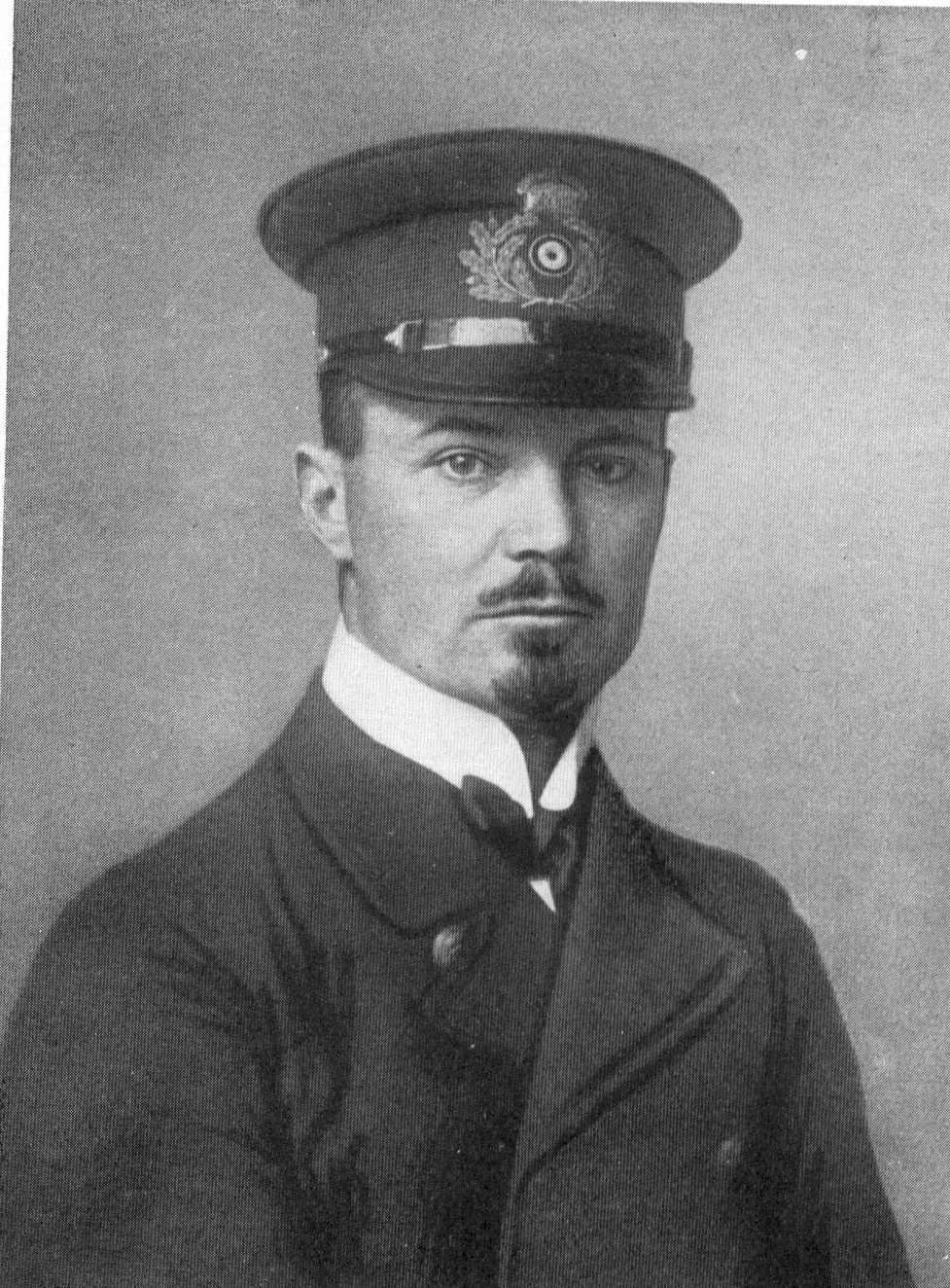
Hermann Ehrhardt (29 November 1881 – 27 September 1971) was a German naval officer in World War I who became an anti-republican and antisemitic German nationalist Freikorps leader during the Weimar Republic. As head of the Marine Brigade Ehrhardt, he was among the best-known Freikorps leaders in the immediate postwar years. The brigade fought against the local soviet republics that arose during the German Revolution of 1918–1919 and later was among the key players in the anti-republican Kapp Putsch of March 1920. After the brigade's forced disbanding, Ehrhardt used the remnants of his unit to
Actualizări recente
Hermann Ehrhardta adăugat o fotografie
acum 6 ore
R.I.P Hermann
Hermann Ehrhardt (29 November 1881 – 27 September 1971) was a German naval officer in World War I who became an anti-republican and antisemitic German nationalist Freikorps leader during the Weimar Republic. As head of the Marine Brigade Ehrhardt, he was among the best-known Freikorps leaders in the immediate postwar years. The brigade fought against the local soviet republics that arose during the German Revolution of 1918–1919 and later was among the key players in the anti-republican Kapp Putsch of March 1920. After the brigade's forced disbanding, Ehrhardt used the remnants of his unit to found the Organisation Consul, a secret group that committed numerous politically motivated assassinations. After it was banned in 1922, Ehrhardt formed other less successful groups such as the Viking League. Because of his opposition to Adolf Hitler, Ehrhardt was forced to flee Germany in 1934 and lived apolitically in Austria until his death in 1971.
0 comentarii0 vizualizări0 reacții
Hermann Ehrhardta adăugat o fotografie
acum 6 ore
R.I.P Hermann
Early life and World War I Hermann Ehrhardt was born in 1881 into a family that had long provided pastors for Diersburg (now part of Hohberg, Baden-Württemberg) in the Grand Duchy of Baden. On 13 August 1927 Ehrhardt married Margarethe Viktoria, Princess of Hohenlohe-Öhringen (1894–1976). They had two children, Marie Elisabeth and Hermann Georg. As a primary school student Ehrhardt slapped his teacher's face out of a bruised sense of honor and had to leave the grammar school in Lörrach. In 1899 he joined the Imperial Navy as a cadet and entered into a naval officer's career. In 1904, as a Leutnant zur See (the lowest officer rank in the German navy), he took part under Lieutenant Colonel Ludwig von Estorff in the Herero and Namaqua genocide in German South West Africa. At the beginning of World War I, Ehrhardt was captain lieutenant in charge of a torpedo boat half-flotilla. In the Battle of Jutland, his group participated in the sinking of the British M-class destroyer HMS Nomad, though his group's flagship, the SMS V27, was sunk in action. Ehrhardt's half-flotilla was transferred to Flanders in October 1916 for anti-submarine duties in the English Channel. After being promoted to corvette…
0 comentarii0 vizualizări0 reacții
Hermann Ehrhardta adăugat o fotografie
acum 6 ore
R.I.P Hermann
On 27 January 1919 communists proclaimed the Wilhelmshaven Soviet Republic (Räterepublik). Ehrhardt gathered about 300 men, mostly professional soldiers from the Imperial German Navy, and with them stormed the 1,000-man barracks where the revolutionaries had entrenched themselves. The resistance quickly collapsed, and as a result of the success the government in Berlin called for the formation of a volunteer unit In Wilhelmshaven. The formation of the Second Marine Brigade Wilhelmshaven was completed on 17 February 1919. From 1 March it was called Marine Brigade Ehrhardt after its leader. At the time of its deployment to Munich in April/May 1919, it was divided into the Officers' Assault Company, the Wilhelmshaven Company, Marine Regiments 3 and 4, a flamethrower platoon, the 1st and 2nd Mortar Companies, the 1st and 2nd Engineer Companies, and a battery of light field howitzers (10.5 cm. caliber) and a battery of field guns (7.7 cm. caliber). The total strength at that time was about 1,500 men. After recruitment and training were completed, the brigade received orders in April 1919 to intervene under the command of General Georg Maercker against the attempts to establish a soviet republic in Braunschweig. The Freikorps met with no resistance, and the revolutionary…
0 comentarii0 vizualizări0 reacții
Hermann Ehrhardta publicat o actualizare
acum 6 ore
Ehrhardt found in Wolfgang Kapp and General Walther von Lüttwitz, at the time commander-in-chief of the Berlin Reichswehr Group Command I, two men who were determined to reverse the results of the revolution. The Reich government ordered the disbanding of the Marine Brigade Ehrhardt and other Freikorps units in early March 1920 under pressure from the Allies who were overseeing the fulfillment of the terms of the Versailles Peace Treaty. Lüttwitz protested the dissolution of the Freikorps by calling for the resignation of both the Reich president and the government. He was subsequently dismissed and on 13 March 1920 instigated the Kapp-Lüttwitz Putsch. Lüttwitz placed himself at the head of the Marine Brigade Ehrhardt, which through an influx of wildcat units had grown to between 2,000 and 6,000 men, and occupied Berlin's government quarter. Workers responded en masse to a government call for a general strike, and as a result the putschists, even though a considerable part of the Reichswehr was behind them, gave up their hastily planned attempt to overthrow the government on 17 March. The Marine Brigade marched back to Döberitz, and on 30 March 1920 Ehrhardt held the last review of his Freikorps before it was officially…
0 comentarii0 vizualizări0 reacții
Hermann Ehrhardta publicat o actualizare
acum 6 ore
After the Marine Brigade Ehrhardt was disbanded, some of the soldiers were incorporated into the regular Reichswehr. In the fall of 1920, the rest of the unit formed the Organisation Consul, an underground right-wing organization that used assassinations to try to provoke a coup from the left so that it could then offer its support to the Reich government in fighting it. Ehrhardt hoped in that way to gain enough influence to be able to change the constitution to make Germany a dictatorship. Members of the Organisation Consul planned and carried out the assassinations of the former Minister of Finance Matthias Erzberger (26 August 1921) and Foreign Minister Walther Rathenau (24 June 1922) and the attempted assassination of former Minister President Philipp Scheidemann (4 June 1922). The "Consul" in the Organisation Consul was Ehrhardt himself, who had an aide-de-camp and his own staff. Together they controlled all aspects of the tightly run military organization. In the aftermath of Erzberger's murder, Ehrhardt fled to Hungary to escape imminent arrest. In the absence of its leader, the Organisation Consul disintegrated and was banned by the Act for the Protection of the Republic (Gesetz zum Schutze der Republik) on 21 July 1922. Otto…
0 comentarii0 vizualizări0 reacții
Hermann Ehrhardta publicat o actualizare
acum 6 ore
On 28 June 1933, the newspaper Westhavelländische Tageszeitung reported that the SS had announced that "Captain Ehrhardt has declared his allegiance to the Nazi Party". He had "personally joined the party" and "had subordinated himself along with his military unit, the Brigade Ehrhardt, to the Reichsführer of the SS." The Ehrhardt Brigade stayed in the SS only a short time. After Ehrhardt was promoted to SS-Gruppenführer in the second half of January 1934, the association was dissolved by SS-Reichsführer Heinrich Himmler on 1 February 1934. Ehrhardt's life was also in danger. Along with many other former opponents of Hitler, he was to be murdered in the course of the Nazi internal purge known as the Night of the Long Knives in June/July 1934. He fled in time, first from the SS to a forest near his estate, then to Switzerland. In 1936 he went to Austria with his family and ran the manorial estate Schloss Brunn am Walde near Lichtenau im Waldviertel. Until his death in 1971, he lived as a farmer and was no longer politically or militarily active.
0 comentarii0 vizualizări0 reacții
Hermann Ehrhardta publicat o actualizare
acum 6 ore
Antisemitism In her 1971 book Die Brigade Ehrhardt, Gabriele Krüger supported the claim made by Ernst von Salomon, an Organisation Consul member who later became a novelist, that Ehrhardt was not an antisemite. He was "first and foremost a soldier, politically without any ideas of his own." The military historian Wolfram Wette, however, ranked Ehrhardt among "the anti-Semitic desperados of the postwar period" who did not find their way back into civilian life after World War I. Wette wrote that all Organisation Consul assassinations were guided by the delusion of a Jewish Bolshevism. Historian Hubertus Büschel called Ehrhardt "one of the best known and most wanted anti-Semitic, German nationalist, anti-republican Freikorps leaders."