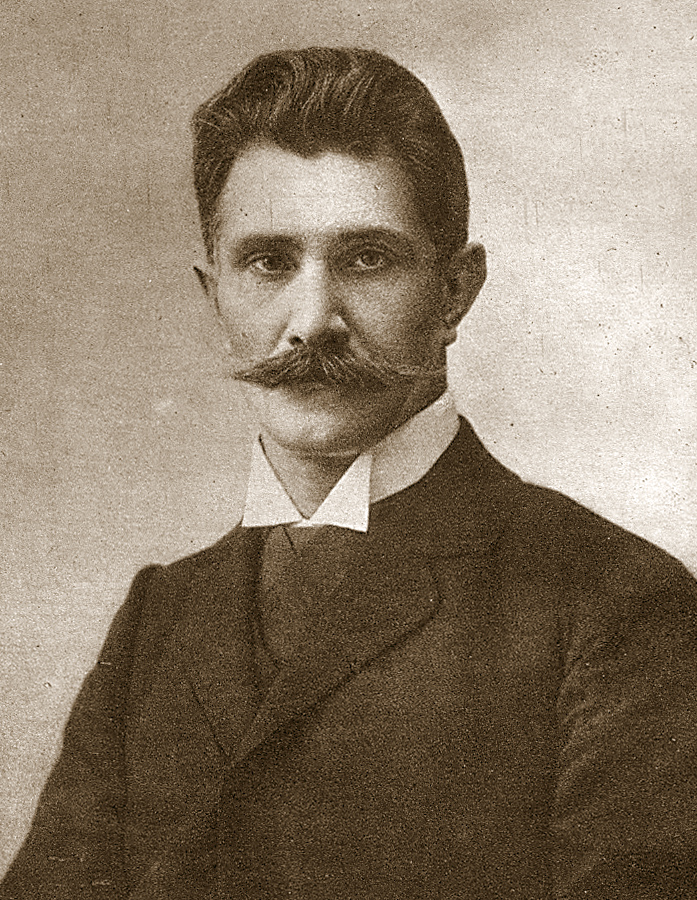
Ignacy Ewaryst Daszyński (pronounced [iɡˈnatsɨ daˈʂɨj̃skʲi] ; 26 October 1866 – 31 October 1936) was a Polish socialist politician, journalist, and very briefly Prime Minister of the Second Polish Republic's first government, formed in Lublin in 1918. In October 1892 he cofounded the Polish Social Democratic Party (Polish abbreviation: PPSD), a precursor to the Polish Socialist Party (PPS). In 1897 he was elected to the Austrian Parliament and remained there until 1918. From 1903 he took part in several congresses and gatherings of the International Socialist Party, advocating for the independ
Actualizări recente
Ignacy Daszyńskia publicat o actualizare
acum 4 ore
From 16 to 23 April 1891, Daszyński led a delegation of Polish socialists to the Congress of the Second International in Brussels. He then went to Berlin, where he became editor-in-chief of the Polish newspaper Gazeta Robotnicza ("Workers' Gazette"). He worked there for six months. When he was leaving Berlin, he was arrested by the German authorities on charges of publishing seditious articles. However, since they could not prove that he was in fact their author, he was released. In early 1892 he went to Lwów, where he played an important role in the first convention of the Polish Social Democratic Party of Galicia (I Zjazd Galicyjskiej Partii Socjalno-Demokratycznej). He delivered a speech about the party's political program and tactics. On his way back, he was arrested again and spent ten days in jail in Kraków. On his release, he returned to Lwów. At the Third Congress of Austrian Socialists he argued for the separation of the Polish Social Democratic Party from the numerous Austrian organizations emphasizing pro-independence clauses in the party's Marxist political program, which aimed to put socialism into practice by abolishing private property. The first steps to achieve this aim were to be democratization of the election…
0 comentarii1 vizualizări0 reacții
Ignacy Daszyńskia publicat o actualizare
acum 4 ore
Daszyński campaigned in the first post-war elections to the Polish Sejm, proclaiming: "The first legislative Sejm is the first administrator of Poland, its builder, the source of law and authority [in] a free, independent and united Poland." 36 members of the PPSD and PPS entered the Sejm and created a parliamentary group named Związek Polskich Posłów Socjalistycznych ("Union of Polish Socialist MPs"). Daszyński became its president. He focused on promoting a socialist program. He advocated nationalizing some industrial sectors, for example creating state monopolies in coal and spirits. He proposed improvements in working conditions and protected workers' rights, as well as supporting development of the cooperative movement and education of peasants and workers. On 26 April 1919, the PPSD, the PPS and the PPS Prussian Section united to form a unitary PPS. Daszyński joined its General Council and became one of its chairmen. He also edited its French-language publication Bulletin Official du Parti Socialiste Polonaise and the weekly magazine Trybuna. After the outbreak of the Polish-Soviet War, Daszyński was for concluding peace as fast as possible. He was opposed to the creation of the Council of National Defense, calling it an "abbreviation of the Sejm". However, on 24 July he…
0 comentarii1 vizualizări0 reacții
Ignacy Daszyńskia publicat o actualizare
acum 4 ore
Vice Speaker (1922–27) On 5 November 1922, Daszyński was again elected to the Sejm. He received 52,874 votes in the constituencies of Kraków County, Chrzanów, Oświęcim, Olkusz and Miechów. On 9 December Daszyński's party put him forward as a candidate for President, but he received only 49 votes. Gabriel Narutowicz was elected President, to the disappointment of the right wing (Narutowicz was elected by members who represented national minorities). On the inauguration day of the president-elect, Daszyński and Bolesław Limanowski were attacked on their way to the ceremony by right wing fighting squads, and forced to barricade themselves inside a house. Daszyński later demanded an explanation for those events. He wrote:
0 comentarii1 vizualizări0 reacții
Ignacy Daszyńskia publicat o actualizare
acum 4 ore
Polish political life cannot be an African jungle, prowled by a dozen of kinds of rogue ... Either your fascism will die smashing its head against Polish democracy, or Poland will boil with civil war. After the assassination of President Narutowicz by Eligiusz Niewiadomski, a supporter of the National Democracy movement, the socialists planned to take revenge on right wing activists. Daszyński objected to their reasoning and forbade further escalation of the violence. On 21 December 1922, at a meeting of the General Council, the PPS tabled a proposal to set up a nationwide worker's educational organization, the Towarzystwo Uniwersytetu Robotniczego (TUR) ("Society of the Workers' University"). On 21 January 1923, the Board of Directors of the TUR was established, headed by Daszyński. He held this position until his death. The creation of the TUR was one of his most important personal achievements. As he later described:
0 comentarii1 vizualizări0 reacții
Ignacy Daszyńskia publicat o actualizare
acum 4 ore
After entering parliament, Daszyński became chairman of a parliamentarian club which numbered 15 members. In 1898, authorities introduced a state of emergency in part of western Galicia. Its aim was to weaken the workers' movement. Most liberties, such as freedom of assembly, were restricted. Daszyński fought against it, for example by giving a famous speech on 22 November, in which he protested against the government's actions. Later, he supported workers' strikes; however, he emphasized that they needed to be held legally. He also engaged in the democratization of the electoral law in parliament; among other things, he called for abolition of curial voting. Daszyńki was a great speaker whose speeches attracted large crowds. He attacked conservatives and President-Minister Badeni. In 1898 he took part in huge demonstrations in Vienna, which resulted in Badeni being dismissed from his position by the Emperor. In 1900, Daszyński was again elected to the Council of State. He focused his activities on circumventing censorship because, as a publicist, he was subjected to limitations on his freedom of speech.
0 comentarii1 vizualizări0 reacții
Ignacy Daszyńskia adăugat o fotografie
acum 4 ore
R.I.P Ignacy
Ignacy Ewaryst Daszyński (pronounced [iɡˈnatsɨ daˈʂɨj̃skʲi] ; 26 October 1866 – 31 October 1936) was a Polish socialist politician, journalist, and very briefly Prime Minister of the Second Polish Republic's first government, formed in Lublin in 1918. In October 1892 he cofounded the Polish Social Democratic Party (Polish abbreviation: PPSD), a precursor to the Polish Socialist Party (PPS). In 1897 he was elected to the Austrian Parliament and remained there until 1918. From 1903 he took part in several congresses and gatherings of the International Socialist Party, advocating for the independence and reunification of all Polish territories, as an integral part of the Polish socialist program. In 1912 he began a long collaboration with future Marshal and Chief of State Józef Pilsudski. He was appointed editor-in-chief of the Socialist newspaper Naprzód (Forward), published in Kraków. Following World War I, Daszyński cofounded the Polish National Committee, and for a few days served as head of the Provisional People's Government of the Republic of Poland formed in the city of Lublin on 7 November 1918. On 26 January 1919 he was elected to the Polish Sejm, and was re-elected in 1922, 1928, and 1930. From July 1920 to January 1921 he served…
0 comentarii1 vizualizări0 reacții
Ignacy Daszyńskia adăugat o fotografie
acum 4 ore
R.I.P Ignacy
Childhood Ignacy Daszyński was born on 26 October 1866 in Zbaraż in the Kingdom of Galicia and Lodomeria (now in Ternopil Oblast), which, following the Partitions of Poland, was then a part of the Austrian Empire. He came from a not very wealthy family of the gentry, one that cherished patriotic traditions. He was the son of Ferdynand Daszyński (1816–1875), an Austrian clerk, and Kamila, née Mierzewska (1834–1895). He had three brothers, one sister, and older half siblings from his father's first marriage. In 1872 Daszyński began his education in a school run by Franciscans in Zbarazh. He was a very good student because he already knew how to read and write and, as he grew up in a multicultural environment, he knew several languages. From childhood, he could speak Ukrainian and Yiddish and understood German. On 6 December 1875, his father died and the family moved to Stanisławów. To improve their financial situation, his mother leased flats to secondary school students. Two years later, he entered secondary school. During this time he earned money by giving his colleagues private lessons. At that time, he was under the strong influence of his older brother, Feliks, who taught him how to…
0 comentarii1 vizualizări0 reacții
Ignacy Daszyńskia adăugat o fotografie
acum 4 ore
R.I.P Ignacy
The atmosphere of Drohobycz was calling me to rebel. The brutality of the sinister rascals who were then making their careers in Drohobycz was so evident and public that you did not have to be a socialist to hate their felonious "production" based on the natural treasures of Mother Earth and on the unbridled exploitation of several thousand peasants who dug up the mineral wax in Borysław. In September 1884, when his mother moved to Przemyśl, Ignacy was left alone in Lwów. Again he was refused enrollment at school, and so studied at home.
0 comentarii1 vizualizări0 reacții
Ignacy Daszyńskia adăugat o fotografie
acum 4 ore
R.I.P Ignacy
At that time, Daszyński's socialist political views were already taking shape. In 1886, he became a tutor to some friends of his parents. On 8 April 1888, he was allowed to pass the Matura (school leavers' examinations) without attending the classes. He received his diploma on 22 September 1888 and went on to study philosophy at the Jagiellonian University in Kraków. Thanks to his brother Feliks, he was in touch with socialists in Kraków. In 1889, he met Ludwik Kulczycki, whom he helped in delivering socialist brochures in Congress Poland. Daszyński soon had to abandon his studies because of financial problems. He became a tutor again, working under a false name for the Gniazdowski family from Czarnostaw. On the night of 2–3 May 1889, he was arrested by the Russian police and spent six months in jail in Pułtusk because he was mistaken for his older brother Feliks, who was engaged in the socialist movement abroad (he attended the Congress of the Second International in Paris). When Ignacy was released from jail he was expelled from Congress Poland and returned to Kraków. While there, he was accused of engaging in illegal political activities, but was acquitted under a statute of…
0 comentarii1 vizualizări0 reacții
Ignacy Daszyńskia publicat o actualizare
acum 4 ore
Social Democratic Party Daszyński wanted to unite all the working-class movements of Galicia. Particular groups were connected with two newspapers, Praca and Robotnik; he himself was a Praca journalist. At a meeting on 7 November 1890 in Lwów, socialist activists decided to create an official and legal Labour Party. The next step was to establish a new socialist poverty-relief and educational association, Siła ("strength" or "force"), on 15 February 1891. When the organization grew bigger, its presence reached Stanisławów and Kraków. At that time, he was very active as a journalist and politician. He delivered speeches at many rallies, such as the election rally on 1 May 1891 in Lwów, and he published a political brochure, O partiach politycznych w Galicji ("On the Political Parties in Galicia"), under the pseudonym Żegota on 30 April 1891. After its publication, he was charged with affiliation with an underground organization, but, since the Socialist Party was legal, the charge was dismissed. In June he became a Galician delegate at the Congress of the Social Democratic Workers' Party of Austria in Vienna.
0 comentarii1 vizualizări0 reacții
Ignacy Daszyńskia publicat o actualizare
acum 4 ore
Kraków City Council On 12 May 1902, Daszyński became a member of the Kraków City Council. While on it, he focused on struggling against conservative and royalist members of the council. Daszyński was also engaged in social matters and issues connected with Kraków's infrastructure. He was a member of municipal committees dealing with industrial affairs, coal and canals. On 2 February 1905, after the outbreak of the 1905 Russian Revolution, he took part in a demonstration on Kraków's Market Square, during which he burned a portrait of the Tsar. Police tried to disperse the demonstrators but failed to seize the council. In 1907, parliament passed a new electoral law allowing all men above 24 to vote in elections for the Council of State. In May of the same year, socialists achieved considerable electoral success while conservatives lost a significant number of parliamentary representatives.
0 comentarii1 vizualizări0 reacții
Ignacy Daszyńskia publicat o actualizare
acum 4 ore
1912–18 Just before World War I, the Polish Social Democratic Party (PPSD) came to an agreement with Józef Piłsudski's Polish Socialist Party – Revolutionary Faction (PPS – Frakcja Rewolucyjna). They decided that, in the coming conflict, Poles should support the Central Powers, which could lead to the creation of a unified Austria-Hungary-Poland. Daszyński co-authored the PPSD resolution, which stated that:
0 comentarii1 vizualizări0 reacții
Ignacy Daszyńskia publicat o actualizare
acum 4 ore
As the true representatives of the Polish nation, we declare our conviction that in a prospective conflict between Austro-Hungary and Russia, whose outbreak is beyond our control, all the forces of the Polish nation should be directed against the Russian emperor, who is the irreconcilable and cruel oppressor of the great majority of our nation. Daszyński recommended members of socialist parties to join Polish paramilitary troops. Thanks to this, these organizations were recognized as legal by the Austrian authorities. In November 1912, the PPS Revolutionary Faction and the PPSD joined the Temporary Commission of Confederated Independence Parties (Tymczasowa Komicja Skonfederowanych Stronnictw Niepodległościowych). Galician socialists were hoping to provoke an uprising after the outbreak of war in the Kingdom of Poland. In August 1914, when World War I started, Daszyński became the deputy military commissioner in Miechów for a few days. He tried to urge the population to fight against Russia, but was unsuccessful and quickly returned to politics. After the creation of the Supreme National Committee by the parliamentary Koło Polskie (Polish Circle), Daszyński became one of the members of the Executive Department. This unit decided to form the Polish Legions. In Daszyński's opinion, Poland should seek support from Austria-Hungary.…
0 comentarii1 vizualizări0 reacții
Ignacy Daszyńskia publicat o actualizare
acum 4 ore
All Poles declare that they want sovereignty over all three partitions brought about by the rape of Poland: all three partitions should be joined and announced as an independent country, but this unification and this independence needs to be achieved in accordance with international law in an international peace convention.
0 comentarii1 vizualizări0 reacții
Ignacy Daszyńskia publicat o actualizare
acum 4 ore
On 15 October 1918 Daszyński and other Polish deputies to the Austrian parliament adopted a document in which they declared themselves to be Polish citizens. Late October brought the first signs of collapse of the once mighty Austria-Hungary. On 28 October he became a member of the Polish Liquidation Committee, which was led by Wincenty Witos and headquartered first in Kraków, then in Lwów. On 6 November, Daszyński and others proclaimed the "Provisional People's Government of the Polish Republic" (Tymczasowy Rząd Ludowy Republiki Polskiej), based in Lublin, with Daszyński as Prime Minister. Other members of the government included Wincenty Witos, Tomasz Arciszewski, Jędrzej Moraczewski, Stanisław Thugutt, and Colonel Edward Rydz-Śmigły as military commander. The government's manifesto called upon workers and peasants to take power into their own hands and build "the edifice of an independent and united People's Republic of Poland", in which all citizens would enjoy equal political and civil rights, especially freedom of conscience, speech and assembly. Within the framework of improving social conditions, there were promises of an eight-hour working day in industry, trade and craft, and of the nationalization of mines and large estates. The future country was intended to be a democratic parliamentary republic. Setting…