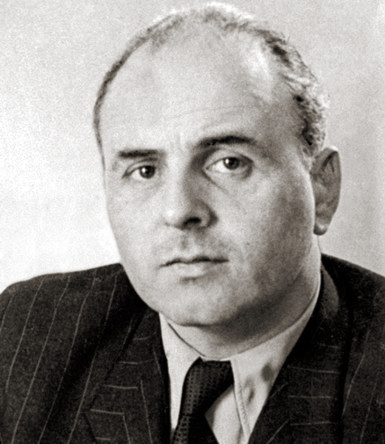
Jakub Berman (23 December 1901 – 10 April 1984) was a Polish communist politician. An activist during the Second Polish Republic, in post-war communist Poland he was a member of the Politburo of the Polish Workers' Party (PPR) and then of the Polish United Workers' Party (PZPR). From 1948, he was considered the second most powerful politician in Poland after President Bolesław Bierut, until he was removed from power in 1956, following Bierut's death. Alongside Bierut, Berman was responsible for party oversight of the Stalinist Ministry of Public Security, commonly known as the "UB". Under Berm
Actualizări recente
Jakub Bermana publicat o actualizare
acum 10 ore
Political career in communist-ruled Poland In the summer of 1944, Berman joined the Politburo of the Polish Workers' Party (PPR) and returned to Poland. In Lublin, at the Polish Committee of National Liberation (PKWN), Berman practically led the foreign affairs department; which was primarily concerned with securing international recognition for the new communist-led governing entity. In January 1945, with the conquest of Warsaw from the Nazis by the Red Army, the Provisional Government of the Republic of Poland (formerly the PKWN) moved from Lublin to the Praga district of Warsaw. Berman, as a member of the Politburo of the PPR, was charged with oversight of the state security apparatus (the Ministry of Public Security). In post-war Poland Berman organized state censorship, supervised the development of, and permissions for political parties and organizations, and was the main liaison between the PPR and the PKWN.[a] Berman's decisions had to be consulted with and could be vetoed by two resident Soviet advisers, who remained in Poland until 1953 and 1954. From 1948, together with Bolesław Bierut, general secretary of the Polish United Workers' Party (PZPR), a successor of the PPR, and economist Hilary Minc, Berman formed a triumvirate of Stalinist leaders of Poland.[b]…
0 comentarii2 vizualizări0 reacții
Jakub Bermana publicat o actualizare
acum 10 ore
Early career Jakub Berman was born into a middle-class Jewish family in Warsaw on 23 December 1901. His younger brother was Adolf Berman. Jakub became a member of the Communist Youth Union and in 1928 joined the Communist Party of Poland (KPP). He was arrested a few times, but unlike many other activists, had not been imprisoned for a prolonged period. He received a law degree in 1925 from the University of Warsaw. He wrote a magister thesis entitled Służba domowa w Warszawie w końcu w. XVIII oraz próby jej zrzeszenia się zawodowego ('Domestic servantry in Warsaw at the end of the 18th century and its attempts to establish a trade association'). Berman's academic adviser, Marxist sociologist Prof. Ludwik Krzywicki, wanted to hire Berman at the university as his assistant, but this was not allowed because of Berman's Jewish origin. Krzywicki's efforts to find Berman a mainstream non-university job also failed and Berman ended up working for a Jewish agency, in a poorly paid position. The family was supported largely by Berman's wife, Gustawa (née Grynberg), who was a well-regarded physician and dentist. Berman's social contacts in Warsaw included many communist sympathizing members of the Polish intelligentsia; Janina and Władysław…
0 comentarii2 vizualizări0 reacții
Jakub Bermana publicat o actualizare
acum 10 ore
World War II On 6 September 1939, after the invasion of Poland by Nazi Germany, Berman followed government directions for "able-bodied men" and took a train going in an easterly direction. He went to Białystok, occupied by the Soviet Union after the Soviet invasion of Poland. With his friend Alfred Lampe, Berman was active in Polish-communist circles there and became a Soviet citizen. In March 1941 he moved to Minsk, where he worked as an editor at Sztandar Wolności ('The Banner of Freedom'), a Polish-language bulletin published by the Communist Party of Byelorussia. Berman's doctoral dissertation, written under the direction of Krzywicki and entitled O strukturze miast polskich na podstawie spisu ludności w 1791 r. ('On the structure of Polish cities based on the population census of 1791'), was brought to Białystok by his friend and colleague Irena Sawicka, but burned in Minsk when a dormitory where Berman and other journalists were housed was bombed by the Germans. After the German invasion of the Soviet Union in 1941, Berman escaped to Moscow. He later became an instructor at the International Lenin School, the Comintern school, where he trained displaced Polish communists, activists for the new Soviet-sponsored Polish Workers' Party (PPR).…
0 comentarii2 vizualizări0 reacții
Jakub Bermana publicat o actualizare
acum 10 ore
Fall from power In 1952, Anna Duracz, Berman's secretary, was arrested. In 1954, he was attacked during a party plenum by Aleksander Zawadzki, who claimed that, as he originated from a bourgeois Jewish family, Berman lacked a proper understanding of the Polish workers' movement. After the death of First Secretary Bierut, Berman resigned from the PZPR Politburo (and from the position of first deputy prime minister) in May 1956. He was earlier incriminated by Józef Światło, a former official in the Ministry of Public Security, who defected to the West. Berman was relieved from the Central Committee of the PZPR in the fall of 1956 and in May 1957, in the aftermath of the Polish October, dismissed from the party altogether. He attempted to get his membership reinstated, wrote appeals in 1960 and 1964, but was rejected on both occasions. He was considered responsible for the "Stalinist-era errors and distortions" by which they meant dogmatic and sectarian party attitudes and breaking the rule of law.
0 comentarii2 vizualizări0 reacții
Jakub Bermana publicat o actualizare
acum 10 ore
Retirement For two years Bermam remained without steady employment and supported himself by accepting various assignments, such as translations of works by Karl Marx and Friedrich Engels. In September 1958, Berman was placed by the party in the state-run Książka i Wiedza ('Book and Knowledge') publishing house, where he worked until he was retired by the authorities in 1968. His wife was removed from her position at the Rheumatology Institute. For the first time, according to his daughter Lucyna Tychowa, Berman could enjoy normal life with his family and friends. He engaged in activities, such as reading or attending films and theatrical productions. In the autumn of 1981, he was hit by a car and permanently injured while he attempted to cross a street. He died in Warsaw in April 1984 and was buried at Powązki Cemetery.
0 comentarii2 vizualizări0 reacții
Jakub Bermana adăugat o fotografie
acum 10 ore
R.I.P Jakub
Jakub Berman (23 December 1901 – 10 April 1984) was a Polish communist politician. An activist during the Second Polish Republic, in post-war communist Poland he was a member of the Politburo of the Polish Workers' Party (PPR) and then of the Polish United Workers' Party (PZPR). From 1948, he was considered the second most powerful politician in Poland after President Bolesław Bierut, until he was removed from power in 1956, following Bierut's death. Alongside Bierut, Berman was responsible for party oversight of the Stalinist Ministry of Public Security, commonly known as the "UB". Under Berman's leadership, 200,000 people were imprisoned for alleged political crimes, and 6,000 were executed.