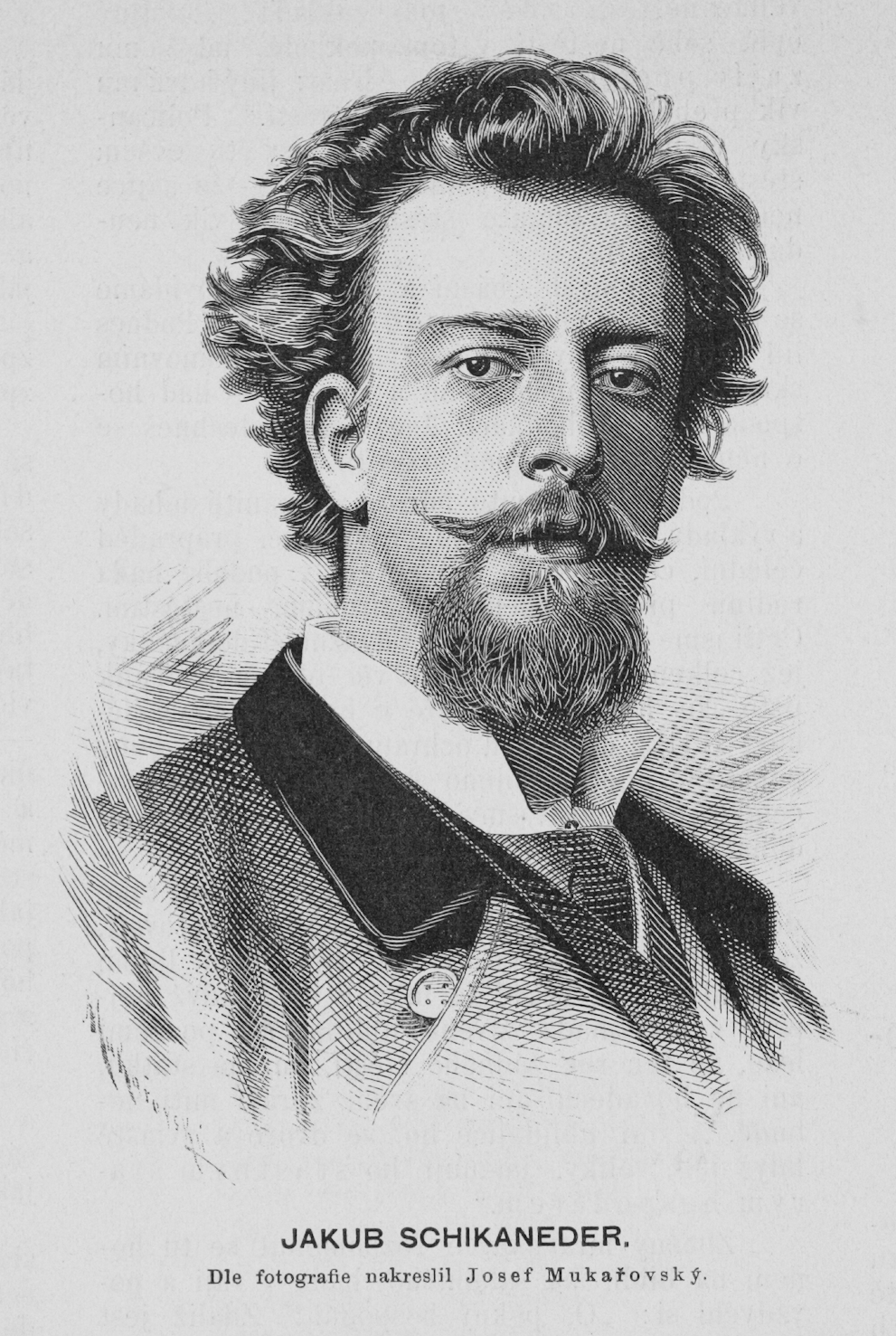
Jakub Schikaneder (27 February 1855 – 15 November 1924) was a Czech painter and art professor. His work is known for its atmospheric, soft, and sorrowful genre scenes. The melancholy and moody themes of Schikaneder's pieces bear resemblance to the artistic trends of Romanticism, Realism, and Symbolism. Gabriel von Max, a Prague artist and professor of history painting, was a mentor and teacher for Schikaneder. Schikaneder notably participated in the decorating of the National Theatre in Prague in 1881. Much of Schikaneder's work has since been lost, and the artist passed largely unknown to Cze
Actualizări recente
Jakub Schikanedera adăugat o fotografie
acum 4 ore
R.I.P Jakub
Jakub Schikaneder (27 February 1855 – 15 November 1924) was a Czech painter and art professor. His work is known for its atmospheric, soft, and sorrowful genre scenes. The melancholy and moody themes of Schikaneder's pieces bear resemblance to the artistic trends of Romanticism, Realism, and Symbolism. Gabriel von Max, a Prague artist and professor of history painting, was a mentor and teacher for Schikaneder. Schikaneder notably participated in the decorating of the National Theatre in Prague in 1881. Much of Schikaneder's work has since been lost, and the artist passed largely unknown to Czech society until the rediscovery of his work in 1998.
0 comentarii1 vizualizări0 reacții
Jakub Schikanedera adăugat o fotografie
acum 4 ore
R.I.P Jakub
Early life Jakub (or Jakob) Schikaneder was born on 27 February 1855 in Prague, Bohemia, in the Austrian Empire to an Austrian father and a Czech mother. His father, Karel Friedrich Schikaneder, was from Vienna and worked as a customs office clerk in Prague. His mother Leokadia (née Běhavá) was a native of Prague. He was a paternal descendant of Urban Schikaneder, the elder brother of librettist Emanuel Schikaneder.
0 comentarii1 vizualizări0 reacții
Jakub Schikanedera adăugat o fotografie
acum 4 ore
R.I.P Jakub
The Schikaneder family's love of art and their middle-class status in Prague society enabled him to pursue his studies at the Academy of Fine Arts from the age of 15. From 1870 to 1878, Schikaneder was immersed in the academy's stereometric and classical art style. He was a student of Antonín Lhota at the academy and finished his studies in 1878, serving for a year in the Austro-Hungarian Army. He travelled to and stayed in Paris from 1878 to 1880, where he gleaned inspiration from the late-nineteenth-century Parisian art scene before continuing his studies at the academy in Munich under Czech painter Gabriel von Max. Max's teaching allowed Schikaneder to explore deeper spiritual themes and examine the social contradictions in Czech art and culture of the time. He counted amongst those who admired the Munich School of the end of the 19th century. Schikaneder first attempted to publicly exhibit his work in 1879 at the Žofín salon, where he applied concepts of genre painting rather than the classic form taught by the Academy of Fine Arts. Schikaneder returned to Prague and participated in the painting of the National Theatre in Prague. From 1868 to 1881, this decorating brought together many…
0 comentarii1 vizualizări0 reacții
Jakub Schikanedera adăugat o fotografie
acum 4 ore
R.I.P Jakub
Style Schikaneder is known for his soft paintings of the outdoors, often lonely and melancholic. Paul Signac defines Schikaneder's intention behind his work as striving for a “unifying and moral harmony." Inspired by a Neo-Impressionist approach, Schikaneder's artistic technique consists of small brushstrokes that effectively infuse effects of gleam, mist, and blurriness. His paintings often feature poor and outcast figures and "combined neo-romantic and naturalist impulses." Schikaneder takes a particular interest in depicting shadow–both indoors and outdoors–that draws parallels to the nostalgic atmosphere of fin-de-siècle Symbolism. Other motifs favoured by Schikaneder were autumn and winter, corners and alleyways in the city of Prague and the banks of the Vltava – often in the early evening light, or cloaked in mist. Painting the Czech cultural atmosphere provided Schikaneder an opportunity to respond to the political and cultural dilemmas of the time, as well as the confrontation between the individual and society. Schikaneder also recurrently depicted the lifeless bodies of women, following the current times’ themes of ruin and despair. He draws inspiration from Parisian culture for depicting women, 19th-century European painting for themes of nostalgia and despair, and baroque Dutch painting–especially that of Rembrandt–for depicting light and aestheticism. In the beginning…
0 comentarii1 vizualizări0 reacții
Jakub Schikanedera publicat o actualizare
acum 4 ore
Notable works Schikaneder's first well-known work was the monumental painting Repentance of the Lollards (2.5m × 4m) which has since been lost. Inspired by teacher Garbiel von Max, Schikaneder's famous Murder in the Block (1887–90) represents an attempt to expand the political and emotional range of genre painting.Drowned (1893) depicts a similar recurrent theme of dead women, illustrating a drowned female body lying in the same fashion–though inverted–as the murdered woman. Schikaneder gave poet Jaroslav Vrchlicky a sketch of Drowned in 1893. Another of Schikaneder's notable works, painted in 1910, is Evening Mood. The painting's haziness represents an existential filter on one's perception of place; its hazy glow symbolically stops sunset's fading time into a lasting present. Another notable landscape of Schikaneder is Early Evening at Hradčany (1909), depicting a winter dusk and the back of a lone woman leaning over the wally of a bridge. Schikaneder's mysterious and melancholic mood were often infused by the paintings of a lone figure seen from behind.
0 comentarii1 vizualizări0 reacții
Jakub Schikanedera publicat o actualizare
acum 4 ore
Legacy Schikaneder is known for his moody, twilight urban scenes. His work has been mostly lost since he first started his artistic career. Due to the popularity of Cubist and Surrealist art within Czech culture during much of the 20th century, Schikaneder passed mainly unknown to the Czech public. His work was largely unappreciated by the art world and perceived to be disrupting the genre norms of the time. His work was rediscovered in 1998 in a retrospective exhibit at the National Gallery Prague.
0 comentarii1 vizualizări0 reacții
Jakub Schikanedera publicat o actualizare
acum 4 ore
Art exhibitions Following his death, Schikaneder's work was first exhibited in 1926 in a collection of The Union of Fine Artists. In 1977, a second exhibition created by Jiří Kotalík and Dagmar Šefčíková showcased Schikaneder's pieces. Schikaneder's work has also been displayed in the National Gallery of Prague, Trade Fair Palace. Several auctions have also exhibited Schikaneder's pieces, with a record price of US$580,110 for his Winter in Prague, sold at Sotheby's London in 2021.
0 comentarii1 vizualizări0 reacții
Jakub Schikanedera publicat o actualizare
acum 4 ore
Further reading Tomáš Vlček: Schikaneder: Jakub Schikaneder, Prague painter of the turn of the century ("A thematic guide to a retrospective exhibition, National Gallery in Prague, Collection of Old Masters, Wallenstein Riding School in Prague, May 15, 1998 – January 10, 1999"). Prague: National Gallery, 1998.