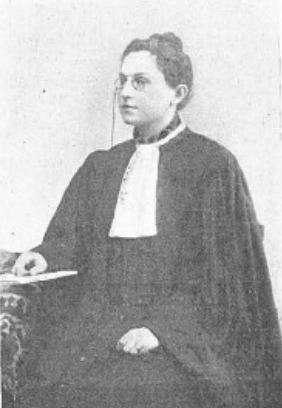
Józefa Joteyko (Polish pronunciation: [juˈzɛfa jɔtˈɛjkɔ]; 29 January 1866 – 24 April 1928) was a Polish physiologist, psychologist, pedagogue, and researcher. After completing her undergraduate studies at the University of Geneva, she entered medical school at the Free University of Brussels and completed her Doctor of Medicine in 1896 at the University of Paris. She opened a medical practice in France but decided two years later that she preferred research and moved back to Brussels. Operating as an assistant at the Solvay Institute of Physiology, she lectured and conducted research into musc
Actualizări recente
Józefa Joteykoa adăugat o fotografie
acum 4 ore
R.I.P Józefa
Józefa Joteyko (Polish pronunciation: [juˈzɛfa jɔtˈɛjkɔ]; 29 January 1866 – 24 April 1928) was a Polish physiologist, psychologist, pedagogue, and researcher. After completing her undergraduate studies at the University of Geneva, she entered medical school at the Free University of Brussels and completed her Doctor of Medicine in 1896 at the University of Paris. She opened a medical practice in France but decided two years later that she preferred research and moved back to Brussels. Operating as an assistant at the Solvay Institute of Physiology, she lectured and conducted research into muscle and nervous system fatigue. Convinced that science could solve societal challenges, Joteyko expanded her research in order to study how science could improve the lives of workers while leading to improvements in industrial efficiency and productivity. This led her to conduct investigations on children, examining how educational facilities could optimize the potential of their students by drawing on scientific methodology. She served as president of the Belgian Neurological Society beginning in 1904 and received numerous awards for her research, including the Desmath Prize of the Imperial and Royal Academy of Brussels, the Dieudonnée Prize of the Belgian Royal Academy of Medicine. In addition, she was frequently recognized with…
0 comentarii1 vizualizări0 reacții
Józefa Joteykoa adăugat o fotografie
acum 4 ore
R.I.P Józefa
Early life Józefa Franciszka Joteykówna was born on 29 January 1866 in Poczujki, Romanov volost of the Skvyra uezd in Kiev Governorate of the Russian Empire (today village of Pochuiky is located in Popilnia Raion, Zhytomyr Oblast). Her parents were Karolina (née Odrowąż-Kurzańska) and Lucjan Joteyko. Her family, which included a sister, Zofia, and two brothers Mieczysław and Tadeusz, was descended from landowning Lithuanian nobility and members of the Polish intellectual elite. She and her siblings grew up on the large family estate, but to improve their opportunities for education, the family moved to Warsaw in 1873, after leasing the property in Poczujki. Joteyko began her studies with her mother and Madame Perosette, a French tutor. In 1876, the family moved to Smolna Street, near the Sierakowska Boarding School. Joteyko was enrolled there but only attended a for few months because her mother thought the instruction in sciences was inadequate. As the only other schooling option at the time was for Joteyko to attend a government school, which required assimilation of Russian culture, her mother organized private tutoring at home with Polish professors. After seven years of study, Joteyko prepared to take the examination to become a private teacher. Though…
0 comentarii1 vizualizări0 reacții
Józefa Joteykoa adăugat o fotografie
acum 4 ore
R.I.P Józefa
Opting to go to Geneva, where her maternal uncle Zygmunt Miłkowski lived, Joteyko enrolled in the University of Geneva in 1886 to study physical and biological sciences. When she arrived in Switzerland, she cut her hair short, wore tailored dresses with a more masculine style, and was rumored to smoke. She met the former high school teacher, Michalina Stefanowska, with whom she established both a personal and professional relationship. After two years of study, Joteyko graduated with a Bachelor of Science degree and briefly returned to Warsaw. In 1889, she and her family moved to Brussels, where Joteyko entered the Faculty of Medicine of the Free University of Brussels. Her father's illness forced the family to return to Warsaw in 1890. Joteyko did not return with them but instead moved to Paris, where Stefanowska was studying physiology. Within a few months, her father died and the family was threatened with bankruptcy. Joteyko left France briefly and went to Saint Petersburg to take the financial matters in hand. She was able to rescue some of the family capital and with her share, she returned to Paris and rented an apartment with Stefanowska. Enrolling in medical studies under Charles Richet at the…
0 comentarii1 vizualizări0 reacții
Józefa Joteykoa adăugat o fotografie
acum 4 ore
R.I.P Józefa
France and Belgium For the next two years, Joteyko practiced medicine in Paris but found she disliked the routine. In 1898, she accepted an offer to move to Belgium, as an assistant at the Solvay Institute of Physiology. She also lectured on experimental psychology at the Casimir Laboratory of the New University of Brussels. In 1903, she became the director of the Casimir Laboratory and a protégée of Hector Denis. She published papers on physiology and her research into the effects of anesthesia by means of ether or chloroform on muscles, nerves, and the nervous system. Joteyko was particularly interested in muscle and central nervous system fatigue and increasingly worked on methods to quantitatively measure fatigue. Her scientific works were recognized with numerous honors, including a joint award in 1900 with Casimir Radzikowski for the Desmath Prize of the Imperial and Royal Academy of Brussels; a co-honor in 1901 with Stefanowska for the Dieudonnée Prize of the Belgian Royal Academy of Medicine and with Victor Pachon for the Montyon Prize of the French Academy of Sciences; and in 1903 co-honors with Paul-Émile Garnier and Paul Cololian for the Lallemand Prize of the French Academy of Sciences and the Monyton Prize…
0 comentarii1 vizualizări0 reacții
Józefa Joteykoa publicat o actualizare
acum 4 ore
In 1904, Joteyko became president of the Belgian Neurological Society and chaired the organization's congress in Liège the following year. In 1906, Stefanowska left Paris and returned to Poland, becoming headmistress of a girl's secondary school. Joteyko strongly objected to her partner leaving, but Stefanowska was tired of research and wanted to return to teaching. She convinced Joteyko, whom she referred to as her towarzyszka życia (life companion), with the promise that they could write letters and visit each other. Though she continued to research physiology, Joteyko began lecturing on pedagogical psychology at teacher's seminars in Charleroi and Mons. In 1908, she founded and became editor of the Revue Psychologique, a journal which explored developments in the field of psychology from a scientific and educational perspective. Through her work there, she met and began collaborating with a young, Georgian scientist, Varia Kipiani, who served as a secretary to the Revue. The two women carried out joint research on vegetarianism, to which they both adhered and were awarded the 1908 Vernois Prize of the Académie Nationale de Médecine. Joteyko organized summer Paedological Seminars inviting international scholars to participate. Joteyko and Stefanowska published their last joint paper, "Psychophysiology of Pain", a synthesis…
0 comentarii1 vizualizări0 reacții
Józefa Joteykoa publicat o actualizare
acum 4 ore
Return to Poland Unable to gain full-time employment, in 1919 Joteyko returned to Poland with Grzegorzewska soon after the Second Republic was established. She applied to the University of Warsaw to chair the experimental psychology department, but was rejected. Joteyko believed that the rejection was caused by an aversion to women in Polish scientific circles, as well as the fact that she lived with long-term female partners. Grzegorzewska, who had found employment with the Ministry of Religious Affairs and Public Enlightenment to manage special education development for schools, institutions and educators, helped Joteyko find work as a lecturer at the Państwowy Instytut Pedagogiczny (National Pedagogical Institute) and National Institute of the Deaf in Warsaw. A year later, Joteyko was offered the chair of the General and Pedagogical Psychology Department at the Institute. She brought her private laboratory equipment from Brussels to establish the workshop for the Pedagogical Institute. Using various instruments, she taught her students to measure fine motor skills, rates of reaction to stimuli, and spatial orientation, as well as analyzing psychological results from such examinations as the Binet-Simon intelligence, Otis mental-ability, and Stanford educational tests. In 1921, Joteyko joined the editorial committee of the Rocznik Pedagogiczny (Pedagogical Yearbook)…
0 comentarii1 vizualizări0 reacții
Józefa Joteykoa publicat o actualizare
acum 4 ore
In the late 1920s, Joteyko developed a heart condition which became more serious in 1927. Her companion Grzegorzewska cared for her during her final illness. She died on 24 April 1928 in Warsaw and was buried in the Powązki Cemetery. Her funeral procession was led by First Marshall Józef Piłsudski and President Ignacy Mościcki. At the time of her death, Joteyko was widely respected for her work, and, along with Marie Skłodowska-Curie, was one of the most internationally recognized Polish scientists. She is also remembered as a pioneer in educational reform in Poland. Her pedagogical approach to educational reform recognized that education included care not only of what students were learning, but of their physical and mental well-being, and adequately trained educators who fostered and inspired learning. Joteyko published 262 works and left a collection of research in manuscript form. During her lifetime, she was appointed as a member of the Royal Society of Medical and Natural Sciences of Brussels and the Belgian Neurological Society in 1902, a member of the Association of French Chemists in 1903, and from 1904 a member of the Polish Philosophical Society in Lviv. She became an honorary member of the Accademia di fisica e…
0 comentarii1 vizualizări0 reacții
Józefa Joteykoa publicat o actualizare
acum 4 ore
Barańska, Małgorzata; Grochowska, Małgorzata; Machnik, Hanna, eds. (2012). Bibliografia Polska 1901–1939 (PDF) (in Polish). Vol. 14. Warsaw, Poland: Biblioteka Narodowa. pp. 18–27. ISBN 978-83-7009-778-3.. An extensive list of publications.