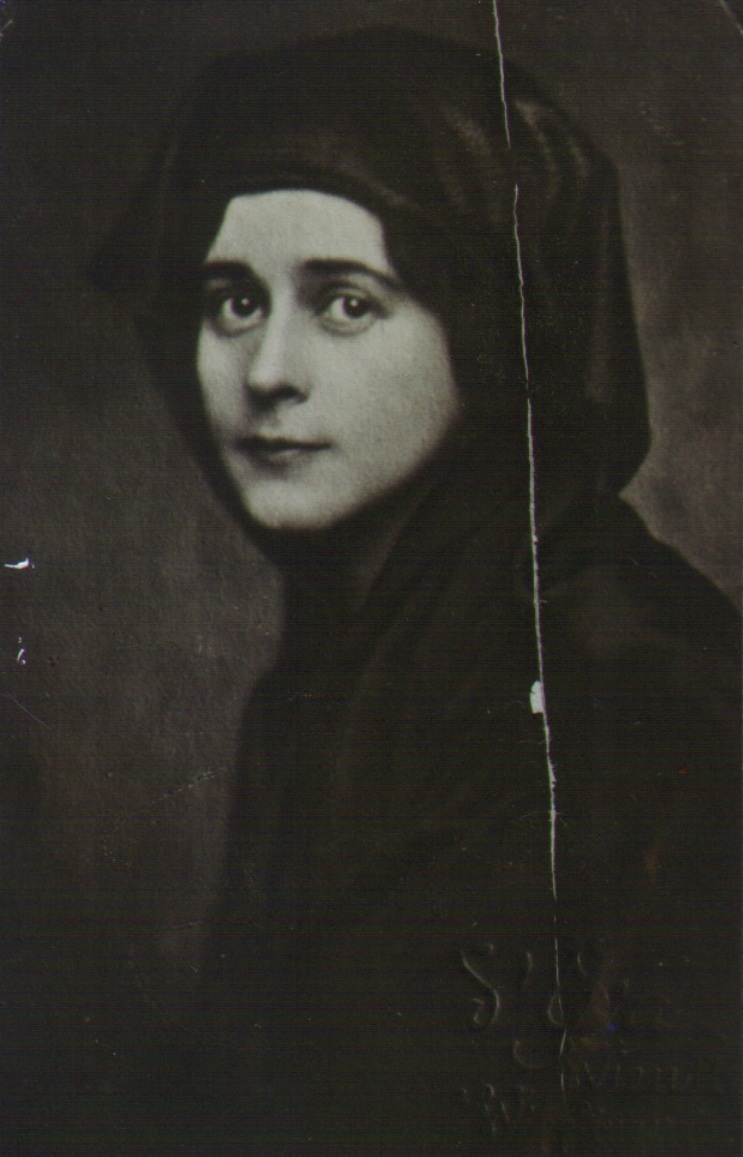
Javidan Hanim, also known as Djavidan (Arabic: جاويدان هانم; born May Torok von Szendro; June 15, 1877– August 5, 1968), was a Hungarian noble, and Khediva consort of Egypt from 1910 to 1913 as the second wife of Khedive Abbas II of Egypt.
Actualizări recente
Májuska Puskása adăugat o fotografie
acum 7 ore
R.I.P Májuska
Javidan Hanim, also known as Djavidan (Arabic: جاويدان هانم; born May Torok von Szendro; June 15, 1877– August 5, 1968), was a Hungarian noble, and Khediva consort of Egypt from 1910 to 1913 as the second wife of Khedive Abbas II of Egypt.
0 comentarii3 vizualizări0 reacții
Májuska Puskása publicat o actualizare
acum 7 ore
Marriage Javidan first laid eyes on her future husband during one of her infrequent visits to her brother. She met the Egyptian prince twice during that period, when Josef introduced his sister to the prince. A little more than a year before her brother's graduation, Abbas was summoned suddenly to Egypt. A telegram had arrived announcing that Khedive Tewfik had died in his house in Helwan, south of Cairo on 7 January 1892. Egypt's heir apparent, not yet eighteen was expected in Egypt post haste. Several years passed before Javidan met Abbas again. By that time he was married to his first wife Ikbal Hanim, a father of four and more importantly, Khedive of Egypt. The meeting took place in France in June 1900. She was in Paris visiting her mother and stepfather, and the khedive was passing through on his way to London. The khedive was immediately smitten with her and wasted no time initiating a short but passionate correspondence followed by an invitation for the countess to visit Egypt. At the port of Alexandria, she was met by Friedrich von Thurneyssen, the khedive's Austrian Master of the Horse. The visit developed into a long romance culminating into a…
0 comentarii3 vizualizări0 reacții
Májuska Puskása publicat o actualizare
acum 7 ore
As consort In Cairo, she lived in the khedival domain of Mostorod, north east of the nation's capital. The rest of the time she accompanied the khedive on his travels to Ottoman Empire and Europe as well as inside Egypt. When traveling to and from Egypt she was seldom seen aboard the khedival yacht El Mahrousa. In order to keep the rumourmongers at bay she would use regular passenger liners between Alexandria and Trieste or Constantinople. Most of the time the travel dates coincided with Abbas Hilmi's separate travel arrangements aboard the royal yachts. She took an active role in the creation of Tchibukli Palace which was close to her heart. The architectural and stylistic intent for their residence was to replicate their beloved Alexandrian home Muntaza Palace. In Egypt, she took part in civic affairs. As a member of the Red Cross she brought solace to victims of the first Balkan War of 1912. By order of the khedive, the wounded, mostly from Kavala near Macedonia, were allowed to recuperate in the Ras El Tin Palace, its halls and long corridors having been transformed into a temporary hospital. The khedival entourage meanwhile stayed at Montaza Palace, his favourite residence.…
0 comentarii3 vizualizări0 reacții
Májuska Puskása publicat o actualizare
acum 7 ore
Later life Her life after divorce was hard. During World War I she opened a salon in Vienna selling cosmetic articles. She made the acquaintance of composer Eugène d'Albert with whom she perfected her piano. Other acquaintances included Tsar Ferdinand I of Bulgaria, Austrian novelist Robert Musil, Norwegian writer Olaf Gulbransson and German author-playwright Gerhart Hauptmann. Between the two wars, she made a dash for the motion pictures and theater planks, her latest vocation earning her occasional cover stories, some of which were picked up by the Egyptian press. But with painful disappointment she realised she was two generations too late and no match for younger rivals like Marlene Dietrich or Lucie Mannheim. It was too late for stardom and Josef von Sternberg would not cast her as Lola in his 1930 production The Blue Angel. In 1931, she published her memoirs under the name Harem Life of Princess Djavidan Hanum. Re-settled at No. 49 Schlueterstr Berlin-Charlottenburg, she gave piano concerts, wrote short plays for the radio and authored several works including Back to Paradise, The Great Seven, Soul And Body and Gulzar. During World War II, she took refuge in Vienna and immediately after the Germans surrendered, moved to…
0 comentarii3 vizualizări0 reacții
Májuska Puskása publicat o actualizare
acum 7 ore
Death Javidan died in Graz on 5 August 1968, aged 91. She was buried at the cemetery of St. Leonhard with only a few Muslim students from the nearby university in attendance, with only the words "Djanan Djavidan" on the gravestone.
0 comentarii3 vizualizări0 reacții
Májuska Puskása adăugat o fotografie
acum 7 ore
R.I.P Májuska
Early life Javidan Hanim was born May Torok von Szendro in Philadelphia, Pennsylvania, United States, on 15 June 1877. Her father was Count József Torok von Szendro, former head of Ung county. Her mother was Countess Sofie Vetter von der Lilie, who after their divorce in 1881 married Hungarian inventor Tivadar Puskás, a close collaborator of Thomas Edison in 1882 in Westminster, Middlesex, England. She had an elder brother Count Josef Torok von Szendro (1873 – 98). She spent most of her youth at Wassen Castle, south of Graz, Austria. At aged 12, she allegedly wrote short articles for various journals and played the piano. At 15, she had her own apartment in Graz. Although she never went to school, her elder brother, following Austrian tradition, was enrolled at the Theresianum, Vienna's famous academy patronized by Habsburg princes and scions of European, Egyptian, Ottoman and Oriental aristocracy. It was there that her brother befriended Prince Abbas Hilmi, an Egyptian prince one year his junior.
0 comentarii3 vizualizări0 reacții
Májuska Puskása publicat o actualizare
acum 7 ore
Divorce Almost a year before he was deposed in 1914, Abbas Hilmi separated from Javidan. Rumors circulating both in and outside the court claimed the khedive was seeing Georgette Mesny also known as Andrée de Lusange whom he met at Maxim's in Paris the previous summer. The couple had returned to Egypt together aboard the MS Helwan. Lusange was a 20 years old short, lean, heavily painted woman who distributed her favors for 20 francs and once in the khedive's entourage spied for the French government. During his exile, the khedive continued his relationship with Lusange, traveling with her all over Europe and showering her with expensive gifts and jewellery. On 7 August 1913, she received her divorce papers in Austria. These were signed by the President of the Alexandria Sharia Court, Sheikh Hassan al-Banna. Concurring this document was the Grand Mufti of Egypt Sheikh Bakry Ashour al-Sadfi. Abbas continued to support her financially up to the end.