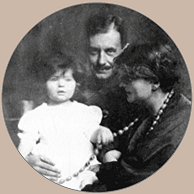
Alma Manon Anna Justina Carolina Gropius (5 October 1916 – 22 April 1935) was the Austrian-born daughter of the German architect Walter Gropius and the Austrian composer and diarist Alma Mahler and the stepdaughter of the novelist and poet Franz Werfel. She is a Randfigur (peripheral person) whose importance lies in her relationships to major figures: a muse who inspired the composer Alban Berg, as well as Werfel and the Nobel Prize-winning writer Elias Canetti. Manon Gropius is most often cited as the "angel" and dedicatee of Berg's Violin Concerto.
Actualizări recente
Manon Gropiusa adăugat o fotografie
acum 5 ore
R.I.P Manon
Alma Manon Anna Justina Carolina Gropius (5 October 1916 – 22 April 1935) was the Austrian-born daughter of the German architect Walter Gropius and the Austrian composer and diarist Alma Mahler and the stepdaughter of the novelist and poet Franz Werfel. She is a Randfigur (peripheral person) whose importance lies in her relationships to major figures: a muse who inspired the composer Alban Berg, as well as Werfel and the Nobel Prize-winning writer Elias Canetti. Manon Gropius is most often cited as the "angel" and dedicatee of Berg's Violin Concerto.
0 comentarii4 vizualizări0 reacții
Manon Gropiusa adăugat o fotografie
acum 5 ore
R.I.P Manon
Life Manon Gropius, christened in a Lutheran church as Alma Manon Anna Justina Carolina, was born in Vienna during the height of World War I, on 5 October 1916, the third child of Alma Mahler, the widow of the composer and conductor Gustav Mahler, and wife of the architect and Bauhaus founder Walter Gropius. Her parents separated soon after Gropius discovered Alma's affair with the writer Franz Werfel in the summer of 1918 and the true paternity of her fourth child, Martin Johannes Gropius.
0 comentarii4 vizualizări0 reacții
Manon Gropiusa publicat o actualizare
acum 5 ore
Like other children of her background and parentage, Manon, called "Mutzi" by family and friends (she was childhood friends with Maria Altmann, also called "Mutzi" later in life), was raised by her nanny, a former Austro-Hungarian Army nurse, Ida Gebauer (whom Manon called "Schulli"). Her early life was spent traveling with her mother between Alma's three homes in Vienna, Breitenstein am Semmering, and Venice, as well as at Weimar, the site of the first Bauhaus school. Her travels also included many German cities, including Leipzig, where Franz Werfel's play Spiegelmensch (Mirror Man) premiered in 1921. There, the precocious five-year-old saw the rehearsals and began to "perform" the roles of the heroine as well as declaim lines. From that time on, her mother, Werfel, and others in their milieu cultivated the girl's interest in the theater. During the early 1920s, Walter Gropius gave Alma the legal grounds to divorce him for infidelity, by arranging to be discovered in flagrante delicto with a prostitute. His cooperation came with the understanding that Manon would be allowed to stay with him and his new wife, Ise Gropius, at Dessau, where the Bauhaus had relocated. Only in November 1927 did Alma finally agree to an…
0 comentarii4 vizualizări0 reacții
Manon Gropiusa publicat o actualizare
acum 5 ore
Hardly a moment later a gazelle came tripping into the room, a light-footed, brown-haired creature disguised as a young girl, untouched by the splendor into which she had been summoned, younger in her innocence than her probable sixteen years. She radiated timidity even more than beauty, an angelic gazelle, not from the ark but from heaven. I jumped up, thinking to bar her entrance into this alcove of vice or at least to cut off her view of the poisoner on the wall, but Lucrezia, who never stopped playing her part, had irrepressibly taken the floor: "Beautiful, isn't she? This is my daughter Manon. By Gropius. In a class by herself. You don't mind my saying so, do you, Annerl [diminutive for Anna Mahler]? What's wrong with having a beautiful sister? Like father, like daughter. Did you ever see Gropius? A big handsome man. The true Aryan type. The only man who was racially suited to me. All the others who fell in love with me were little Jews. Like Mahler. The fact is, I go for both kinds. You can run along now, pussycat. Wait, go and see if Franzl [diminutive for Franz Werfel] is writing poetry. If he…
0 comentarii4 vizualizări0 reacții
Manon Gropiusa publicat o actualizare
acum 5 ore
In March 1934, Manon and her mother traveled to Venice for the Easter holiday. There, Manon contracted polio, which left her totally paralyzed. She returned to Vienna, where she recovered some use of her arms and hands. She was still determined to act; teachers from the famous Reinhardt-Seminar made house calls. Alma also encouraged visitors, including a younger Austrofascist, a bureaucrat named Erich Cyhlar, to court Manon, in the hopes that pending nuptials would compel her to walk again. In mid-April, Manon gave her mother and stepfather a private performance in their home. Then, over Holy Week, she suffered breathing problems and organ failure. She had been receiving an aggressive form of diathermy that employed X-ray machines, which can induce iatrogenic complications. Manon Gropius died on 22 April 1935, and was buried in Grinzing Cemetery in a ceremony that Canetti also described in great detail. Her father and stepmother traveled from England to Germany, which placed strictures on its citizens as well as punitive fees for crossing its border with Austria.
0 comentarii4 vizualizări0 reacții
Manon Gropiusa publicat o actualizare
acum 5 ore
Legacy In the weeks after her funeral, two attendees, Franz Werfel and Alban Berg, both planned to honor Manon's memory as well as console her mother Alma, who had not attended the funeral. Berg had already started his Violin Concerto before Manon's death. He and his wife, Helene, considered Manon a daughter; the childless Helene Berg kept a photograph of Manon by her bed. Berg soon adapted and finished the concerto, which included programmatic allusions to Manon and, according to some musicologists, Berg's illegitimate daughter, Albine, in much the same way his Lyric Suite (1926) alludes to its secret dedicatee, Hanna Fuchs-Robettin, Werfel's sister, with whom Berg had an affair in the 1920s. Werfel planned a novel about a fictional Catholic saint's life in late-17th-century Venice, Legends, with various subtitles: The Intercessoress of Animals, of Snakes, and of the Dead. Much of the research for this book eventually informed The Song of Bernadette (1942), a novel dedicated to Manon that features elements of her character and appearance in both the character Bernadette and the apparition of the Blessed Virgin, which she calls the Lady in White, a pagan term related to the Weiße Frauen of German folklore. Werfel also wrote…
0 comentarii4 vizualizări0 reacții
Manon Gropiusa publicat o actualizare
acum 5 ore
Further reading Reidel, James (2021). Manon's World: A Hauntology of a Daughter in the Triangle of Alma Mahler, Walter Gropius and Franz Werfel. Seagull Books. ISBN 978-0-85742-749-6.