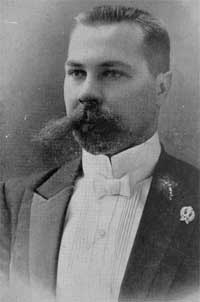
Mykola Ivanovych Mikhnovskyi (Ukrainian: Микола Іванович Міхновський; 31 March [O.S. 19 March] 1873 – 3 May 1924) was a Ukrainian independence activist, lawyer and journalist who was one of the early leaders of the Ukrainian nationalist movement in the late 19th and early 20th centuries. Mikhnovsky was the author of the pamphlet Independent Ukraine, one of the organisers of the Ukrainian People's Army, and co-founder of the first political party in eastern Ukraine, the Revolutionary Ukrainian Party, as well as the co-founder and leader of various other parties, including the Ukrainian People's
Actualizări recente
Mykola Mikhnovskya adăugat o fotografie
acum 4 ore
R.I.P Mykola
Mykola Ivanovych Mikhnovskyi (Ukrainian: Микола Іванович Міхновський; 31 March [O.S. 19 March] 1873 – 3 May 1924) was a Ukrainian independence activist, lawyer and journalist who was one of the early leaders of the Ukrainian nationalist movement in the late 19th and early 20th centuries. Mikhnovsky was the author of the pamphlet Independent Ukraine, one of the organisers of the Ukrainian People's Army, and co-founder of the first political party in eastern Ukraine, the Revolutionary Ukrainian Party, as well as the co-founder and leader of various other parties, including the Ukrainian People's Party, the Ukrainian Democratic Party, and the Brotherhood for Self-Determination.
0 comentarii1 vizualizări0 reacții
Mykola Mikhnovskya publicat o actualizare
acum 4 ore
Early life and education Mykola Mikhnovsky was born in the village of Turivka on 31 March 1873. The son of a priest, Mikhnovsky's family was primarily Cossack, with roots going back to the 17th century. He spent his childhood in the countryside, listening to folk songs, stories and songs. His world views were influenced by his father, who shaped his "spirit of independence". His father held church services in the Ukrainian language. Mykola was educated in the town of Pryluky. After graduating from high school in 1890, he studied Law at Kyiv University.
0 comentarii1 vizualizări0 reacții
Mykola Mikhnovskya publicat o actualizare
acum 4 ore
Student independence activism The growth of Ukrainian national consciousness in the late 19th century led to a rift among the Ukrainian intelligentsia. The older generation approached the "Ukrainian question" through culture and education, limiting their demands to moderate reforms that would have abolished the national-cultural restrictions for Ukrainian within the Russian Empire. The younger generation, however, were attracted to socialist ideals. They believed that national liberation could be achieved through a common struggle with other nations against the existing social order in Russia. In the early 1890s, a new trend developed. It was started by a Mikhnovsky, a student who openly declared the state independence of the Ukrainian nation. He began to preach boldly, that the only way to gain state independence was through armed conflict and that this was the only path for the Ukrainian people. As a freshman at the Kyiv University, Mikhnovsky joined the Ukrainian national movement and became a member of the "Young community". However, cultural and apolitical activities did not satisfy him. As a radical-minded young man, in 1891 he formed a secret student organization. The first Ukrainian national organization with a clearly political purpose was founded by a group of students from Kharkiv and…
0 comentarii1 vizualizări0 reacții
Mykola Mikhnovskya publicat o actualizare
acum 4 ore
Political activities In 1898, Mikhnovsky moved to Kharkiv, where he became a lawyer and a prominent Ukrainian independence activist. In 1900, he became one of the founding members of Revolutionary Ukrainian Party, which became the first Ukrainian political party under Russian rule. In response to the spread of Marxist ideas in RUP, in 1902 some of its members organized a new organization called Ukrainian People's Party, of which Mikhnovsky became a leader. After the 1905 Revolution, Mikhnovsky founded a few Ukrainian newspapers and, in 1909, helped to create a mutual credit society in Kharkiv. As a member of Ukrainian liberation movement, he also took part in organizing terror attacks against Russian monuments, one of which succeeded (the pedestal of the monument to Alexander Pushkin in Kharkiv was destroyed). Mikhnovskyy's "Ten Commandments" for the Ukrainian People's Party labelled Jews, Poles, Russians, Hungarians, Romanians enemies "for as long as they ruled and exploited us [Ukrainians]." He condemned intermarriage with foreigners. The Ukrainian People's Party did not become popular, and existed for 5 years before dissolving.
0 comentarii1 vizualizări0 reacții
Mykola Mikhnovskya publicat o actualizare
acum 4 ore
Ukrainian Revolution After the outbreak of the First World War, Mikhnovsky joined the Imperial Russian Army. After a short stay at the front as a lieutenant, he became a lawyer in Kyiv, in the military district court. There, he proposed to create Ukrainian national units in the Imperial Russian Army. In March 1917 he joined the Ukrainian Central Council and headed the newly created Polubotok Military Club, aiming to create a separate Ukrainian military. After the Central Council refused to support the club, its members started a coup attempt, which ended in a failure. Mikhnovsky was detained by the gendarmerie and sent for military service to the Romanian Front (without direct evidence of his involvement in the coup, nor an official investigation). After the October Revolution in Russia, he returned to Ukraine and entered the Ukrainian Democratic Peasant Party (UDKhP), founded by Vyacheslav Lypynsky. When German armies occupied Ukraine and installed the Hetmanate regime, Mikhnovsky opposed the rule of hetman Pavlo Skoropadskyi, but refused to take part in a coup to topple him. Skoropadskyi contemplated offering Mikhnovsky the post of Prime Minister of Ukraine, but instead offered him the position of personal adviser. Mikhnovsky refused this offer. In late 1918…
0 comentarii1 vizualizări0 reacții
Mykola Mikhnovskya publicat o actualizare
acum 4 ore
Return to Ukraine and death In 1924 Mikhnovsky returned to Kyiv, where he was arrested by GPU, but released in a short time. On 3 May 1924, Mikhnovsky was found hanged in a garden belonging to his long-time political ally Volodymyr Shemet. Officially his death was ruled a suicide, however, there were rumours of Soviet secret services' involvement.
0 comentarii1 vizualizări0 reacții
Mykola Mikhnovskya publicat o actualizare
acum 4 ore
Legacy During the era of Soviet rule in Ukraine, public mention of Mikhnovsky was forbidden, as he was considered a Ukrainian bourgeois nationalist. After Ukrainian independence, a number of memorial plates and monuments were installed in his memory, including one in Kharkiv. In 2016, as part of Ukraine's decommunization process, Kharkiv's Anna Khoperska Street (a Soviet revolutionary) was renamed to Mykola Mikhnovsky Street. In December 2022 the Druzhby Narodiv (or Friendship of Peoples) boulevard in Kyiv was renamed to Mykola Mikhnovsky boulevard. On 20 May 2024 the Poltava city council renamed a street in its city in honour of Mikhnovsky.