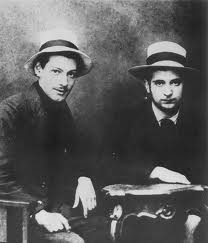
Stanislav Vinaver (Serbian Cyrillic: Станислав Винавер; 1 March 1891 – 1 August 1955) was a Serbian writer, poet, translator and journalist. Vinaver was born to affluent Ashkenazi Jewish parents that had immigrated to Serbia from Poland in the late 19th century. He studied at the University of Paris, volunteered to fight in the Balkan Wars and later took part in World War I as an officer in the Royal Serbian Army. In 1915, he lost his father to typhus. He travelled to France and the United Kingdom the following year, delivering lectures about Serbia and its people. In 1917, he was assigned to
Actualizări recente
Stanislav Vinavera publicat o actualizare
acum 7 ore
Legacy Vinaver is considered one of the key representatives of the Serbian and Yugoslav literary avant-garde. Literary critics consider his Pantologija to be the best avant-garde parody in all of Serbian literature. In September 2011, the Government of Serbia unveiled a commemorative plaque dedicated to Vinaver on the façade of the Belgrade building in which his apartment was located. The Stanislav Vinaver Award is presented for artistic excellence in the writing of short stories. Notable recipients include the Serbian-Jewish writer David Albahari.
0 comentarii1 vizualizări0 reacții
Stanislav Vinavera adăugat o fotografie
acum 7 ore
R.I.P Stanislav
Stanislav Vinaver (Serbian Cyrillic: Станислав Винавер; 1 March 1891 – 1 August 1955) was a Serbian writer, poet, translator and journalist. Vinaver was born to affluent Ashkenazi Jewish parents that had immigrated to Serbia from Poland in the late 19th century. He studied at the University of Paris, volunteered to fight in the Balkan Wars and later took part in World War I as an officer in the Royal Serbian Army. In 1915, he lost his father to typhus. He travelled to France and the United Kingdom the following year, delivering lectures about Serbia and its people. In 1917, he was assigned to the Serbian consulate in Petrograd, where he was to witness the Russian Revolution and its aftermath. Following World War I, Vinaver briefly worked for the Ministry of Education of the newly created Kingdom of Serbs, Croats and Slovenes (later Yugoslavia). In the 1930s, he worked for Radio Belgrade and was appointed chief of Yugoslavia's central press bureau. This period was defined by his tumultuous relationship with his ethnic German wife, who held antisemitic and anti-Slavic views, as well as his inclusion in Rebecca West's acclaimed travel book Black Lamb and Grey Falcon. In April 1941, Vinaver was…
0 comentarii1 vizualizări0 reacții
Stanislav Vinavera adăugat o fotografie
acum 7 ore
R.I.P Stanislav
Life Stanislav Vinaver was born in Šabac on 1 March 1891. He came from an affluent family. His father Josif was a physician and his mother Ruža was a pianist and Polish-language translator. Both of his parents were Ashkenazi Jews. They had relocated to Serbia in the 1880s amid a wave of anti-Semitic pogroms in the Russian Empire. Vinaver completed his primary education in Šabac. He attended high school in Šabac until 1908, when he transferred to a high school in the Serbian capital, Belgrade. Upon completing high school, he enrolled at the University of Paris, where he studied mathematics and physics. He also attended the lectures of the philosopher Henri Bergson and the anthropologist Lucien Lévy-Bruhl, and studied music under Wanda Landowska. It was during this time that he became interested in contemporary literature and art. Bergson's philosophical teachings left a strong impression on the young Vinaver. In 1912, Vinaver returned to Serbia to enlist in the Royal Serbian Army (Serbian: Vojska kraljevine Srbije; VKS) and fight in the Balkan Wars. During the First Balkan War, he served as a lieutenant in the Students' Battalion. By 1914, he had published three books. Following the outbreak of World War I,…
0 comentarii1 vizualizări0 reacții
Stanislav Vinavera adăugat o fotografie
acum 7 ore
R.I.P Stanislav
At the war's end, Vinaver held the rank of lieutenant colonel. In 1919, he joined the Ministry of Education of the newly created Kingdom of Serbs, Croats and Slovenes, working alongside fellow writers Branislav Nušić and Borisav Stanković at the ministry's artistic department. He nearly lost his job following a dispute with the country's Minister of Foreign Affairs, Ante Trumbić. In 1920, the artistic department was shut down following a government reshuffling, and Trumbić's antagonism precluded Vinaver from taking up further government positions. Vinaver took up journalism full-time and became one of interwar Yugoslavia's most prolific columnists. In the 1930s, he began working at Radio Belgrade and was appointed chief of Yugoslavia's central press bureau. In 1938 he was appointed press attaché at the Embassy of Yugoslavia in Prague. Vinaver was a convert to Serbian Orthodoxy and identified as a Serb, despite his Jewish heritage. He was married to an ethnic German woman named Elsa. As a result of Elsa's anti-Semitic and anti-Slavic views, the marriage was a tumultuous one. The couple had two children. Vinaver features prominently in Rebecca West's acclaimed 1941 travel guide Black Lamb and Grey Falcon, appearing under the pseudonym Constantine. His wife appears under the…
0 comentarii1 vizualizări0 reacții
Stanislav Vinavera publicat o actualizare
acum 7 ore
Vinaver was an avant-gardiste. He authored the first avant-garde programmatic text in Serbian literature, Manifest ekspresionističke škole (Manifesto of the Expressionist School; 1920). He often resorted to burlesque and used parody as a means of mocking both friends and enemies, the weak and the powerful, as well as the avant-garde, and even himself. This is best exemplified in his 1920 anthology Pantologija novije srpske pelengirike (The Pantology of New Serbian Peasant Trousers), which takes aim at the conservative writer Bogdan Popović's influential 1911 compendium Antologija novije srpske lirike (Anthology of New Serbian Poetry). "The parodies were not just a game of virtuosity," the literary scholar Svetlana Slapšak writes. "They challenged the accepted literary chronologies, genre schemes and value systems." Vinaver continued writing parodies even after the war, despite his Holocaust experience, this time targeting Yugoslavia's new communist authorities. Slapšak describes Vinaver as a "unique and versatile" writer. In his journalistic endeavours, the biographer Branko Šašić writes, Vinaver wrote in a manner that was "concise, brief and clear". Most prolific as an essayist and a poet, Vinaver made his literary debut in 1911, with a collection of poetry titled Mjeća. His poetry was written in free verse, with exclusive emphasis placed…