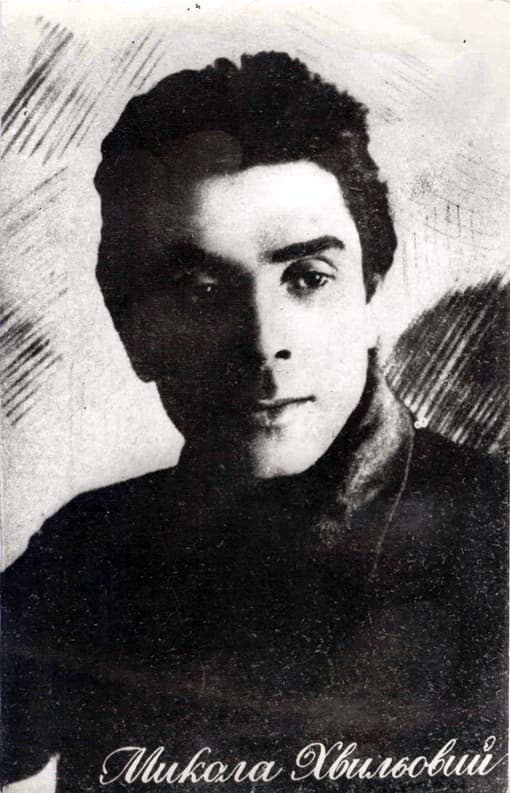
Mykola Khvylovy (Ukrainian: Микола Хвильовий, romanized: Mykola Khvyliovyi [mɪˈkɔlɐ xwɪlʲoˈwɪj]; born Mykola Hryhorovych Fitiliov [Микола Григорович Фітільов]; December 13 [O.S. December 1] 1893 – May 13, 1933) was a Ukrainian novelist, poet, publicist, and political activist, one of the founders of post-revolutionary Ukrainian prose, and one of the most famous representatives of the Ukrainian Renaissance in literature of the 1920s–1930s. Khvylovy was one of the main figures of Ukrainian 'National Communism' and the author of the slogan "Away from Moscow!"
Mykola Khvylovy (Ukrainian: Микола Хвильовий, romanized: Mykola Khvyliovyi [mɪˈkɔlɐ xwɪlʲoˈwɪj]; born Mykola Hryhorovych Fitiliov [Микола Григорович Фітільов]; December 13 [O.S. December 1] 1893 – May 13, 1933) was a Ukrainian novelist, poet, publicist, and political activist, one of the founders of post-revolutionary Ukrainian prose, and one of the most famous representatives of the Ukrainian Renaissance in literature of the 1920s–1930s. Khvylovy was one of the main figures of Ukrainian 'National Communism' and the author of the slogan "Away from Moscow!"
0 comentarii0 reacții
Mîkola Hvîlovîia adăugat 2 fotografii
acum 3 luni
R.I.P Mîkola
Biography Born as Mykola Fitilyov in Trostianets, Akhtyrsky Uyezd, Kharkov Governorate, Russian Empire to a Russian laborer father and Ukrainian schoolteacher mother. His father, Hryhoriy Oleksiiovych Fitilyov, had noble origins but was, as Khvylovy himself wrote, "a highly careless person" and a drunkard. He spoke Russian, and it was thanks to him that the boy read both Russian and foreign classics. Khvylovy shared his father's interest in the revolutionary movement of the 1860s, sympathised with the ideology of the Narodniks, the former Russian populists of that era, and was equally inspired by the works of Nikolay Dobrolyubov, Vissarion Belinsky and Dmitry Pisarev. He studied at an elementary school in the village of Kolontayev, where his mother, Yelyzaveta Ivanivna (nee Tarasenko), was a teacher, then continued his studies at the Okhtyr Male Gymnasium, which he was forced to leave due to his participation in a so-called Ukrainian revolutionary circle, and later at the Bohodukhiv Gymnasium, from which he was expelled for his connections with socialists during the revolutionary unrest. As a teenager, he traveled around Donbas and southern Ukraine in search of income. Later, he worked as a locksmith in a craft school, in the office of the parish council of…
0 comentarii0 reacții
Mîkola Hvîlovîia adăugat o fotografie
acum 3 luni
R.I.P Mîkola
Works Khvylovy wrote both poetry and short stories. His short stories are best known for their difficult narrative forms and complicated imagery. A novel, titled Valdshnepy (The Woodsnipes), remained unfinished and unpublished when he died. Its second part — the first published in Vaplite in 1927 — had been confiscated. He wrote a number of pamphlets presenting his views of the connection between politics and art. He advocated an orientation toward cultural trends in Western Europe in order to loosen Ukraine's dependence on Russian forms and inspiration, as he deemed excessive Russian influence on Ukrainian literature as something akin to colonialism. His pamphlets created a major controversy and divided representatives of the budding Ukrainian literary scene and created tensions with the authorities. In the second series, Dumky proty techyi (Thoughts against the Current), which appeared in Kul’tura i pobut in November–December 1925 and separately in 1926, Khvylovy further developed his argument against the "cult of epigonism". By adopting a psycho-intellectual orientation on Europe, he argued, Ukrainians can enter onto their own path of development. Leaving aside poetry, from which the writer soon turned to prose, the work of M. Khvylovy following G. A. Kostyuk can be divided into three periods:…